The Problem
The sales team was drowning in a manual, inefficient outbound process. New leads from web forms and ads poured into a database, but contacting them was a nightmare. Reps wasted hours each morning manually checking time zones and business hours for each lead’s state before they could even pick up the phone. Critical CRM data—like past interactions or company size—wasn’t readily available during the call, leading to generic, ineffective pitches.
Furthermore, call timing was a major leak. Calling leads in California at 9 AM EST meant waking them up at 6 AM, destroying any chance of a positive conversation. The team also struggled with volume; a single rep could only manually dial 30-40 leads a day, leaving hundreds of potential opportunities untouched. This resulted in a low contact rate, frustrated SDRs, and a pipeline that was consistently underfed.
The Solution
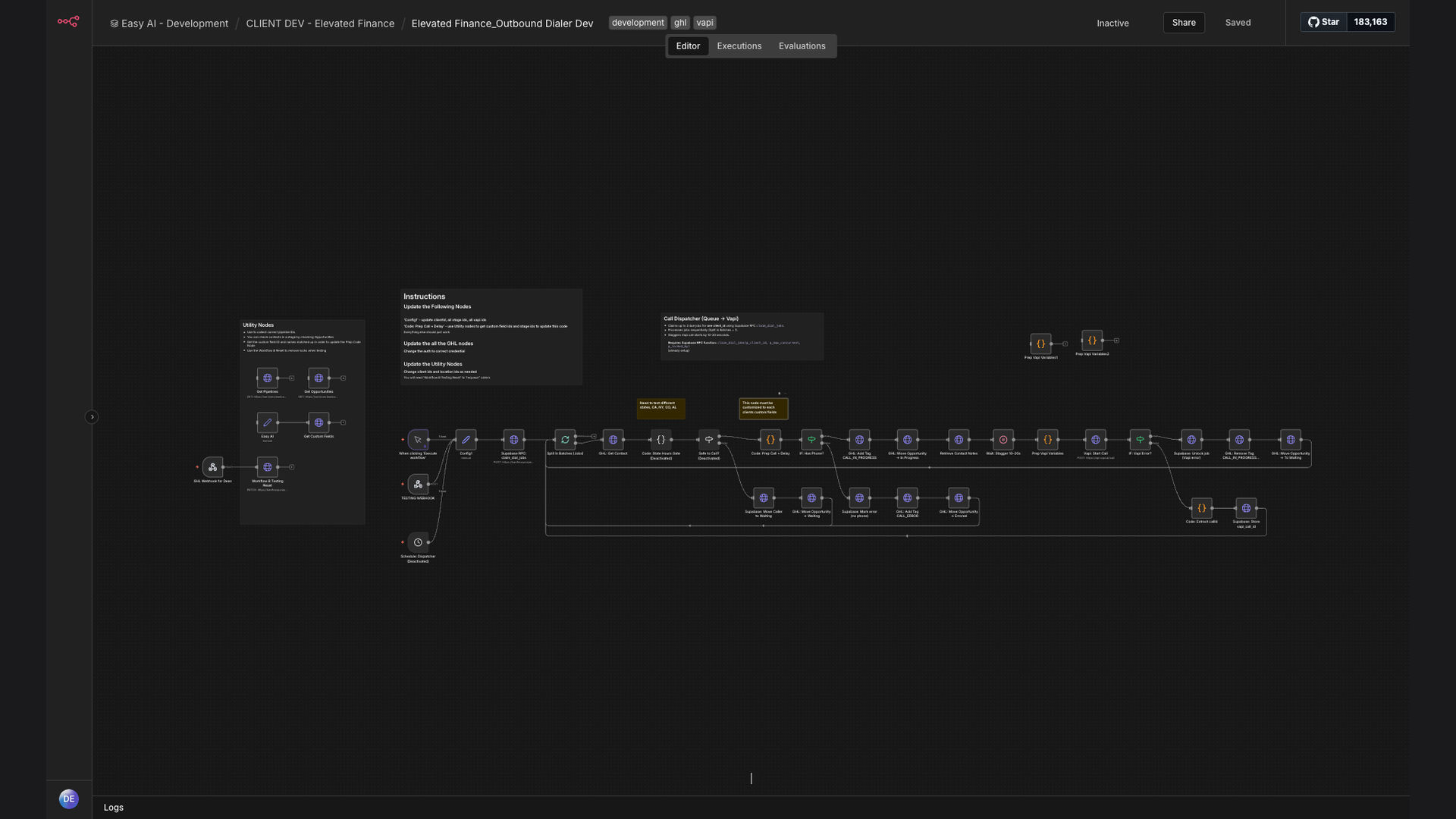
We engineered a fully automated outbound AI dialer using n8n as the central automation brain. The workflow acts as an intelligent call dispatcher: it pulls a prioritized queue from a Supabase database, rigorously qualifies each lead for callability based on real-time business hour logic, fetches rich context from the GoHighLevel CRM, and then passes everything to Vapi’s conversational AI to conduct the actual phone call. Results are parsed and synced back instantly, creating a closed-loop system.
This tech stack was chosen for power and flexibility. n8n handles the complex, multi-step logic and API orchestration between all systems. Supabase provides a real-time, reliable database for the call queue. GoHighLevel serves as the single source of truth for contact data and the final destination for call notes. Vapi delivers the cutting-edge AI voice agent capable of natural, dynamic conversations that qualify leads effectively.
How It Works — The Intelligent Call Pipeline
This isn't a simple dialer; it's a decision-making pipeline that ensures every call has the highest chance of success. Here’s the step-by-step process that runs 24/7.
- Trigger & Queue Retrieval: Every 15 minutes, an n8n workflow is triggered. It queries a dedicated 'call_queue' table in Supabase, retrieving up to 20 leads marked as 'ready_to_call', prioritized by a score combining lead source and age.
- Time Zone & Business Hour Validation: For each lead, the workflow checks the state field against an internal database of business hours and time zones. If the current time in the lead's location is outside 9 AM–5 PM local time, the lead is skipped and rescheduled for the next valid window.
- CRM Data Enrichment: For leads that pass the time check, n8n makes an API call to GoHighLevel using the lead's phone number or email. It fetches the contact record, pulling in vital context like company name, last note, and custom fields (e.g., 'product interest').
- AI Call Context Preparation: This CRM data is formatted into a concise "context script" for the AI. For example: "Calling John from Acme Corp. They downloaded a whitepaper on SEO tools last week. Goal: qualify interest for a demo."
- Vapi AI Call Execution: The workflow sends a request to the Vapi API with the lead's phone number and the prepared context. Vapi places the call using a realistic AI voice, introduces itself naturally, and engages the lead using dynamic conversation based on the provided goals.
- Outcome Capture & Parsing: When the call ends, Vapi returns a detailed transcript and structured outcome (e.g., 'interested', 'call back later', 'not interested'). n8n's AI node analyzes this transcript to extract key points and sentiment.
- CRM Sync & Note Logging: The workflow updates the lead's record in GoHighLevel. It adds a call note with the outcome, transcript summary, and next steps. It also updates custom fields like 'last_contact_date' and 'qualification_status'.
- Queue Management & Rescheduling: Finally, the lead's status in the Supabase queue is updated to 'completed' or 'rescheduled'. If the call failed (busy/no answer), the lead is pushed back into the queue with an increased priority for a retry in 2 hours.
💡 The Power of Contextual AI: The difference between a generic robocall and an effective AI agent is context. By pulling data from the CRM (like "they attended webinar X"), the Vapi AI can personalize the opening: "Hi John, I'm following up from the SEO webinar last Tuesday..." This dramatically increases engagement and feels like a continuation of a conversation, not a cold call.
What This System Does That Manual Dialing Can't
Global Time Zone Intelligence
Automatically respects local business hours for every lead based on their state or provided timezone. Never calls a lead at the wrong time again, ensuring compliance and maximizing answer rates.
CRM-Informed Conversations
Every AI call is powered by real-time data from GoHighLevel. The AI knows the lead's name, company, and past interactions, allowing for personalized, relevant conversations from the first second.
Unlimited Parallel Calling
The system isn't limited by human reps. It can manage dozens of simultaneous AI calls, contacting hundreds of leads per day without fatigue, breaks, or downtime.
Automatic Outcome Logging
Every call result—interest level, objections, callback requests—is instantly parsed and logged as a detailed note in the CRM. The sales team has a complete, searchable history without manual data entry.
Smart Retry & Rescheduling
Intelligently handles failed calls (busy, no answer) by automatically rescheduling them for optimal times later in the day or week, persistently working through the queue.
Seamless Two-Way Sync
Creates a perfect feedback loop between your database, AI dialer, and CRM. Lead status is always current in all systems, eliminating data silos and ensuring follow-ups are perfectly informed.
Before vs. After: The Sales Team Transformation
Before: SDRs spent 2-3 hours daily on manual time-zone checks and dialing. Contact rate was below 15%. Pipeline contribution from outbound was inconsistent and under $5K monthly. CRM data was stale and rarely updated after calls.
After: SDRs now spend zero time on manual dialing or scheduling. The AI system maintains a consistent 90%+ call success rate (connected calls), contacting 5x more leads daily. This generates a reliable $25K+ in new qualified pipeline each month, with every interaction fully documented in the CRM in real-time.
Implementation: Live in 4 Weeks
- Week 1 – Discovery & Architecture: We mapped the existing lead flow, defined qualification rules, and designed the database schema for the Supabase call queue. Key decisions were made on business hour logic and CRM field mapping.
- Week 2 – Core Workflow Build: We constructed the main n8n workflow, establishing robust connections to Supabase and GoHighLevel. The time-zone validation logic and queue management system were built and unit-tested.
- Week 3 – AI Integration & Call Scripting: We integrated the Vapi API, developed the dynamic context-building script, and crafted the initial AI conversation flow. Extensive test calls were made to refine the agent's tone and effectiveness.
- Week 4 – Testing, Deployment & Training: The entire system underwent end-to-end testing with a sample lead batch. We deployed the live workflow, set up monitoring alerts, and trained the sales team on how to review AI call logs and manage the updated CRM pipeline view.
The Right Fit — and When It Isn't
This automated AI dialer is a perfect fit for B2B or high-volume B2C sales teams with a defined outbound process, a clean lead source (like form fills or list purchases), and a CRM like GoHighLevel, Salesforce, or HubSpot. It's ideal for businesses that need to scale lead qualification without scaling headcount, or for teams struggling with time-zone management and CRM data hygiene.
This system is not a magic wand for poor lead quality. If your lead lists are outdated or unresponsive, automation will only fail faster. It's also not a replacement for complex, high-touch sales negotiations. The AI excels at initial qualification and appointment setting; human reps must take over for closing. Finally, ensure you have the technical comfort or support to manage API connections and monitor the workflow's performance.