The Problem
Planning professionals in the UK face a significant challenge in efficiently analyzing planning application data. The data, often stored in large Excel files, requires manual extraction and sorting to identify trends and patterns. This process is not only time-consuming but also prone to errors, hindering effective decision-making.
The lack of structured insights from this data makes it difficult to understand geographic patterns, approval rates, and timelines. This can lead to inefficient resource allocation, missed opportunities, and delays in project approvals. The need for a streamlined, automated solution is critical for planning professionals to optimize their operations and make informed decisions.
The Solution
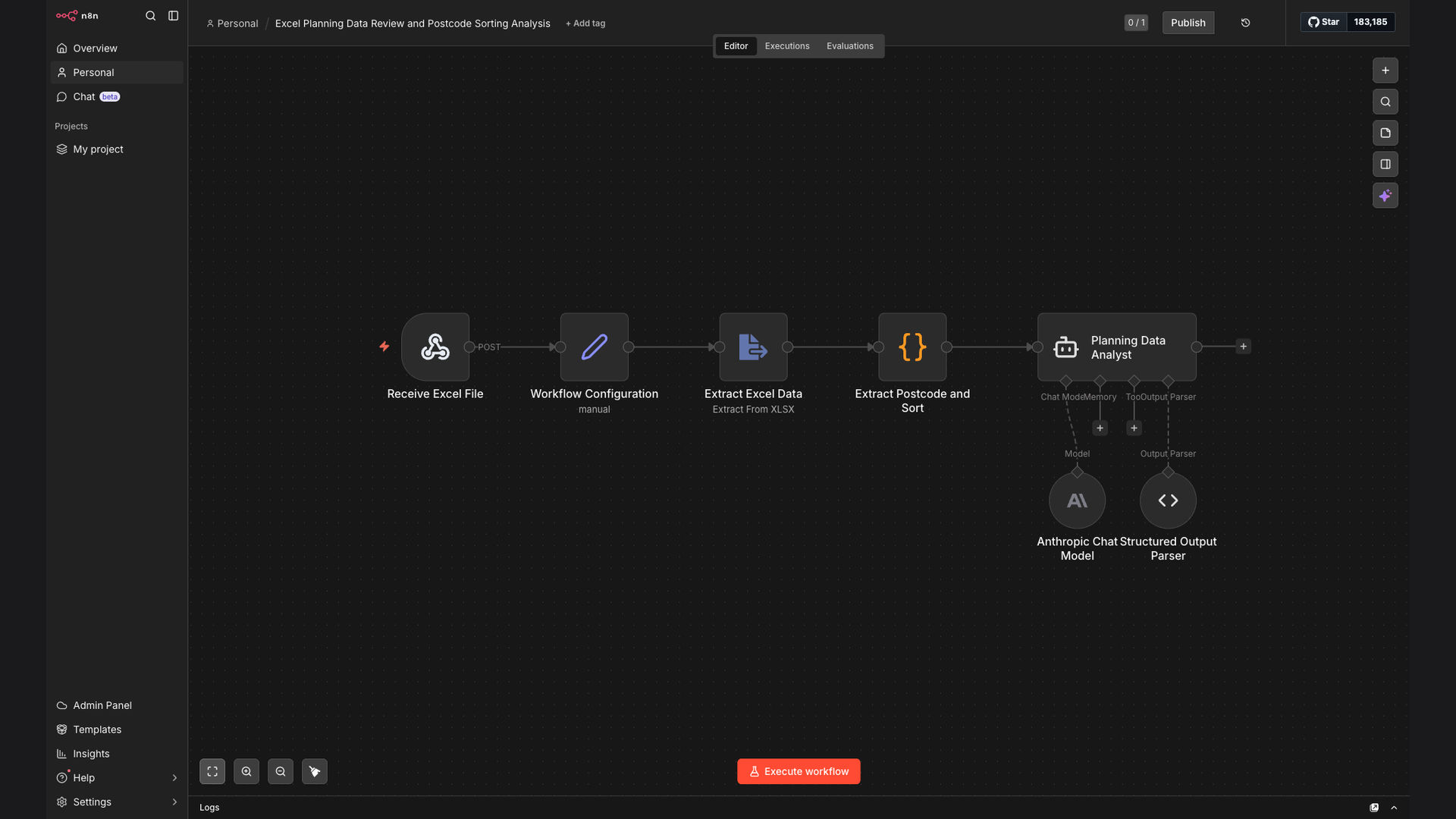
The solution is an automated workflow built with n8n that processes and analyzes UK planning application data. This workflow extracts data from Excel files, sorts it by postcode, and then uses AI, specifically OpenAI, to generate structured insights. The analyzed data is then compiled into reports in Google Sheets, providing a clear overview of key metrics.
This tech stack was chosen for its ability to handle large datasets, integrate AI for advanced analytics, and present data in an accessible format. n8n's flexibility allows for seamless integration with OpenAI and Google Sheets, creating a powerful and efficient data analysis pipeline. The combination of these tools ensures accurate, timely, and actionable insights for planning professionals.
How It Works — AI-Powered Planning Data Analysis
This automated system streamlines the analysis of UK planning application data, providing actionable insights in minutes.
- Data Extraction: The workflow begins by extracting planning application data from Excel files, ensuring all relevant information is captured.
- Postcode Sorting: The extracted data is then sorted by postcode, allowing for geographic-specific analysis and pattern identification.
- AI-Driven Analysis: OpenAI is used to analyze the sorted data, generating insights on approval rates, timelines, and emerging trends.
- Insight Structuring: The AI-generated insights are structured into a coherent and actionable format, ready for reporting.
- Report Generation: The structured insights are compiled into reports in Google Sheets, providing a clear overview of key metrics.
- Trend Identification: The system identifies trends in planning applications, helping professionals anticipate future developments.
- Performance Monitoring: The workflow monitors the performance of planning applications, providing real-time updates and alerts.
💡 Data-Driven Decisions: By automating the analysis of planning application data, professionals can make informed decisions based on accurate and timely insights, leading to better outcomes and efficient resource allocation.
What This System Does That Manual Process Can't
Speed & Efficiency
Automated data processing and analysis significantly reduces the time required to generate insights, enabling faster decision-making.
Comprehensive Analysis
AI-driven analysis provides a more thorough understanding of planning application data, identifying trends and patterns that may be missed manually.
Targeted Insights
Sorting data by postcode allows for geographically targeted insights, enabling professionals to focus on specific areas and address local needs.
Scalability
The automated workflow can handle large volumes of data, making it suitable for organizations of all sizes and ensuring consistent performance.
Accuracy
Automated data processing reduces the risk of human error, ensuring the accuracy and reliability of insights for informed decision-making.
Cost Savings
By automating data analysis, organizations can reduce labor costs and allocate resources more efficiently, resulting in significant cost savings.
Before vs. After: AI-Enhanced Planning Insights
Before: Manual data analysis took weeks, with limited insights and high error rates, costing approximately $20,000 annually in labor.
After: Automated analysis provides comprehensive insights in minutes, with near-zero error rates, saving over $15,000 annually.
Implementation: Live in 3 Weeks
- Planning & Design: The initial phase involves understanding the specific data analysis needs and designing the workflow architecture.
- Data Integration: The next step is integrating the Excel data source with n8n, ensuring seamless data extraction and transfer.
- AI Configuration: Configuring OpenAI for data analysis, including defining the parameters and objectives for insight generation.
- Workflow Testing: Thorough testing of the workflow to ensure accurate data processing, analysis, and report generation.
- Deployment & Training: Deploying the automated workflow and providing training to planning professionals on how to use the system.
The Right Fit — and When It Isn't
This automated solution is ideal for planning professionals and organizations that need to analyze large volumes of UK planning application data quickly and accurately. It's particularly beneficial for those seeking to identify trends, optimize resource allocation, and make data-driven decisions.
However, it may not be the right fit for organizations with very small datasets or those that do not require in-depth analysis. In such cases, manual analysis may be sufficient. Additionally, organizations that lack the technical expertise to manage and maintain the workflow may need to consider alternative solutions.