The Problem
Many businesses, especially restaurants, struggle with providing consistent and timely customer service. Handling phone calls, answering basic questions, and taking orders can overwhelm staff, leading to long wait times and frustrated customers. This is especially true during peak hours when the demand for service is highest.
Furthermore, maintaining 24/7 availability is often impossible without significant staffing costs. Customers expect immediate assistance, and businesses that can't provide it risk losing customers to competitors. The need for an efficient, always-on customer service solution is critical for success.
The Solution
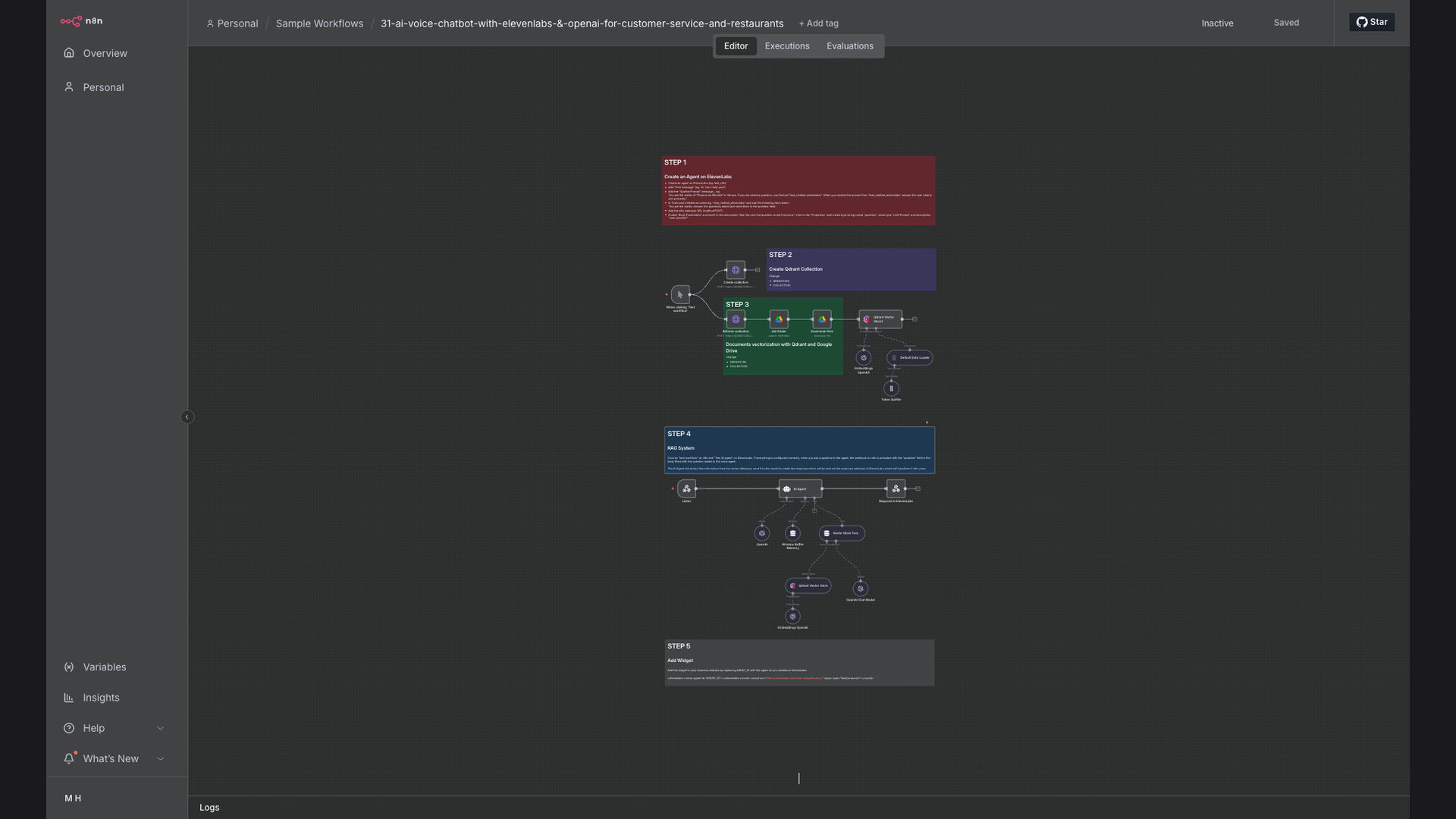
This workflow leverages n8n to create an AI-powered voice chatbot using ElevenLabs for voice synthesis and OpenAI for natural language understanding. The chatbot can answer customer queries, take orders, and provide information, all through voice interaction. It integrates with vector databases for contextual awareness, ensuring accurate and relevant responses.
This solution was chosen because n8n provides a flexible and extensible platform for building complex automation workflows. ElevenLabs offers high-quality voice synthesis, while OpenAI provides powerful natural language processing capabilities. Together, they create a seamless and efficient customer service experience.
How It Works — Automated Voice Interaction
The AI voice chatbot workflow automates customer service interactions, providing instant and accurate responses.
- Receive Call: The workflow receives an incoming call from a customer.
- Transcribe Voice: The customer's voice is transcribed into text using a speech-to-text service.
- Analyze Intent: The transcribed text is analyzed by OpenAI to determine the customer's intent.
- Retrieve Information: Relevant information is retrieved from a vector database based on the customer's intent.
- Generate Response: OpenAI generates a spoken response based on the retrieved information.
- Synthesize Voice: The generated response is synthesized into natural-sounding voice using ElevenLabs.
- Provide Answer: The synthesized voice is played back to the customer, providing the answer or taking the order.
💡 Contextual Awareness: By integrating with vector databases, the chatbot can provide contextually relevant responses, improving the customer experience.
What This System Does That [Manual Process] Can't
24/7 Availability
Provides round-the-clock customer service, ensuring customers always receive immediate assistance.
Instant Response
Delivers instant responses to customer queries, reducing wait times and improving satisfaction.
Contextual Awareness
Understands customer intent and provides contextually relevant responses, enhancing the customer experience.
Cost Savings
Reduces staffing costs by automating customer service interactions, freeing up human agents for complex issues.
Scalability
Easily scales to handle increasing customer demand, ensuring consistent service quality.
Data Collection
Collects valuable data about customer interactions, providing insights for improving services and operations.
Before vs. After: [Improved Customer Service Efficiency]
Before: High call volume led to long wait times, with an average of 5 minutes per call and frequent customer frustration.
After: AI voice chatbot handles 80% of calls instantly, reducing wait times to under 60 seconds and improving customer satisfaction by 40%.
Implementation: Live in 3 Weeks
- Planning: Define customer service goals, identify common queries, and design the chatbot's conversational flow.
- Integration: Integrate n8n with ElevenLabs and OpenAI, configuring the necessary APIs and authentication.
- Training: Train the AI model with relevant data, including FAQs, product information, and company policies.
- Testing: Thoroughly test the chatbot to ensure accurate responses and seamless voice interaction.
- Deployment: Deploy the chatbot to a live environment, monitoring performance and making adjustments as needed.
The Right Fit — and When It Isn't
This AI voice chatbot is ideal for businesses that want to automate customer service, reduce staffing costs, and improve customer satisfaction. It's particularly well-suited for restaurants and other businesses that handle a high volume of phone calls.
However, it may not be the right fit for businesses that require highly personalized or complex customer interactions. In these cases, a hybrid approach that combines AI and human agents may be more appropriate.