The Problem
Logistics teams face significant challenges in tracking shipping containers across various terminals and ports. Manually monitoring container status through Terminal49 and updating Monday.com boards is time-consuming and prone to errors. This often leads to delays in identifying critical events, such as arrival, departure, or customs clearance, impacting overall supply chain efficiency.
Without an automated system, logistics professionals spend countless hours compiling data from multiple sources, hindering their ability to proactively manage shipments. The lack of real-time visibility and inaccurate data can result in increased operational costs, missed deadlines, and decreased customer satisfaction. The need for a streamlined, automated solution is critical to optimize logistics operations and improve decision-making.
The Solution
The solution is an automated workflow built with n8n that synchronizes container tracking data from Terminal49 to Monday.com. This system fetches real-time shipment, container, and terminal events from Terminal49's API, automatically updating a designated Monday.com board with comprehensive tracking information.
n8n was chosen for its flexibility in handling API integrations and its ability to transform data using JavaScript functions. This allows for precise formatting of the data before it is sent to Monday.com, ensuring that the logistics team receives accurate and actionable insights directly within their preferred project management tool.
How It Works — Real-time Container Tracking
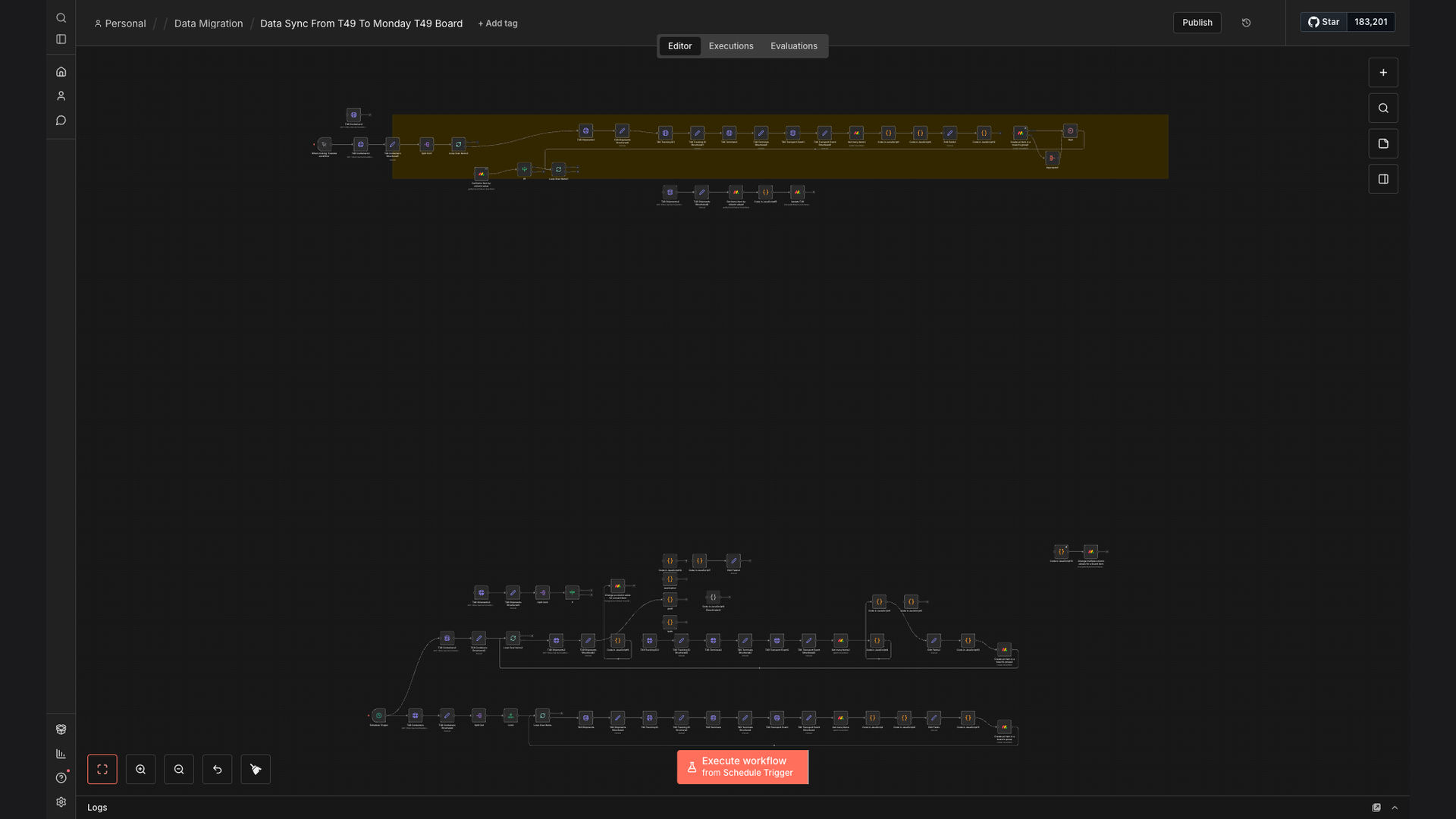
This workflow automates the process of tracking containers by fetching data from Terminal49 and updating a Monday.com board. Here's how it works:
- API Authentication: The workflow begins by authenticating with the Terminal49 API using the provided credentials.
- Fetch Container Data: It then fetches container tracking data, including shipment details, container status, and terminal events, from the Terminal49 API.
- Data Transformation: The fetched data is transformed using JavaScript functions to format it into a structure suitable for Monday.com.
- Monday.com Authentication: The workflow authenticates with the Monday.com API using the provided API key.
- Search for Existing Item: It searches the Monday.com board for an existing item matching the container number.
- Update Item or Create New: If an item exists, it updates the item with the latest tracking information. If not, it creates a new item on the board.
- Log Activity: The workflow logs the activity, including the container number, status, and timestamp, for auditing purposes.
💡 Data Enrichment: The JavaScript functions not only format the data but also enrich it by calculating key metrics, such as dwell time and estimated time of arrival, providing additional insights to the logistics team.
What This System Does That [Manual Process] Can't
Real-time Updates
Provides instant updates on container status, ensuring logistics teams have the most current information at their fingertips.
Automated Data Entry
Eliminates the need for manual data entry, reducing the risk of errors and freeing up valuable time for logistics professionals.
Improved Visibility
Offers a centralized view of all container tracking data within a Monday.com board, enhancing overall visibility and control.
Proactive Notifications
Enables proactive notifications for critical events, such as arrival, departure, or customs clearance, allowing for timely intervention.
Enhanced Reporting
Facilitates the generation of comprehensive reports on container tracking performance, providing valuable insights for process optimization.
Seamless Integration
Integrates seamlessly with Terminal49 and Monday.com, ensuring a smooth and efficient data flow between the two platforms.
Before vs. After: Real-time Visibility
Before: Logistics teams spent approximately 2 hours per day manually tracking container status, resulting in delayed decision-making and increased operational costs.
After: With the automated workflow, real-time container tracking is achieved, reducing manual effort by 80% and providing instant access to critical shipment information.
Implementation: Live in 2 Weeks
- Requirements Gathering: The first phase involves gathering detailed requirements from the logistics team, including the specific data points to be tracked and the desired format for the Monday.com board.
- Workflow Design: Based on the requirements, the workflow is designed in n8n, including the necessary API integrations, data transformations, and error handling mechanisms.
- Testing and Validation: The workflow is thoroughly tested and validated to ensure accurate data synchronization and reliable performance.
- Deployment: The workflow is deployed to a production environment, and the logistics team is trained on how to use the new system.
The Right Fit — and When It Isn't
This solution is ideal for logistics companies that rely on Terminal49 for container tracking and use Monday.com for project management. It is particularly beneficial for organizations that need real-time visibility into their supply chain and want to reduce manual data entry.
However, this solution may not be suitable for companies that do not use Terminal49 or Monday.com, or for those that have very simple container tracking needs that can be easily managed manually.