
10–15 Hours a Week Lost to Manual Data Entry Between Platforms
The client — a growing BigCommerce store with complex product catalogs, high order volumes, and expanding customer base — was drowning in the daily grind of manual data synchronization. Their e-commerce operations team spent 10–15 hours every week copying product details, order information, customer profiles, and inventory levels between BigCommerce and Airtable.
Data entry errors were causing inventory discrepancies that led to overselling and stockouts, order fulfillment mistakes that damaged customer satisfaction, and outdated analytics that hampered decision-making. There was no systematic way to ensure every data record synced properly — products and orders were regularly missed during manual transfers. As order volumes grew, the manual synchronization bottleneck became the single biggest obstacle to scaling the business.
An Intelligent Sync System That Routes, Iterates, and Syncs — In Real-Time
We built a Make.com automation that continuously monitors BigCommerce for new products, order updates, inventory changes, and customer information — then intelligently routes each data type to the appropriate Airtable table using router logic and iterator processing. The entire synchronization happens in real-time, keeping both platforms perfectly aligned within seconds of any change.
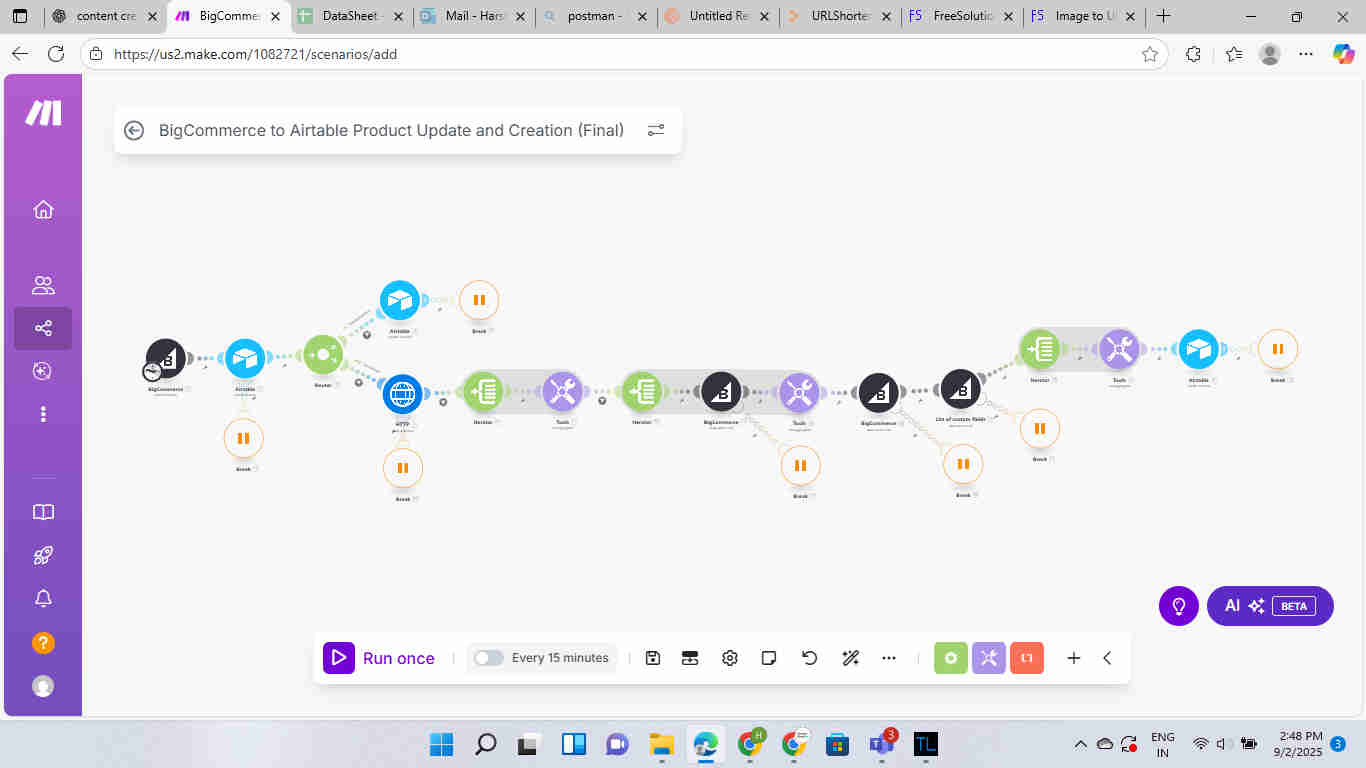
The moment a product is added, an order is placed, inventory levels change, or a new customer registers in BigCommerce, the automation triggers instantly. Router modules analyze the incoming data type and direct it to the corresponding Airtable table with proper field mapping. Iterator modules loop through every record ensuring 100% synchronization completeness — no missed products, orders, or customers. Within seconds, Airtable reflects the exact state of BigCommerce without a single manual keystroke.
How the Data Synchronization Pipeline Works
- BigCommerce Monitoring (Real-Time Triggers): Make.com continuously monitors BigCommerce for new and updated products, orders, customers, and inventory changes — triggering the sync workflow instantly when changes occur.
- Data Extraction Pipeline: Make.com modules fetch product details including SKUs, pricing, descriptions, and images, retrieve order information with customer data and fulfillment status, pull inventory levels, and capture customer profiles with purchase history.
- Intelligent Data Routing (Make.com Router): Router modules analyze incoming BigCommerce data, determine the type — products, orders, customers, or inventory — and direct each to the corresponding Airtable table with proper field mapping automatically.
- Complete Record Processing (Iterator Modules): Iterator modules loop through every data entry in bulk updates, ensuring no single product, order, or customer record gets missed during synchronization — preventing data gaps.
- Airtable Structured Updates: Modules create or update Airtable records with structured field mapping, maintaining proper data relationships, categories, and formats matching business requirements.
- Error Prevention & Validation: Automated field validation and data type matching ensures accurate transfers, eliminating manual entry mistakes and data corruption across platforms.
.png)
The combination of router logic and iterator processing was the key engineering decision. Routers ensure each data type reaches the correct Airtable table automatically, while iterators guarantee 100% record completeness — together delivering error-free, gap-free synchronization at scale.
What Makes This System Different
Real-Time Data Synchronization
Continuous monitoring pushes BigCommerce changes to Airtable within seconds — no delayed batch processing or scheduled syncs. Data updates instantly as changes occur in your store.
Intelligent Data Routing
Router modules analyze incoming data types automatically directing products, orders, customers, and inventory to appropriate Airtable tables with proper field mapping — eliminating manual sorting.
Complete Record Processing
Iterator modules loop through every data entry ensuring no products, orders, or customers get missed during bulk updates — guaranteeing 100% synchronization completeness without gaps.
Error-Free Accuracy
Automated field validation and data type matching eliminates manual entry mistakes — preventing inventory discrepancies, order errors, and customer data corruption across platforms.
Structured Database Organization
Airtable maintains organized tables with proper field structures, relational links, and real-time accuracy — enabling instant analytics, reporting, and operational visibility.
Scalable Architecture
Handles growing data volumes seamlessly — whether you have 100 or 100,000 products, the iterator and router architecture scales without performance degradation.
Inside the Technical Architecture
The Make.com scenario uses BigCommerce API modules to continuously monitor for new and updated records across products, orders, customers, and inventory. When changes are detected, the data extraction pipeline fetches complete record details including SKUs, pricing, descriptions, images, fulfillment status, and customer profiles.
.png)
Router modules then segregate the data by type — products go to the Products table, orders to Orders, customers to Customers, and inventory updates to Inventory. Each route has its own field mapping configuration ensuring data lands in the correct columns with proper formatting. Iterator modules within each route process every record in the batch, preventing the common problem of partial syncs where some records get missed.
Error handling is built into every stage — failed records are logged and retried automatically, field validation catches data type mismatches before they corrupt the database, and Make.com's built-in error notifications alert the team immediately if any sync encounters issues. The Airtable base is structured with separate tables for each data type, relational links between them (orders linked to customers, inventory linked to products), and custom views for different business use cases.
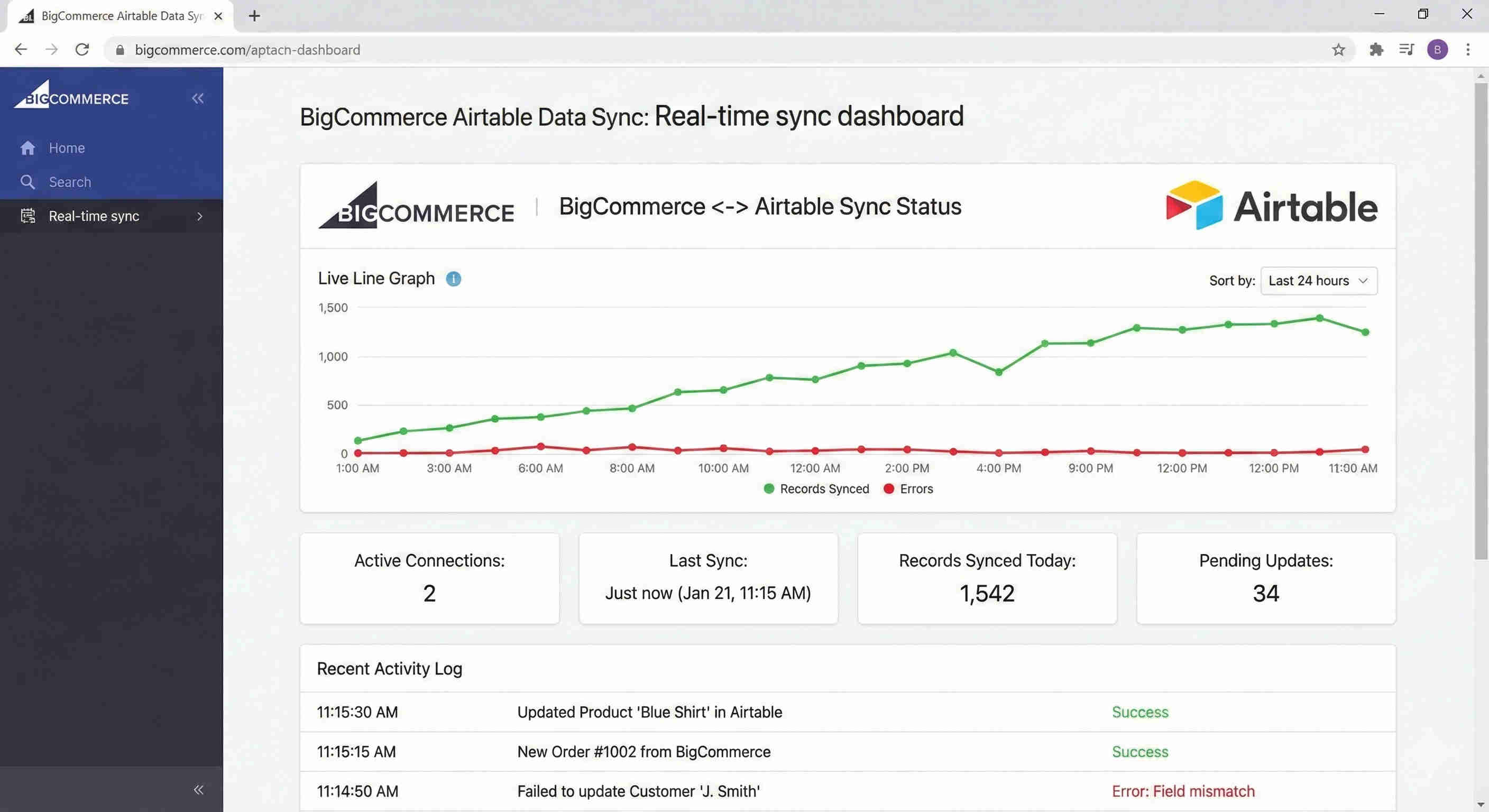
Results: From 15 Hours of Manual Entry to Real-Time Automated Sync
Before: E-commerce teams manually copied data between BigCommerce and Airtable spending 15+ hours weekly with frequent entry errors causing inventory mistakes, order fulfillment delays, and outdated analytics hampering decision-making.
After: Automated synchronization transfers all data types in real-time with intelligent routing, complete record processing, and error-free accuracy — eliminating manual work completely while maintaining perfect platform alignment.
Who Should Build This
BigCommerce store owners, e-commerce operations teams, inventory managers, data analysts, multi-channel retailers, and any business using Airtable for e-commerce analytics, reporting, or operations management requiring synchronized BigCommerce data. If your team spends more than a few hours a week manually transferring data between BigCommerce and Airtable, this system pays for itself within the first month.