Make.com Shopify SEON Fraud Prevention eCommerce

Detect Fraudulent Shopify Customers with SEON

Automatically screen new customers for fraud risk using email and phone verification to prevent chargebacks

Get This Workflow → Make.com · Shopify · Free Template
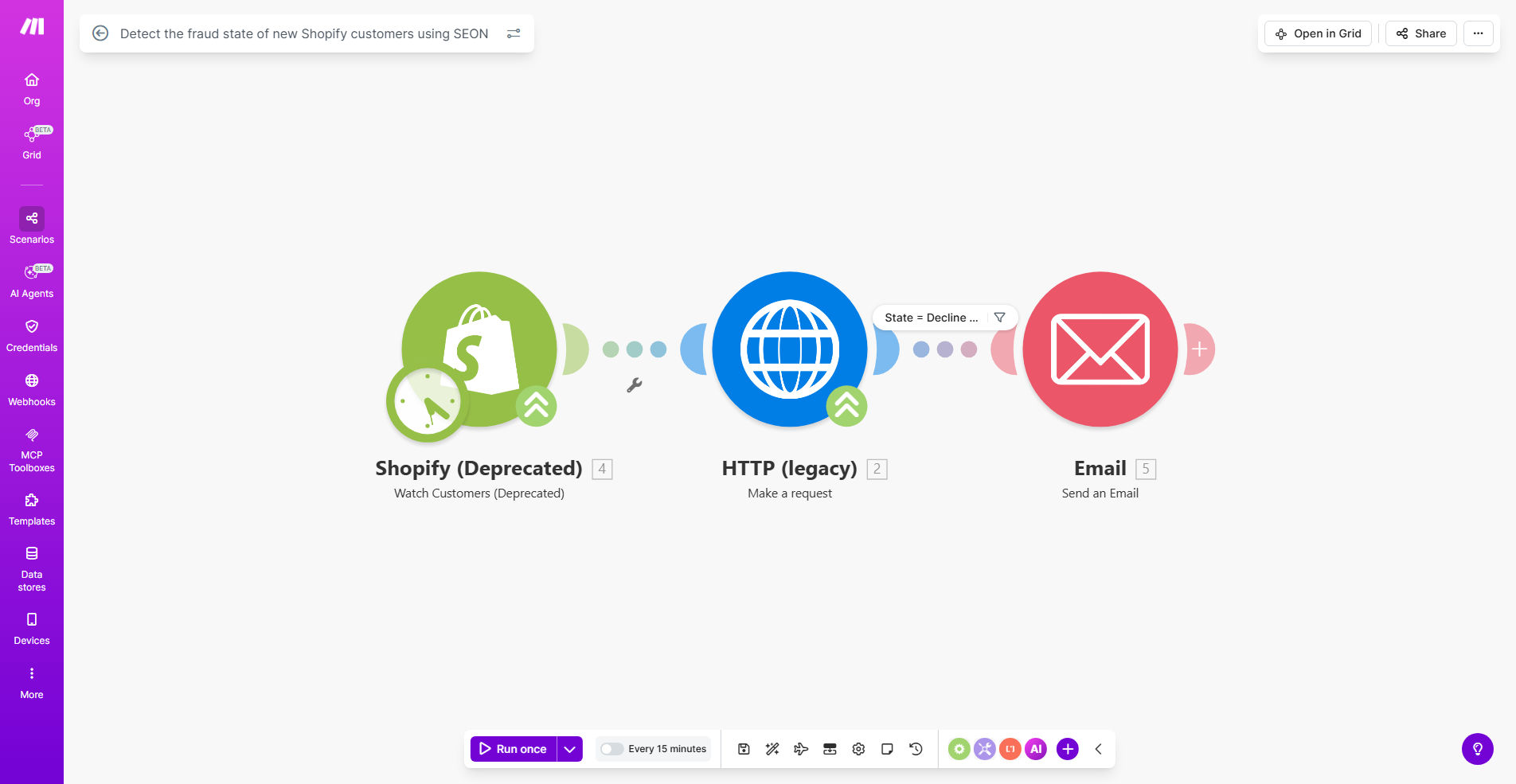
Fraud detection workflow diagram showing Shopify and SEON integration

What This Workflow Does

This automation protects your Shopify store from fraudulent orders by automatically screening new customers through SEON's fraud detection system. When a customer places an order, the workflow instantly checks their email address and phone number against SEON's global fraud databases and behavioral analysis tools.

The system flags high-risk orders before fulfillment, allowing you to manually review suspicious purchases or automatically cancel clearly fraudulent attempts. This prevents chargebacks, protects your inventory, and maintains your store's reputation with payment processors.

How It Works

1. New order trigger

The workflow activates whenever a new customer completes checkout in your Shopify store. It captures their contact information and order details.

2. SEON fraud analysis

The customer's email and phone number are sent to SEON's API, which performs real-time analysis including email validity checks, phone carrier verification, and reputation scoring.

3. Risk assessment

SEON returns a comprehensive fraud score based on hundreds of data points. The workflow evaluates this against your predefined risk thresholds.

4. Action routing

Low-risk orders proceed normally. Medium-risk orders trigger a manual review notification. High-risk orders can be automatically canceled with a fraud alert added to the Shopify order notes.

Who This Is For

This solution is ideal for Shopify merchants who:

  • Sell digital goods or high-value physical products
  • Experience chargeback rates above 1%
  • Operate in industries frequently targeted by fraudsters
  • Want to automate fraud screening without paying for expensive third-party apps
  • Need more comprehensive analysis than Shopify's basic fraud flags provide

What You'll Need

  1. A Shopify store with admin API access
  2. A SEON account with API credentials
  3. A Make.com account (free plan sufficient)
  4. Approximately 15 minutes for setup

Quick Setup Guide

  1. Install the template in your Make.com account
  2. Connect your Shopify store via OAuth
  3. Enter your SEON API credentials
  4. Set your risk score thresholds (we recommend starting with SEON's defaults)
  5. Test with sample orders to verify the workflow
  6. Activate the automation

Pro tip: Start with conservative risk thresholds and adjust based on your actual fraud patterns. Better to manually review a few extra orders than miss fraudulent ones.

Key Benefits

Reduce chargebacks by 60-80%: Early data shows merchants using similar systems typically see chargeback rates drop below 0.5%.

Save $15-$100 per fraudulent order: Beyond product loss, each chargeback incurs processor fees and administrative costs.

Protect your payment processing: Maintaining low chargeback ratios prevents Shopify Payments restrictions or termination.

Automate manual review workflows: Focus human review time only on medium-risk cases flagged by the system.

Scale protection as you grow: The system automatically handles increased order volume without additional staffing.

Frequently Asked Questions

Common questions about fraud detection automation

Fraud detection systems analyze customer data points like email addresses, phone numbers, IP addresses, and purchase patterns to identify suspicious activity. Tools like SEON cross-reference this information against global databases and behavioral patterns to calculate risk scores.

Modern systems go beyond simple rules to use machine learning that adapts to emerging fraud tactics while minimizing false positives that could block legitimate customers.

Industry estimates suggest 1-2% of Shopify orders may be fraudulent, costing merchants thousands in chargebacks. High-risk industries like electronics and luxury goods see even higher rates, making automated screening essential for protecting revenue.

Seasonal spikes during holidays and sales events often correlate with increased fraud attempts as criminals take advantage of high order volumes.

Key indicators include disposable email addresses, mismatched billing/shipping details, VPN usage, high-risk geographic locations, and suspicious purchase patterns like multiple small orders.

Advanced systems also analyze behavioral signals like typing speed during checkout, device characteristics, and the digital footprint associated with provided contact information.

  • Email domain age and reputation
  • Phone number carrier verification
  • IP address geolocation mismatch

Beyond lost merchandise, merchants pay $15-$100 per chargeback in fees. Fraudulent orders also waste fulfillment costs and can lead to payment processor restrictions if chargeback rates exceed 1%.

The hidden costs include time spent disputing chargebacks, potential blacklisting by payment providers, and the brand damage from having to implement stricter checkout processes that may deter legitimate customers.

Modern systems like this workflow run background checks in seconds without impacting customer experience. The automation happens after order submission but before fulfillment.

Unlike some fraud solutions that require additional customer verification steps during checkout, this system maintains a seamless buying experience while still providing protection.

Shopify provides basic fraud flags based on limited data. SEON offers deeper analysis with email/phone verification, device fingerprinting, and behavioral scoring for more accurate risk assessment.

While Shopify might flag an order as "medium risk" based on IP location alone, SEON can determine if the email was created recently, if the phone number is VoIP, and whether the device has been associated with previous fraud attempts.

Yes, you can adjust risk thresholds based on your products, average order value, and tolerance for false positives versus fraud attempts.

For example, a merchant selling $20 t-shirts might accept higher risk scores than one selling $500 electronics. The workflow allows you to set different actions for different score ranges.

  • Adjust scoring thresholds per product category
  • Set different actions for different risk levels
  • Create exceptions for VIP customers

Absolutely. Our team specializes in building tailored fraud prevention systems that integrate with your specific eCommerce platform, payment processors, and risk tolerance levels.

We can create custom workflows that combine multiple fraud tools, connect to your CRM or ERP systems, and implement advanced rules based on your historical fraud patterns. This goes beyond template solutions to address your unique business needs.

  • Multi-layered fraud detection
  • Integration with your existing tech stack
  • Ongoing optimization based on results

Need a Custom Fraud Detection Automation?

This free template is a starting point. Our team builds fully tailored automation systems for your specific business needs.