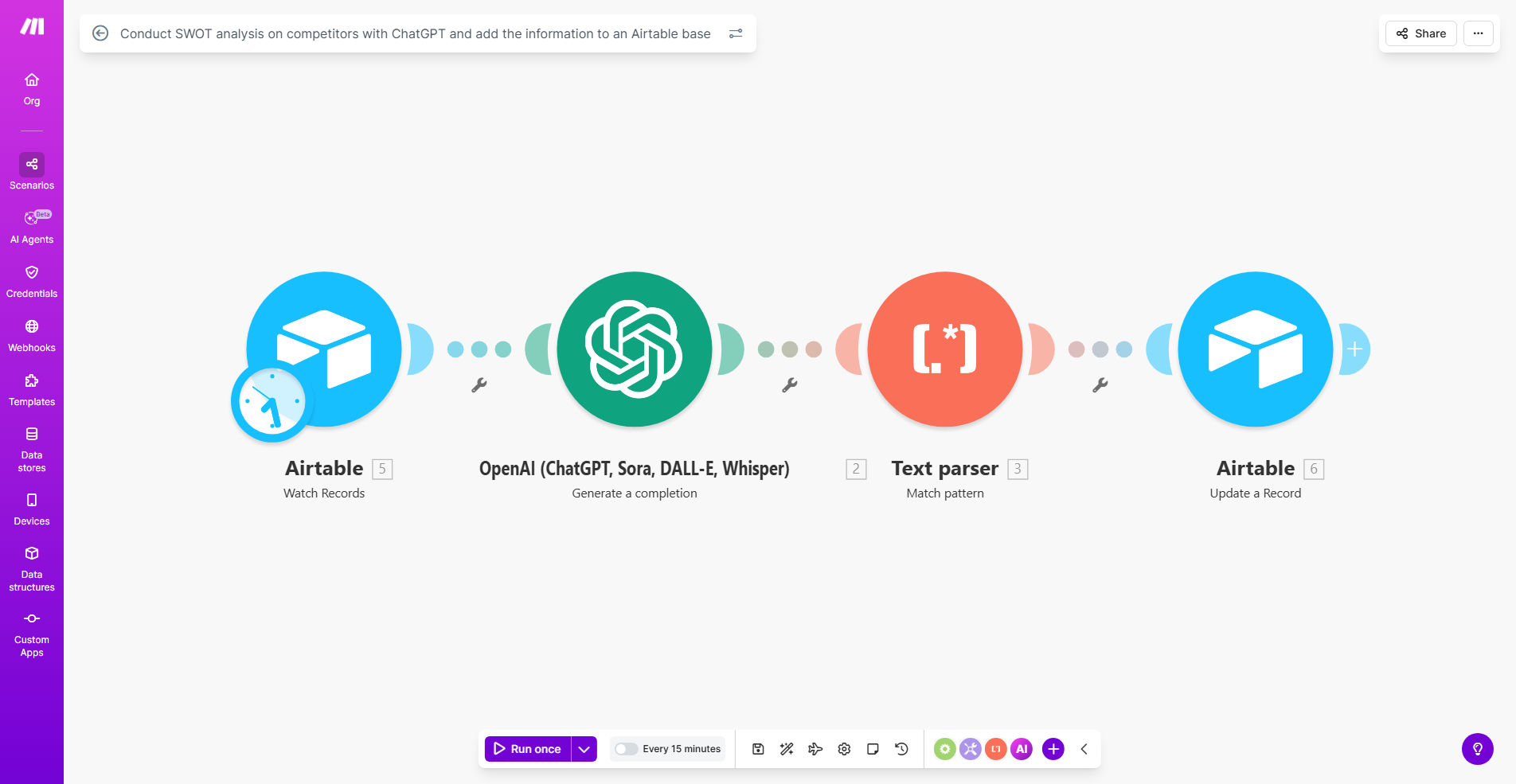
What This Workflow Does
Staying ahead of the competition requires constant vigilance, but manual competitor research is a massive time sink. Marketing teams, founders, and strategists often spend 10-15 hours monthly combing through websites, social media, and reviews, only to have their insights scattered across notes and outdated spreadsheets. This workflow solves that by automating the entire intelligence-gathering process.
It systematically collects information on your competitors, uses ChatGPT to conduct a structured SWOT (Strengths, Weaknesses, Opportunities, Threats) analysis, and then logs those strategic insights directly into an Airtable base. This turns a reactive, ad-hoc task into a proactive, data-driven system that provides a consistent competitive edge.
How It Works
The automation acts as your 24/7 market research assistant, following a clear, repeatable process.
Step 1: Trigger & Data Collection
The workflow can be triggered on a schedule (e.g., weekly) or manually. It begins by gathering raw data on your specified competitors. This could involve pulling publicly available information from their website, app store listings, or news mentions.
Step 2: AI-Powered SWOT Analysis
The collected data is sent to ChatGPT via the OpenAI module. A carefully crafted prompt instructs the AI to analyze the information and generate a balanced, insightful SWOT assessment. It identifies not just obvious factors but also latent opportunities and potential threats.
Pro tip: Fine-tune your ChatGPT prompt to focus on your specific industry metrics, like "analyze pricing strategy weaknesses" or "identify content marketing opportunities," for more actionable insights.
Step 3: Structured Data Logging in Airtable
The generated SWOT analysis—broken into clear Strengths, Weaknesses, Opportunities, and Threats—is then formatted and sent to a pre-configured Airtable base. Each competitor gets a record, with fields for each SWOT category, date of analysis, and source data.
Who This Is For
This automation is a strategic asset for any business that operates in a competitive landscape. It's ideal for startup founders validating their market position, marketing managers tracking rival campaigns, product managers benchmarking features, and business development teams seeking partnership opportunities. Consultants and agencies can also use it to deliver ongoing competitive intelligence reports to their clients.
What You'll Need
- A Make.com account (free tier available).
- An OpenAI API key with access to ChatGPT.
- An Airtable account and a pre-built base with fields for Competitor Name, Date, Strengths, Weaknesses, Opportunities, and Threats.
- A defined list of competitor names or websites to analyze.
Quick Setup Guide
- Clone the Template: Click "Get This Workflow" and duplicate the scenario into your Make.com account.
- Connect Your Apps: In the Make.com editor, authorize the OpenAI and Airtable modules using your API key and account credentials.
- Configure the Trigger: Set the schedule module to run weekly or monthly, or set up a manual trigger button.
- Customize the Data Source: Update the first module to collect data from your preferred source (e.g., a list in Google Sheets, a manual entry form).
- Map to Airtable: Point the final Airtable module to your specific base and table, ensuring the SWOT fields are mapped correctly.
- Test & Activate: Run a test with one competitor to see the SWOT analysis populate in your Airtable, then activate the scenario.
Key Benefits
Save 10+ hours per month on manual research. Automating data collection and initial analysis frees up your team to focus on strategy and action, not just gathering information.
Make data-driven decisions with an unbiased AI perspective. ChatGPT reduces human bias, providing a consistent analytical framework that can reveal insights you might have overlooked.
Build a living competitive intelligence database. Airtable becomes a single source of truth that your entire team can access, search, and use to track competitor evolution over time.
React faster to market changes. With automated, regular analysis, you'll be alerted to new competitor features, pricing changes, or marketing campaigns as they happen, not weeks later.
Scale your analysis effortlessly. Adding a new competitor to track is as simple as adding a name to a list. The system handles the rest, allowing you to monitor dozens of competitors as easily as one.