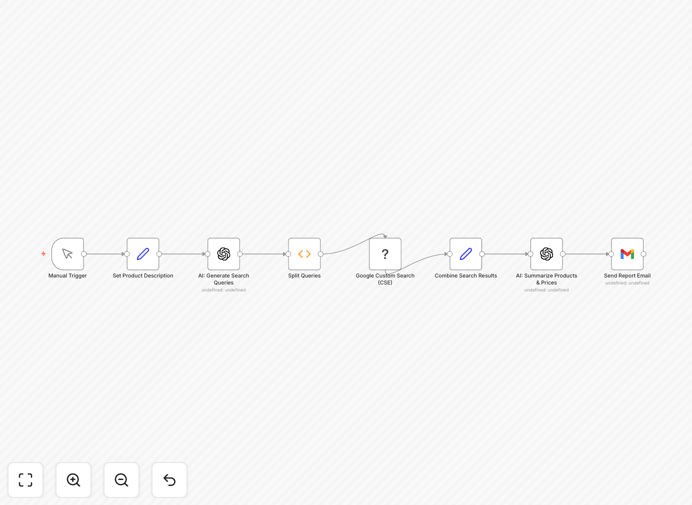
What This Workflow Does
Manual product research is time-consuming and often incomplete. Whether you're sourcing equipment for your business, comparing software tools, or finding the best consumer product, you likely spend hours browsing multiple websites, reading reviews, and trying to compare features and prices.
This intelligent automation solves that problem by acting as your personal AI research assistant. You simply provide a detailed description of what you're looking for, and the workflow automatically searches the web, analyzes results using AI, and delivers a comprehensive report with product options, key features, and potential retailers.
The system transforms vague requirements into actionable purchasing intelligence, helping you make better-informed decisions faster while saving significant research time.
How It Works
The workflow follows a logical sequence that mimics how an expert researcher would approach product discovery, but at machine speed.
Step 1: Input & Query Generation
You start by providing a natural language description of the product you need. For example: "a durable, lightweight hiking backpack for multi-day trips with good ventilation and waterproof compartments." The AI analyzes this description and generates optimized search queries that will yield the most relevant results.
Step 2: Web Search Execution
The system executes these queries through Google's search index, gathering the top results including titles, snippets, and URLs. It searches beyond just shopping platforms to include manufacturer sites, review blogs, and specialty retailers.
Step 3: AI Analysis & Pattern Recognition
OpenAI or another AI service analyzes the search results to identify common product types, recurring features, price ranges, and potential retailers. It extracts key insights that would take a human researcher much longer to spot.
Step 4: Report Compilation
The workflow compiles a concise summary report with categorized findings, direct links to relevant product pages, and recommendations for next steps. It structures the information for easy comparison and decision-making.
Step 5: Delivery
The final report is delivered directly to your email inbox, ready for review. You receive a comprehensive market overview without ever opening a browser tab.
Who This Is For
This automation is valuable for anyone who regularly needs to research products or make purchasing decisions. Procurement teams can use it to compare suppliers and materials. Small business owners can research equipment, software, or inventory. Marketing teams can analyze competitor products. Even individuals making significant personal purchases like electronics, appliances, or outdoor gear can benefit from the objective, comprehensive analysis.
It's particularly useful for businesses that need to make data-driven purchasing decisions but lack the time or resources for thorough manual research. The automation scales research efforts without scaling headcount.
What You'll Need
- Google Custom Search Engine (CSE) credentials – API Key and Search Engine ID from Google Cloud Platform.
- AI service API key – From OpenAI, Google AI, or another compatible provider.
- Email service connection – Gmail or another email provider configured in n8n to receive reports.
- n8n instance – Self-hosted or cloud version of n8n to run the workflow.
- Clear product requirements – Detailed descriptions yield the best results.
Pro tip: When setting up your Google CSE, configure it to search the entire web rather than limiting to specific sites for the broadest research coverage. The workflow includes detailed setup instructions.
Quick Setup Guide
While this workflow involves more setup than simpler automations due to API integrations, the process is straightforward with the provided guidance.
- Import the template into your n8n instance using the downloaded JSON file.
- Create a Google Custom Search Engine in your Google Cloud Console and obtain your API Key and Search Engine ID.
- Configure the Google Search node in the workflow with your credentials.
- Add your AI service API key to the OpenAI (or equivalent) node.
- Connect your email service to the email sending node.
- Test with a sample product description and adjust search parameters as needed.
- Schedule or trigger the workflow whenever you need product research.
Key Benefits
Save 5-10 hours per research project by automating the manual browsing, comparison, and analysis work. What used to take half a day now happens automatically while you focus on other tasks.
Make more informed purchasing decisions with comprehensive, unbiased market analysis. The AI considers options you might have missed and provides structured comparison data.
Scale research efforts without adding staff by running multiple research projects simultaneously. The automation handles the heavy lifting regardless of volume.
Reduce "analysis paralysis" with clear, structured reports that highlight key differences and recommendations. Move from overwhelming information overload to actionable insights.
Create consistent research methodology across your organization with standardized processes and reporting formats. Ensure all purchasing decisions benefit from the same thorough analysis.