What This Workflow Does
Social media monitoring has evolved beyond counting likes and shares. Today's brands need to understand the emotional tone behind conversations—are customers excited about your new product, frustrated with support, or indifferent to your campaign? This AI-powered sentiment analyzer solves that problem by automating what used to require hours of manual review.
The workflow fetches mentions from Twitter (X) and comments from Facebook, processes them through GPT-4o for sophisticated sentiment classification and keyword trend analysis, then delivers polished HTML reports directly to your marketing team. It transforms unstructured social chatter into structured business intelligence you can act on immediately.
Beyond simple positive/negative scoring, the system identifies emerging topics, tracks sentiment shifts over time, and highlights influential conversations that might require engagement. It's like having a dedicated social listening analyst working 24/7, but at zero marginal cost after setup.
How It Works
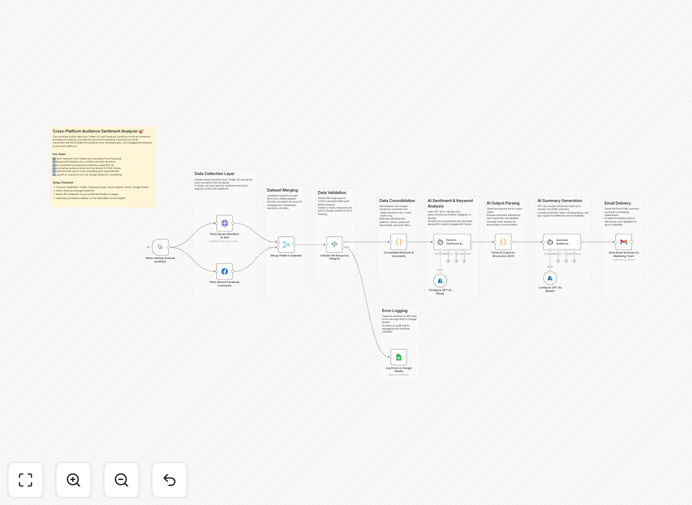
1. Data Collection & Merging
The workflow starts by fetching recent Twitter mentions using the Twitter API and Facebook comments via the Graph API. These separate data streams are then merged into a unified dataset, normalizing different field names and formats so subsequent analysis treats all social content consistently regardless of source.
2. Data Validation & Preparation
Before analysis, the system validates that all required fields are present and checks for API response errors. A custom JavaScript node then cleans and prepares the text—removing URLs, handling emojis, and standardizing formatting—to ensure optimal AI processing accuracy.
3. AI-Powered Sentiment Analysis
GPT-4o analyzes each social media post, classifying sentiment (positive, negative, neutral, mixed) and extracting key topics, emotions, and trending keywords. The AI considers context, sarcasm, and platform-specific slang that simpler keyword-matching tools would miss.
4. Insight Generation & Reporting
The structured AI output is parsed to calculate overall sentiment ratios, identify dominant trends, and highlight noteworthy individual comments. GPT-4o then generates a human-readable HTML report complete with emojis, bullet-point insights, and visual trend indicators.
5. Delivery & Monitoring
The formatted report is emailed to designated team members via Gmail, while any workflow errors or API issues are automatically logged to Google Sheets for monitoring. This creates a complete closed-loop system from data collection to insight delivery.
Who This Is For
Marketing Teams tracking campaign performance and brand perception across social platforms. The automated reports replace manual social listening dashboards that require constant updating.
PR & Communications Professionals monitoring for potential crises or negative sentiment spikes that need immediate response. Early detection of shifting sentiment can prevent minor issues from becoming major problems.
Product Managers gathering unfiltered customer feedback about features, pain points, and requests. Sentiment analysis reveals emotional responses that traditional surveys might miss.
Customer Support Leaders identifying unresolved complaints or satisfaction issues mentioned publicly on social media rather than through support tickets.
Agencies & Consultants providing client reporting on social media performance with deeper insights than standard analytics platforms offer.
What You'll Need
- Twitter API credentials (OAuth 2.0) with read access to fetch mentions and tweets
- Facebook Graph API token with permissions to read page posts and comments
- Azure OpenAI or OpenAI API access with GPT-4o capability enabled
- Gmail account or SMTP credentials for sending automated reports
- Google Sheets setup with a dedicated error logging sheet
- n8n instance (cloud or self-hosted) to run the workflow
Pro tip: Start with monitoring just one platform (Twitter usually has more public conversation data) before adding Facebook. This lets you validate the AI analysis accuracy and reporting format before scaling to multiple sources.
Quick Setup Guide
- Import the template into your n8n instance using the downloaded JSON file
- Configure API credentials for Twitter, Facebook, Azure OpenAI, and Gmail in their respective nodes
- Update platform IDs with your Twitter user ID and Facebook Page ID
- Set recipient emails in the Gmail node for report delivery
- Test the workflow manually to ensure data flows correctly through all stages
- Schedule execution (daily or weekly) based on your monitoring needs
- Review initial reports and adjust AI prompt parameters if needed for your industry terminology
Key Benefits
Save 15-20 hours weekly on manual social media monitoring and reporting. What used to require a team member scrolling through feeds and compiling spreadsheets now happens automatically overnight.
Detect sentiment shifts 80% faster than manual monitoring. The AI analyzes thousands of comments in minutes, alerting you to emerging issues while they're still manageable rather than after they've trended.
Consistent, unbiased analysis across all platforms and over time. Unlike human reviewers who might have different interpretations day-to-day, the AI applies the same criteria consistently, making trend tracking truly reliable.
Actionable executive reporting that translates social chatter into business intelligence. The HTML reports are presentation-ready for leadership meetings, replacing vague "engagement is up" with specific "positive sentiment increased 22% around our new feature launch."
Scalable across regions and languages with minimal additional setup. The same workflow can monitor multiple brand accounts, product lines, or geographic markets by simply duplicating the data collection nodes.
Implementation note: The biggest value often comes from connecting this sentiment data to other systems—like creating support tickets for negative comments or updating CRM records with customer sentiment scores. Consider this template your foundation for a complete customer intelligence system.