Zapier AI Automation Legal Tech Contract Management GPT-4

Automate Contract Analysis & Negotiation with GPT-4

Transform hours of manual legal review into minutes of automated analysis. Identify risks, flag unfavorable terms, and streamline negotiations with AI-powered contract intelligence.

Download Template JSON · n8n compatible · Free
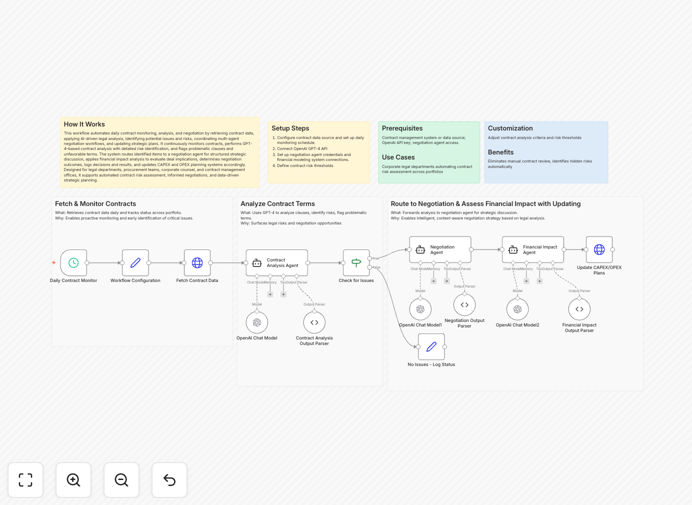
AI contract analysis automation workflow diagram showing contract intake, GPT-4 analysis, risk assessment, and negotiation routing

What This Workflow Does

Manual contract review is a massive time sink for legal teams, procurement departments, and business executives. This automated workflow eliminates that bottleneck by using AI to continuously monitor, analyze, and negotiate contracts. It retrieves contract data from your document management systems, applies GPT-4-powered legal analysis to identify potential issues and risks, coordinates multi-agent negotiation workflows, and updates your strategic planning systems with the results.

The system flags problematic clauses, unfavorable terms, compliance gaps, and financial implications automatically. It then routes identified items to appropriate stakeholders for structured strategic discussion, applies financial impact analysis to evaluate deal implications, determines negotiation outcomes, logs decisions, and updates your CAPEX and OPEX planning accordingly. What used to take days of legal review now happens in minutes with consistent, data-driven results.

How It Works

1. Contract Monitoring & Intake

The workflow automatically monitors designated folders in your document management system (Google Drive, SharePoint, Dropbox) or contract management platform. When a new contract is detected, it extracts the text and metadata, preparing it for analysis.

2. AI-Powered Legal Analysis

Using GPT-4, the system performs comprehensive legal analysis, identifying standard clauses, deviations from your preferred language, missing sections, and potential risks. It compares terms against your legal playbook and flags anything that requires attention.

3. Risk Identification & Scoring

Each contract receives a risk score based on predefined criteria: liability exposure, termination conditions, renewal terms, indemnification language, and compliance requirements. High-risk contracts are prioritized for immediate review.

4. Financial Impact Assessment

The workflow calculates the financial implications of contract terms, including potential costs of unfavorable clauses, savings from negotiated terms, and impact on budgeting forecasts. This data feeds directly into your financial planning systems.

5. Negotiation Workflow Coordination

Based on analysis results, the system automatically routes contracts to the appropriate stakeholders—legal for high-risk items, procurement for vendor terms, finance for cost implications—with clear recommendations and negotiation talking points.

6. Decision Logging & System Updates

All negotiation outcomes, approved changes, and final terms are logged in your contract repository. The system updates your CAPEX/OPEX planning tools with new financial commitments and alerts relevant teams about upcoming renewals or compliance deadlines.

Who This Is For

This automation is ideal for legal departments drowning in contract review requests, procurement teams managing vendor agreements, corporate counsel overseeing compliance, and contract management offices handling high-volume agreements. Businesses that regularly deal with NDAs, service agreements, vendor contracts, partnership agreements, and employment contracts will see immediate value.

Companies in regulated industries (finance, healthcare, technology) benefit particularly from the consistent compliance checking. Growing startups can use this to establish professional contract processes without hiring a full legal team. Enterprises can scale their legal operations without proportionally increasing headcount.

What You'll Need

  1. n8n instance (cloud or self-hosted) with workflow execution capabilities
  2. OpenAI API key with GPT-4 access for contract analysis
  3. Document storage connection (Google Drive, SharePoint, Dropbox, or similar)
  4. Contract repository or CRM to store analyzed contracts and results
  5. Financial planning system access (optional, for CAPEX/OPEX updates)
  6. Defined legal playbook with your standard clauses and risk thresholds

Pro tip: Start with your most common contract type (like NDAs or vendor agreements) to build confidence in the AI's analysis before expanding to more complex agreements. The system learns from your corrections, improving over time.

Quick Setup Guide

1. Import the template into your n8n instance using the download button above.

2. Configure your document source by connecting to Google Drive, SharePoint, or your preferred storage system in the first node.

3. Add your OpenAI API key in the GPT-4 analysis node and customize the prompt to match your legal requirements.

4. Set up notification channels for alerts—Slack, email, or your team's communication platform.

5. Define your risk thresholds in the scoring node based on your organization's risk tolerance.

6. Test with sample contracts to verify the analysis accuracy before going live with real documents.

7. Activate the workflow and start processing contracts automatically on your preferred schedule.

Key Benefits

Reduce contract review time by 80-90%. What takes lawyers hours or days becomes minutes with AI analysis, freeing your legal team for strategic work rather than administrative review.

Eliminate human error and inconsistency. The AI applies the same standards to every contract, ensuring no risky clauses slip through due to reviewer fatigue or oversight.

Improve negotiation outcomes with data-driven insights. Financial impact analysis shows exactly which terms matter most to your bottom line, helping negotiators focus on what truly impacts business value.

Maintain perfect compliance across all agreements. Automatic checking against regulatory requirements and internal policies reduces legal exposure and audit findings.

Gain portfolio-wide visibility into contract risks and obligations. See patterns across all your agreements, identify problematic vendors, and track compliance trends over time.

Frequently Asked Questions

Common questions about contract analysis automation and AI integration

AI-powered contract analysis uses machine learning and natural language processing to automatically review legal documents, identify risks, flag unfavorable clauses, and extract key terms. It's crucial for businesses because it eliminates the manual, time-consuming review process, reduces human error, and ensures consistency across all agreements.

This allows legal and procurement teams to focus on strategic negotiation rather than administrative review, significantly speeding up deal cycles and improving compliance. Companies implementing this technology typically reduce contract review time from days to minutes while catching 30% more potential issues than manual review alone.

Traditional manual contract review is slow, expensive, and prone to inconsistencies. A single lawyer might take hours to review a complex agreement, with costs running into thousands per contract. AI analysis completes this in minutes, at a fraction of the cost, while maintaining consistent standards.

More importantly, AI can process hundreds of contracts simultaneously, identify patterns across your entire portfolio, and flag risks that human reviewers might miss due to fatigue or oversight. The best approach combines AI efficiency with human expertise for final strategic decisions.

Vendor agreements, service level agreements (SLAs), non-disclosure agreements (NDAs), employment contracts, and procurement documents benefit tremendously from automation. These typically contain standardized language where AI excels at identifying deviations, missing clauses, or non-standard terms.

High-volume, repetitive contracts like NDAs and vendor agreements see the fastest ROI, while complex agreements like mergers and acquisitions benefit from AI's ability to quickly surface critical issues for human experts to review. Even custom contracts can be analyzed against your organization's specific risk parameters and legal preferences.

Yes, modern AI contract analysis workflows integrate seamlessly with document management systems like SharePoint, Google Drive, and Dropbox, as well as legal tech platforms like Clio, contract lifecycle management (CLM) systems, and ERP software.

The workflow can automatically pull contracts from these sources, analyze them, and push results back with structured data. This creates a continuous feedback loop where your existing systems become smarter and more automated over time, without requiring manual data entry or switching between platforms.

AI systems are trained to identify unlimited liability clauses, automatic renewal terms, unfavorable termination conditions, non-standard indemnification language, missing insurance requirements, and unusual payment terms.

They also flag compliance issues related to data privacy regulations (GDPR, CCPA), industry-specific requirements, and internal policy violations. The system can be customized to watch for your organization's specific red flags based on historical negotiation data and legal preferences, creating a tailored risk detection model.

For standard clause identification and basic risk detection, AI achieves 95%+ accuracy. However, AI serves as a powerful assistant rather than a replacement for human expertise. It excels at speed, consistency, and volume handling, while human lawyers provide contextual judgment, strategic negotiation advice, and complex interpretation.

The optimal approach combines AI's efficiency for initial screening with human expertise for final review and negotiation strategy, creating a hybrid model that's both fast and reliable. Most organizations use AI to handle 80% of routine review, freeing legal staff to focus on the 20% that requires true expertise.

Automated systems track negotiation cycle time reduction, legal review cost savings, risk exposure quantification, compliance violation prevention costs, and contract value optimization.

You can measure specific metrics like average review time (reduced from days to hours), legal department efficiency gains, early termination risk mitigation, and favorable term improvements. These metrics directly translate to bottom-line impact through reduced legal spend, faster deal closure, and better contract terms that improve profitability over the agreement lifecycle.

Yes, GrowwStacks specializes in building tailored contract automation solutions for specific business needs. While this free template provides a foundation, we can develop custom workflows that integrate with your existing document management systems, incorporate your specific legal playbooks, and connect to your financial planning tools.

Our team works with your legal and procurement departments to understand your unique requirements, risk thresholds, and negotiation strategies, then builds a system that fits seamlessly into your existing processes. We handle everything from initial consultation to implementation and ongoing support.

  • Custom integration with your current tech stack
  • Training on your specific contract types and risk parameters
  • Ongoing optimization based on real-world performance data

Need a Custom Contract Analysis Automation?

This free template is a starting point. Our team builds fully tailored automation systems for your specific business needs.