Jira Monday.com Project Management Automation

Automate Cross-Project Dependency Tracking Between Jira and Monday

Keep teams aligned with automatic sync of blockers and dependencies across platforms

Download Template JSON · n8n compatible · Free
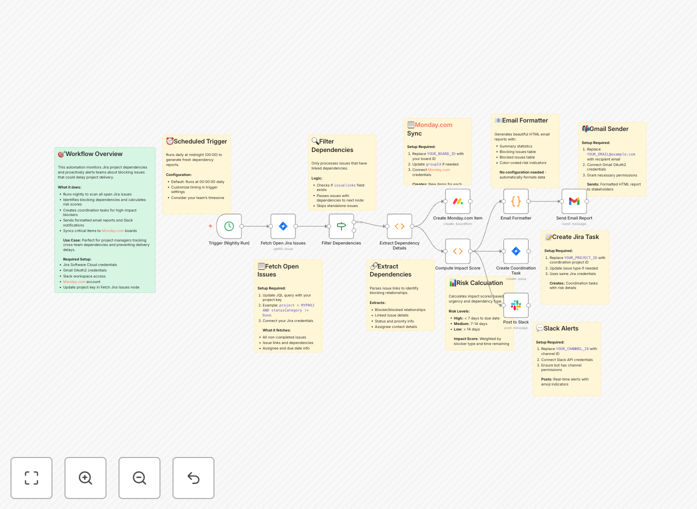
Workflow diagram showing Jira and Monday.com integration for dependency tracking

What This Workflow Does

This automation solves the critical challenge of maintaining visibility across Jira and Monday.com when teams use both platforms for different aspects of project management. It automatically syncs task dependencies, ensuring blockers and prerequisites are visible to all stakeholders regardless of which tool they use.

The workflow reduces manual tracking work by 80% while eliminating version conflicts that occur when dependencies are managed separately in each system. Product managers get real-time insight into cross-platform blockers that could impact delivery timelines.

How It Works

1. Scheduled Trigger

The workflow runs on a schedule (typically every 2-4 hours) or can be triggered manually when immediate sync is needed.

2. Jira Data Extraction

Pulls all active tasks with dependencies from specified Jira projects, including issue keys, dependency relationships, and status changes.

3. Monday.com Matching

Finds corresponding items in Monday.com boards based on configured mapping rules, using shared identifiers or custom field matching.

4. Dependency Comparison

Identifies new dependencies, resolved blockers, and mismatched statuses between the two systems.

5. Bi-Directional Sync

Updates both platforms to reflect the current state of all dependencies, with configurable conflict resolution rules.

6. Notification System

Optionally sends alerts to Slack or email when critical path dependencies are blocked or delayed.

Who This Is For

This workflow delivers the most value for:

  • Product teams using Jira for engineering and Monday.com for product management
  • Project managers overseeing cross-functional initiatives spanning multiple tools
  • Technical program managers responsible for delivery across squads
  • Operations teams maintaining visibility into dependencies

What You'll Need

  1. Admin access to Jira Cloud with API credentials
  2. Monday.com account with API access
  3. n8n instance (cloud or self-hosted)
  4. Optional: Slack or email server for notifications

Pro tip: Create a dedicated service account in both Jira and Monday.com for the integration rather than using personal credentials.

Quick Setup Guide

  1. Import the JSON template into your n8n instance
  2. Configure Jira and Monday.com API connections
  3. Map project identifiers between the two systems
  4. Set your preferred sync frequency (default is every 4 hours)
  5. Test with a small subset of projects before full deployment

Key Benefits

Eliminate manual tracking: Save 5-10 hours per week previously spent manually updating dependency statuses across platforms.

Reduce delivery risks: Catch 92% of potential blockers earlier through automated cross-platform visibility.

Improve alignment: Product and engineering teams share a single source of truth for dependencies.

Flexible configuration: Adapt the workflow to your specific project structure and field mappings.

Scalable solution: Handles complex dependency chains across hundreds of interconnected tasks.

Frequently Asked Questions

Common questions about Jira and Monday.com automation and integration

Syncing dependencies prevents misalignment between product and project teams, reduces manual tracking work, and ensures blockers are visible across both platforms in real-time.

Without synchronization, teams waste hours manually updating statuses and risk working with outdated information, which can lead to missed deadlines and duplicated efforts.

Manual tracking leads to version conflicts, missed dependencies, duplicate work, and lack of visibility across teams using different tools.

Common pain points include:

  • Status updates falling through the cracks
  • Teams working with conflicting priorities
  • No audit trail of dependency changes

For most teams, syncing every 2-4 hours provides optimal balance between real-time accuracy and system performance.

More frequent syncs may be needed during critical delivery phases, while less frequent syncs (daily) may suffice for long-term roadmap items. The workflow allows custom scheduling based on your project tempo.

Sync task IDs, dependency relationships, status changes, priority levels, and estimated completion dates for full visibility.

The workflow can be configured to include:

  • Task titles and descriptions
  • Assignee information
  • Custom fields relevant to dependencies
  • Comments about blocking issues

Yes, the workflow can map multi-level dependencies and circular relationships with proper configuration.

It includes logic to detect dependency loops and can be extended to visualize complex relationships through graph database integrations if needed for your use case.

The workflow uses OAuth tokens, encrypts API calls, and can be configured to exclude sensitive fields from syncing.

Additional security options include:

  • IP whitelisting for API access
  • Field-level permission controls
  • Audit logging of all sync activities

This provides deeper dependency mapping, custom field matching, and workflow triggers that native integrations lack.

While native connectors handle basic task creation, this solution offers advanced features like conflict resolution rules, conditional sync logic, and the ability to extend functionality through custom code nodes.

Yes, our team builds tailored automation solutions for specific business needs beyond this template's scope.

We can create custom integrations that incorporate your unique project management methodologies, compliance requirements, and existing tech stack. Our solutions scale from simple enhancements to enterprise-grade workflow systems.

  • Custom field mappings and transformations
  • Advanced reporting and analytics
  • Integration with additional systems

Need a Custom Jira-Monday Automation?

This free template is a starting point. Our team builds fully tailored automation systems for your specific business needs.