What This Workflow Does
Security teams spend countless hours manually researching new CVEs (Common Vulnerabilities and Exposures), validating proof-of-concept (PoC) data, and creating detection templates. This process is slow, inconsistent, and delays critical security responses. Meanwhile, attackers move quickly to exploit newly published vulnerabilities.
This automation solves that problem by creating a complete pipeline that transforms public vulnerability data into ready-to-use Nuclei templates. It automatically collects recent high-severity PoCs, extracts technical artifacts using AI, validates sources, and generates detection templates that can be immediately deployed in your security testing environment. What used to take security researchers 4-8 hours per CVE now happens automatically with consistent quality and immediate availability.
How It Works
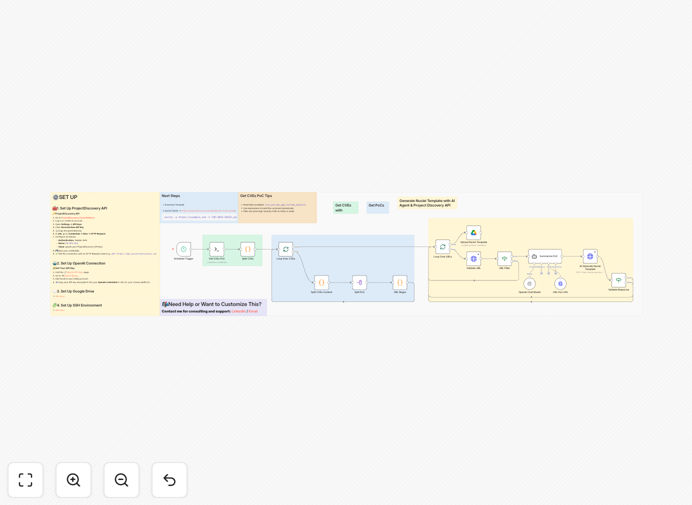
The workflow orchestrates multiple security tools and AI services to create a seamless automation pipeline.
1. Scheduled Vulnerability Collection
The workflow triggers on a schedule (daily or hourly) and executes SSH commands to run vulnx with configured filters. This collects recent, high-severity proof-of-concept data from public sources, focusing on CVEs with CVSS scores above your threshold.
2. Data Parsing and Validation
Raw vulnerability data is parsed into structured CVE entries. The system extracts critical fields: CVE ID, severity score, affected products, remediation guidance, and references. URLs from PoC sections are extracted using regex patterns and validated through HTTP requests to ensure they're accessible and relevant.
3. AI-Powered Technical Extraction
Validated PoC content is sent to OpenAI via LangChain with specialized prompts that force technical-only output. The AI extracts exploit steps, payload patterns, vulnerable endpoints, HTTP request/response structures, and reproduction notes—transforming unstructured PoC descriptions into structured technical artifacts.
4. Template Generation and Storage
Extracted technical data is sent to the ProjectDiscovery Cloud API, which generates properly formatted Nuclei templates in YAML. These templates are validated for correctness and then automatically saved to your configured Google Drive folder, organized and ready for immediate use in security testing.
Pro tip: Configure the workflow to run multiple times daily during business hours when new CVEs are most likely to be published. This ensures your detection capabilities are updated within hours of vulnerability disclosure, dramatically reducing your exposure window.
Who This Is For
This automation delivers the most value to security teams and researchers who need to scale their detection capabilities without increasing headcount. Bug bounty hunters can automatically expand their testing arsenal with new vulnerability checks. Security operations centers (SOCs) can ensure their detection engineering teams have immediate access to validated templates for new threats. Managed security service providers (MSSPs) can maintain consistent, up-to-date detection across multiple client environments. Even development teams implementing security testing in CI/CD pipelines benefit from automatically generated, validated test cases for newly discovered vulnerabilities in their technology stack.
What You'll Need
- n8n instance with the workflow imported and running
- SSH access to a host with vulnx installed and configured
- OpenAI API key for technical artifact extraction (GPT-4 or later recommended)
- ProjectDiscovery API key for Nuclei template generation
- Google Drive OAuth2 credentials with write access to your templates folder
- Network access to reach public CVE sources and validation URLs
Quick Setup Guide
Follow these steps to deploy this automation in your environment:
- Download and import the template JSON file into your n8n instance
- Configure credentials for SSH, OpenAI, ProjectDiscovery, and Google Drive in n8n's credentials management
- Set the schedule trigger to your desired frequency (start with daily if testing)
- Update the Google Drive folder ID where generated templates should be saved
- Adjust severity filters in the vulnx command to match your risk tolerance
- Test with a single CVE first to ensure all components work correctly
- Monitor initial runs and review generated templates for quality
- Integrate with your security pipeline by having systems read from the Google Drive folder
Security note: This workflow performs only data collection and template generation—no active exploitation. Ensure you have appropriate authorization before using generated templates against any systems. Always follow responsible disclosure practices and only test systems you own or have explicit permission to assess.
Key Benefits
Reduce vulnerability detection time by 80-90%. What takes security researchers hours to manually research, extract, and template now happens automatically within minutes of CVE publication. Your security team gains immediate detection capabilities instead of waiting for manual research completion.
Ensure consistent, high-quality detection templates. Human researchers have varying approaches and might miss technical details. AI extraction follows consistent patterns, and automated validation ensures every template meets quality standards before deployment, reducing false negatives in your security testing.
Scale security operations without proportional headcount increases. One automation can handle hundreds of CVEs with the same reliability as a team of researchers. This allows your existing security staff to focus on strategic analysis and response rather than repetitive data collection tasks.
Maintain comprehensive audit trails for compliance. Every step—from CVE collection through template generation—is logged with timestamps, sources, and validation results. This creates defensible evidence for security compliance requirements and post-incident analysis.
Integrate seamlessly with existing security toolchains. The workflow outputs standardized Nuclei templates to Google Drive, where they can be automatically picked up by security orchestration platforms, CI/CD pipelines, or manual testing processes, creating a closed-loop detection system.