AI Agents Finance Automation n8n OpenAI CFO AI

Automate Financial Operations with AI CFO & Finance Team

Build a virtual finance department inside n8n. Automate financial planning, accounting, treasury, analysis, and risk management with AI agents.

Download Template JSON · n8n compatible · Free
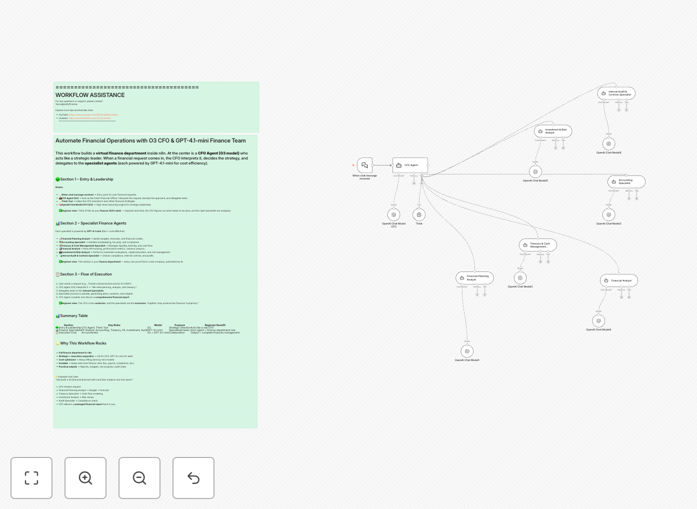
AI CFO and finance team automation workflow diagram in n8n

What This Workflow Does

This workflow creates a complete virtual finance department powered by AI inside n8n. It solves the problem of manual, time-consuming financial operations that drain resources and delay decision-making. Instead of hiring multiple specialists, you deploy AI agents that handle everything from strategic planning to daily accounting.

At the center is a CFO Agent (using OpenAI's O3 model) that acts as the strategic leader. When a financial request arrives—like "Create a Q1 forecast with risk analysis"—the CFO interprets the goal, decides the approach, and delegates tasks to a team of specialist agents. Each specialist is powered by GPT-4.1-mini, optimized for cost and performance in their specific domain.

The result is a cohesive, automated finance function that produces comprehensive reports, budgets, cash flow models, compliance checks, and investment analyses—all without human intervention for routine tasks.

How It Works

Step 1: Request Entry & CFO Leadership

A user submits a financial request via a chat interface or API trigger. The CFO Agent (O3) receives it, analyzes the intent, and uses a "Think Tool" to brainstorm the optimal strategy. It then maps out which specialist agents are needed to fulfill the request.

Step 2: Specialist Agent Execution

The CFO delegates parallel tasks to the specialist team: Financial Planning Analyst builds budgets and forecasts; Accounting Specialist handles bookkeeping and tax prep; Treasury & Cash Management Specialist models liquidity; Financial Analyst tracks KPIs and variance; Investment & Risk Analyst evaluates capital allocation; Internal Audit & Controls Specialist checks compliance.

Step 3: Consolidation & Delivery

Each specialist returns its output to the CFO Agent. The CFO compiles, synthesizes, and formats the results into a unified financial report—including narratives, numbers, charts, and recommendations—then delivers it back to the user.

Who This Is For

This automation is ideal for small to medium businesses that lack a full finance department but need sophisticated financial management. It's also perfect for startups scaling rapidly, consulting firms offering financial services, and companies wanting to augment their existing finance team with AI capabilities.

Finance managers, CFOs, business owners, and operations leaders will benefit most. If you spend hours each week on manual forecasting, reporting, or compliance checks, this workflow can reclaim that time and provide higher-quality insights.

What You'll Need

  1. A running n8n instance (cloud or self-hosted).
  2. OpenAI API keys for O3 and GPT-4.1-mini models.
  3. Basic understanding of n8n node configuration.
  4. Access to your financial data sources (spreadsheets, databases, accounting software) if you want to integrate live data.
  5. Clear financial request formats or triggers (e.g., Slack commands, form submissions, scheduled runs).

Pro tip: Start with simple, rule-based requests like "Generate a monthly P&L summary" before moving to complex predictive tasks. Validate AI outputs against human-made reports for the first few cycles to ensure accuracy.

Quick Setup Guide

  1. Download the template JSON file and import it into your n8n workspace.
  2. Configure the OpenAI nodes with your API keys. Set the CFO Agent to use O3 and specialist agents to use GPT-4.1-mini.
  3. Adjust the trigger node to match your input method (e.g., change "When chat message received" to a schedule or webhook).
  4. Test with a sample request like "Create a 6-month cash flow projection."
  5. Review the output, refine agent instructions if needed, and connect to your data sources (Google Sheets, QuickBooks, etc.) for real-time data pulling.

Key Benefits

80% time reduction on routine finance tasks. Automating budgeting, reporting, and analysis eliminates hours of manual work each week, freeing your team for strategic thinking.

Cost-effective AI deployment. Using GPT-4.1-mini for specialist roles cuts AI operational costs by 60–70% compared to using larger models for everything, making automation affordable.

Improved accuracy and consistency. AI agents follow predefined rules and reduce human error in calculations, data entry, and compliance checks, leading to more reliable financial outputs.

Scalable finance function without hiring. You can add more specialist agents (tax, payroll, etc.) as needed, scaling your virtual department instantly without recruitment overhead.

Real-time insights and proactive alerts. The system can monitor financial metrics continuously and flag anomalies or opportunities, enabling faster decision-making.

Frequently Asked Questions

Common questions about AI finance automation and integration

Automating financial operations with AI reduces manual data entry, improves accuracy, and provides real-time insights. It allows businesses to scale their finance functions without hiring additional staff, saving up to 80% of time on routine tasks like forecasting, reporting, and compliance checks.

For example, a mid-sized company can generate quarterly financial reports in minutes instead of days, enabling faster board reviews and strategic adjustments. The AI also uncovers patterns humans might miss, such as subtle cash flow trends or cost allocation inefficiencies.

AI agents can analyze historical data, market trends, and internal metrics to generate dynamic forecasts. They adjust predictions based on real-time inputs, reducing human bias and error. This leads to more accurate budgets and proactive financial planning, helping businesses allocate resources efficiently.

In practice, an AI forecasting agent can incorporate sudden market shifts, new sales data, or operational changes instantly, updating projections daily. This agility helps companies avoid budget overruns and capitalize on emerging opportunities.

Yes, when properly configured. AI agents follow predefined rules and can cross-check data against regulations. They generate audit trails and flag anomalies, improving compliance accuracy. However, human oversight is still recommended for final review, especially for complex tax and legal matters.

Best practice is to use AI for data consolidation, error spotting, and preliminary reports, then have a human expert validate critical outputs. This hybrid approach maximizes both efficiency and safety.

GPT-4.1-mini is significantly cheaper than larger models while maintaining strong performance for structured financial tasks. Using it for specialist roles like accounting analysis or cash flow modeling reduces AI operational costs by 60–70%, making automation economically viable for small to mid-sized businesses.

This cost optimization allows companies to run multiple agents concurrently without prohibitive API expenses. You can deploy a full finance team AI for less than the cost of one junior accountant.

A CFO AI agent acts as a strategic coordinator. It interprets high-level requests, breaks them into subtasks, and assigns each to the appropriate specialist agent (e.g., planning, treasury, audit). This mimics a real finance department hierarchy, ensuring tasks are handled by the most suitable AI 'role'.

The delegation logic is based on intent recognition and task mapping. For instance, a request containing "risk assessment" and "investment" triggers both the Risk Analyst and Investment Analyst agents, while a "monthly bookkeeping" request goes solely to the Accounting Specialist.

Yes. n8n workflows can connect to platforms like QuickBooks, Xero, SAP, or custom databases. AI agents can pull data, transform it, generate reports, and push updates back. This creates a bridge between legacy systems and modern AI analysis, enhancing existing tools without replacing them.

Integration typically uses API nodes or database queries. The AI agents then enrich the raw data with insights, forecasts, and visualizations, delivering value beyond what your current software provides.

Common pitfalls include insufficient data quality, over-automating complex judgment tasks, and lack of human review loops. Start with clear, rule-based processes like report generation or data consolidation. Gradually add predictive tasks after validating accuracy. Always maintain a human-in-the-loop for critical decisions.

Other risks include misconfigured agent instructions leading to irrelevant outputs, and failing to set cost limits on AI API calls. Pilot the automation on a small, non-critical process first to iron out these issues.

Yes. GrowwStacks specializes in building tailored AI automation systems for finance departments. We assess your existing tools, processes, and goals to design a workflow that integrates your accounting software, data sources, and reporting needs.

Contact us for a free consultation to discuss your specific requirements. We'll map out a phased implementation, from basic automation to advanced predictive analytics, ensuring the solution aligns with your business objectives and compliance standards.

Need a Custom Financial Operations Automation?

This free template is a starting point. Our team builds fully tailored automation systems for your specific business needs.