Zapier AI Automation LinkedIn GPT-4 Gmail

Automate Job Applications with AI Resume Tailoring

Stop applying manually. This free n8n workflow acts as your personal AI recruiter, automating the end-to-end process of finding high-quality jobs, tailoring your resume with GPT-4o, and sending personalized outreach.

Download Template JSON · n8n compatible · Free
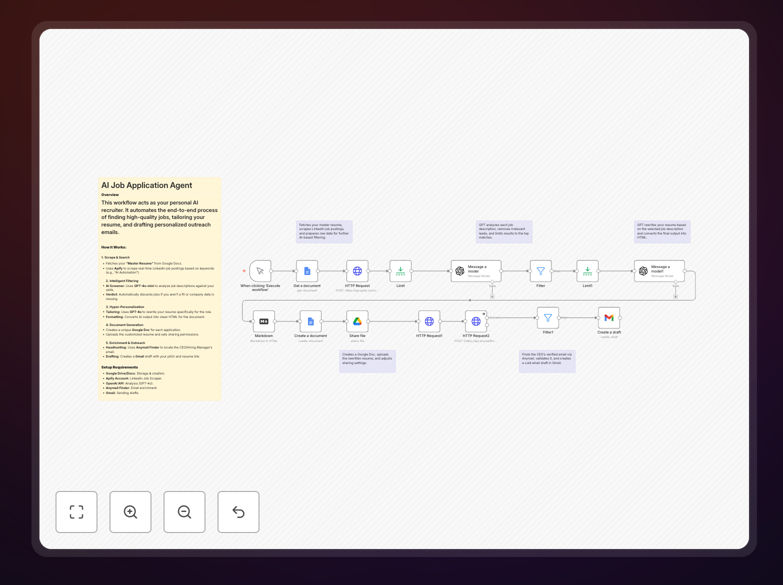
Visual diagram of the AI job application automation workflow connecting LinkedIn, GPT-4, Google Docs, and Gmail

What This Workflow Does

Job hunting is a full-time job in itself. Between searching platforms, reading descriptions, tailoring resumes, and writing cover letters, candidates spend 15–20 hours per week on applications with low response rates. This automation solves that by acting as your 24/7 AI recruitment assistant.

The workflow automatically scours LinkedIn for jobs matching your criteria, uses AI to determine if you're a good fit, rewrites your resume specifically for each role, creates a shareable Google Doc, finds the hiring manager's email, and drafts a personalized outreach message—all without manual intervention. It transforms a process that typically takes hours per application into one that runs continuously in the background, applying to dozens of relevant opportunities with hyper-personalized materials.

How It Works

1. Job Discovery & Filtering

The workflow begins by connecting to Apify's LinkedIn Job Scraper, which pulls real-time job listings based on your configured search parameters (keywords, location, experience level). Each job listing is then analyzed by GPT-4o-mini against your skills and preferences to automatically filter out mismatches, saving you from reviewing irrelevant postings.

2. AI-Powered Resume Tailoring

For each qualifying job, the system retrieves your master resume from Google Docs and uses GPT-4o to rewrite it specifically for that role. The AI extracts key requirements from the job description and restructures your experience to highlight the most relevant qualifications, ensuring each application passes ATS filters and catches human attention.

3. Document Generation & Storage

A new Google Doc is automatically created with the tailored resume, named appropriately for the role and company. The document is set with appropriate sharing permissions, and a shareable link is generated for inclusion in your outreach email.

4. Contact Enrichment & Outreach

The workflow uses Anymail Finder to locate the verified email address of the hiring manager or relevant department head. It then crafts a personalized email in your Gmail drafts folder, referencing the specific role, company, and your tailored resume link, ready for your review and send.

Who This Is For

This automation is ideal for active job seekers across all industries, career changers looking to break into new fields, recruitment agencies managing multiple candidates, and professionals who want to passively explore opportunities while employed. It's particularly valuable for technical roles where keyword matching in resumes is critical, sales and marketing professionals who need to demonstrate relevance, and executives seeking discreet career advancement opportunities.

What You'll Need

  1. n8n instance (cloud or self-hosted)
  2. Google account with Drive and Docs access
  3. Apify account for LinkedIn job scraping
  4. OpenAI API key for GPT-4o and GPT-4o-mini access
  5. Anymail Finder API key for contact enrichment
  6. Gmail account for sending outreach
  7. Master resume document in Google Docs format

Pro tip: Before running the workflow at scale, test it with a single job search to ensure all API connections work correctly and review the AI-generated content for tone and accuracy.

Quick Setup Guide

1. Import the template into your n8n instance using the downloaded JSON file.

2. Configure credentials in n8n for Google Drive, Apify, OpenAI, Anymail Finder, and Gmail.

3. Update the search parameters in the Apify node with your LinkedIn job search URL, including keywords, location, and experience filters.

4. Connect your master resume by pasting its content into the Google Docs node or linking to an existing document.

5. Test the workflow with a single execution to verify all steps complete successfully.

6. Schedule the workflow to run daily or weekly for continuous job discovery and application.

Key Benefits

Save 10–15 hours weekly by automating the most time-consuming parts of job searching—research, tailoring, and outreach.

Increase application quality with AI-optimized resumes that match job descriptions keyword-for-keyword, significantly improving ATS scores.

Apply to 5–10x more positions by automating the process, allowing you to cast a wider net while maintaining personalization.

Direct hiring manager access bypasses crowded applicant portals, putting your application directly in front of decision-makers.

Maintain consistency in your job search even during busy periods, ensuring you never miss relevant opportunities.

Frequently Asked Questions

Common questions about AI-powered job application automation

AI and automation can dramatically improve your job application process by handling repetitive, time-consuming tasks. Instead of manually searching for jobs and tailoring each resume, an automated system can continuously scan platforms like LinkedIn for new postings that match your criteria.

AI can then analyze each job description, extract key requirements, and rewrite your master resume to highlight the most relevant skills and experiences for that specific role. This ensures every application is highly personalized, increasing your chances of getting past automated applicant tracking systems (ATS) and catching a recruiter's eye.

The main benefits are increased efficiency, improved application quality, and better targeting. Automation allows you to apply to dozens of relevant jobs in the time it would take to manually apply to one or two.

AI-powered resume tailoring ensures each application is optimized for the specific role, using keywords from the job description to pass ATS filters. It also helps you target decision-makers directly by finding and emailing hiring managers or department heads, bypassing the generic application portal.

Yes, using AI to tailor your resume is safe and increasingly common. The key is to use it as a tool for enhancement, not fabrication. A good workflow uses your master resume—a comprehensive document of all your genuine skills and experiences—as the source.

The AI then rephrases and restructures this information to align with the language and priorities of each job description. It highlights relevant achievements and formats your experience to match what the employer is seeking. This process is ethical as long as you review the final output to ensure accuracy.

To build a robust job application automation, you typically need a workflow platform like n8n, a web scraping service (like Apify) to pull job listings from LinkedIn or other boards, an AI service (like OpenAI's GPT-4) for resume and email content generation, a document service (like Google Docs) to create and store tailored resumes, and an email service (like Gmail) to send outreach.

You'll also need an email finder service (like Anymail Finder) to locate contact information for hiring managers. These tools are connected in an automation workflow that runs on a schedule, continuously finding, tailoring, and applying to jobs for you.

Automated job searching is faster, more consistent, and can be more strategic than manual methods. While manual searching relies on you remembering to check job boards and often leads to applying to the same popular postings as everyone else, automation can run 24/7, finding new listings the moment they're posted.

It can apply filters more consistently, ensuring you only spend time on roles that truly match your salary, location, and skill requirements. Automation also allows for A/B testing of different resume versions or email subject lines to see what gets the best response.

Yes, automation can help uncover hidden opportunities that aren't advertised on major job boards. By scraping LinkedIn and company career pages directly, you can find roles before they get hundreds of applications.

More advanced automation can monitor company news for expansion announcements or funding rounds that typically precede hiring. It can also identify and reach out to department heads or team leads at target companies directly, potentially discovering roles that are being filled through referrals or haven't been officially posted yet.

An effective automated outreach email should be personalized, concise, and value-oriented. It should mention the specific role and company, reference something genuine about the company's work or values, briefly highlight your most relevant qualification for that particular role, and include a clear call to action, such as viewing your tailored resume or scheduling a brief call.

The email should come from your personal email account (not a bot address) and include a link to the custom resume document created for that specific application. The tone should be professional but human—AI helps draft the email, but you should review it to ensure it sounds authentic before sending.

Yes, absolutely. While this free template provides a solid foundation for individual job seekers, businesses often need more sophisticated solutions. GrowwStacks specializes in building custom automation systems for recruitment agencies, HR departments, and career coaching services.

We can create systems that handle bulk applications for multiple candidates, integrate with your existing ATS or CRM, add advanced filtering logic, include analytics dashboards to track application performance, and ensure compliance with data privacy regulations.

  • Multi-candidate management with individual profiles
  • Integration with existing HR software and databases
  • Advanced reporting on application success rates

Need a Custom Job Application Automation?

This free template is a starting point. Our team builds fully tailored automation systems for your specific business needs.