AI Automation Employee Feedback Process Improvement Baserow HR Tech

Automate Process Improvement with Employee Feedback & AI

Transform team feedback into actionable process improvements automatically. This n8n template analyzes employee comments using AI and suggests concrete optimizations for your procedures.

Download Template JSON · n8n compatible · Free
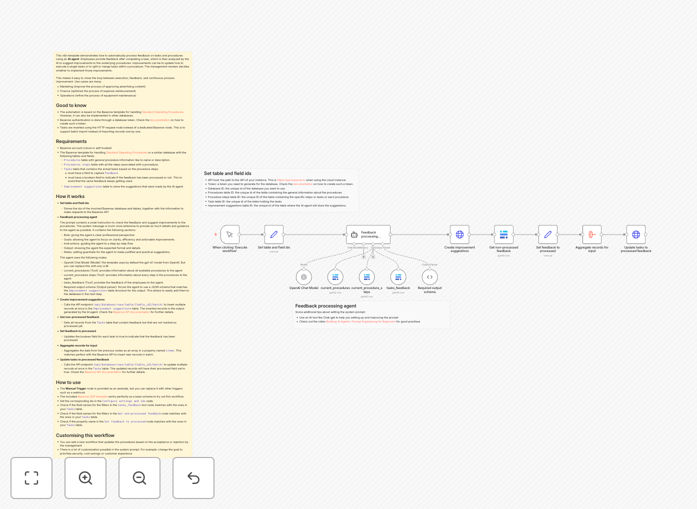
AI employee feedback automation workflow diagram showing feedback collection, AI analysis, and process improvement suggestions

What This Workflow Does

This automation solves the common problem of employee feedback being collected but never acted upon. When team members complete tasks, they often have valuable insights about what could work better—but these suggestions typically get lost in email threads, spreadsheets, or forgotten meeting notes.

The workflow automatically processes feedback submitted by employees, analyzes it using AI to identify specific process improvements, and generates actionable suggestions for management review. It creates a closed-loop system where feedback directly informs continuous process optimization, ensuring your procedures evolve based on actual employee experiences rather than assumptions.

By connecting Baserow (where feedback and procedures are stored) with AI analysis, this automation turns subjective comments into objective improvement opportunities. It can identify patterns across multiple feedback entries, prioritize suggestions based on potential impact, and maintain a clear audit trail of all improvements made.

How It Works

1. Feedback Collection & Storage

Employees submit feedback after completing tasks through your existing systems. This feedback is stored in a Baserow database alongside the relevant procedures and task information. The workflow monitors for new feedback entries that haven't been processed yet.

2. AI Analysis & Insight Generation

An AI agent reviews the feedback in context with the complete procedure details. It analyzes comments to identify common pain points, inefficiencies, and improvement opportunities. The AI is guided by specific instructions to focus on clarity, efficiency, and actionable suggestions.

3. Suggestion Creation & Categorization

The AI generates specific improvement suggestions categorized by type: task simplification, sequence optimization, resource improvements, or clarity enhancements. Each suggestion includes a rationale based on the feedback received and an estimated impact level.

4. Management Review Preparation

All suggestions are compiled in a dedicated Baserow table for management review. The original feedback is marked as processed to prevent duplicate analysis. Managers receive a clean list of prioritized improvements ready for evaluation and implementation decisions.

Who This Is For

This automation is ideal for operations managers, HR teams, department heads, and any business leader responsible for process optimization. It's particularly valuable for companies with standardized procedures in areas like customer service, manufacturing, software development, or administrative workflows.

Teams that already use Baserow for procedure documentation will get immediate value, but the template can be adapted to work with other databases. Organizations with 10+ employees performing repetitive tasks will see the greatest return, as more feedback generates better AI insights and more impactful improvements.

What You'll Need

  1. Baserow account (cloud or self-hosted) with the Standard Operating Procedures template or similar database structure
  2. n8n instance (self-hosted or cloud) with access to AI model nodes (OpenAI, Anthropic, or local LLM)
  3. Database tables for Procedures, Procedure Steps, Tasks with Feedback field, and Improvement Suggestions
  4. Feedback collection method (existing form, survey tool, or manual entry process)
  5. Management review process for evaluating and implementing suggested improvements

Pro tip: Start with a single department or process to refine the AI's analysis before scaling company-wide. This lets you tune the prompts and categories based on real results before broader implementation.

Quick Setup Guide

  1. Download the template and import it into your n8n instance
  2. Configure the Baserow credentials and database/table IDs in the settings node
  3. Connect your preferred AI model (OpenAI GPT-4 works well for this use case)
  4. Test with sample feedback to ensure the AI generates relevant improvement suggestions
  5. Set the workflow to run on a schedule (daily or weekly depending on feedback volume)
  6. Train managers on reviewing and acting upon the AI-generated suggestions

Key Benefits

Close the feedback loop in hours instead of weeks. Traditional feedback processes can take weeks to analyze and act upon. This automation processes feedback immediately, ensuring timely improvements that show employees their input matters.

Save 5-10 hours weekly on manual feedback review. Managers no longer need to read through every comment individually. The AI does the initial analysis, highlighting only the most important insights and patterns for human review.

Make data-driven process decisions based on actual employee experiences. Instead of guessing what needs improvement, you'll have specific suggestions backed by multiple data points. This reduces implementation risk and increases improvement success rates.

Create a culture of continuous improvement with minimal management overhead. The system runs automatically in the background, constantly looking for optimization opportunities. This demonstrates commitment to improvement without burdening managers with additional administrative work.

Scale process optimization across departments without proportional management time increase. As your company grows, the automation scales with you. More feedback generates more insights without requiring more management time for analysis.

Frequently Asked Questions

Common questions about AI-powered employee feedback analysis and process automation

AI-powered employee feedback analysis uses artificial intelligence to automatically process, categorize, and extract insights from employee comments about tasks and procedures. Instead of managers manually reading through feedback, AI identifies patterns, suggests concrete improvements, and prioritizes changes that will have the biggest impact on efficiency and employee satisfaction.

This approach transforms subjective comments into objective data. For example, if multiple employees mention confusion about a specific step in a procedure, the AI will flag this as a clarity issue and suggest improved documentation or training.

Automating feedback analysis creates a continuous improvement loop where employee insights directly inform process optimization. It reduces the time from feedback submission to implementation from weeks to hours, ensures no valuable suggestions are overlooked, and provides data-driven recommendations that are more objective than human interpretation alone.

The system identifies trends that individual managers might miss. When feedback comes from multiple teams or locations, the AI can spot common issues across the organization and suggest standardized solutions that benefit everyone.

Connecting Baserow with AI creates a powerful system where structured data meets intelligent analysis. Baserow stores all your procedures, tasks, and feedback in an organized database, while AI extracts actionable insights from that data. This combination ensures improvements are based on actual employee experiences rather than assumptions, and all suggestions are tracked in a central system for easy review and implementation.

The integration maintains data integrity throughout the process. Feedback stays linked to specific procedures, suggestions reference the original comments that inspired them, and implementation status is tracked—creating a complete audit trail of your improvement initiatives.

AI can identify several types of improvements: task simplification (removing unnecessary steps), sequence optimization (reordering steps for better flow), resource allocation (suggesting better tools or training), clarity enhancements (improving instructions), and automation opportunities (identifying repetitive tasks that can be automated). The AI analyzes feedback to determine which changes will have the greatest impact.

For instance, if employees consistently report spending too much time on data entry between steps, the AI might suggest integrating systems to automate data transfer. Or if feedback indicates confusion about approval thresholds, it could recommend clearer guidelines in the procedure documentation.

Manual feedback review requires hours of reading, categorizing, and analyzing comments each week. Automation processes hundreds of feedback entries in minutes, provides immediate analysis, and generates ready-to-review improvement suggestions. This saves managers 5-10 hours weekly while ensuring more consistent and comprehensive analysis of all feedback received.

The time savings compound as feedback volume grows. What starts as a few hours saved weekly can become days saved monthly in larger organizations, allowing managers to focus on implementing improvements rather than just identifying them.

Traditional methods often result in feedback being collected but not acted upon. This automated approach ensures every piece of feedback is analyzed, categorized, and converted into actionable suggestions. It closes the feedback loop by providing specific improvement recommendations rather than just collecting comments, and it tracks which suggestions are implemented to show employees their input matters.

The system provides context that traditional methods lack. Instead of isolated comments, managers see patterns, frequency, and impact—making it easier to justify and prioritize improvements based on data rather than anecdotal evidence.

Yes, GrowwStacks specializes in building custom automation systems for employee feedback and process improvement. We can tailor the AI analysis to your specific industry terminology, integrate with your existing HR systems, create custom dashboards for management review, and set up automated workflows that match your company's approval processes and implementation cycles.

Our team works with you to understand your unique procedures, feedback channels, and improvement goals. We then build a system that fits seamlessly into your operations, often integrating with tools you already use like Slack, Microsoft Teams, Jira, or your internal portals.

  • Custom AI prompts trained on your industry terminology
  • Integration with existing HR and project management systems
  • Tailored reporting dashboards for different management levels
  • Automated notification and approval workflows

Need a Custom Employee Feedback Automation?

This free template is a starting point. Our team builds fully tailored automation systems for your specific business needs.