Restaurant Tech AI Forecasting Inventory Management Google Sheets n8n

Automate restaurant sales & inventory forecasting with Gemini AI & Google Sheets

AI-powered workflow that predicts weekly demand and generates optimal purchase orders

Download Template JSON · n8n compatible · Free
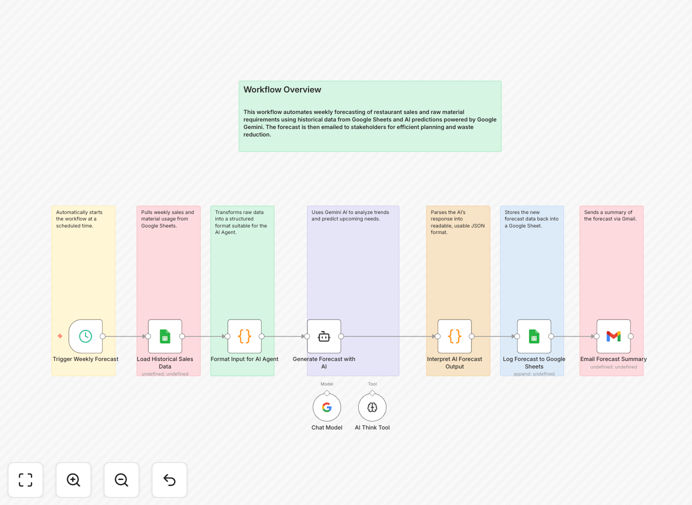
Restaurant inventory forecasting workflow diagram

What This Workflow Does

This automated system solves one of the biggest challenges in restaurant management - accurately predicting weekly sales and translating that into precise inventory requirements. Manual forecasting often leads to either food waste from over-ordering or last-minute emergency purchases from under-ordering.

The workflow combines your historical sales data from Google Sheets with Gemini AI's predictive capabilities to generate weekly forecasts. It analyzes patterns, seasonality, and trends to recommend optimal inventory levels for each ingredient, automatically updating your purchasing spreadsheet.

How It Works

1. Data Extraction

The workflow pulls your restaurant's historical sales data from specified Google Sheets, including item-level sales by day, special events, and past inventory levels.

2. AI Analysis

Gemini AI processes the historical data to identify patterns, seasonality, and correlations. It considers factors like day of week, holidays, and even weather patterns if available.

3. Demand Forecasting

The AI generates predictions for the upcoming week's sales by menu item, with confidence percentages for each prediction. This accounts for both regular patterns and any detected anomalies.

4. Inventory Calculation

The system converts predicted sales into raw material requirements based on your recipe costs sheets, accounting for current inventory levels and supplier lead times.

5. Output Generation

Final purchase recommendations are written back to your Google Sheets, formatted for easy review and with flags for any unusually high or low predictions that may need manual verification.

Who This Is For

This automation is ideal for restaurant owners, kitchen managers, and inventory controllers at:

  • Full-service restaurants with complex menus
  • Cafe chains managing multiple locations
  • Cloud kitchens optimizing ingredient procurement
  • Seasonal restaurants needing to adapt to demand fluctuations
  • Operations looking to reduce food costs through better inventory control

What You'll Need

  1. An n8n instance (cloud or self-hosted)
  2. Google Sheets with at least 3 months of historical sales data
  3. Recipe cost sheets showing ingredient quantities per menu item
  4. Current inventory records
  5. Google Cloud account for Gemini AI API access

Quick Setup Guide

  1. Download the JSON template file
  2. Import into your n8n instance
  3. Connect your Google Sheets credentials
  4. Configure the sheet IDs for historical data and output
  5. Set up Gemini AI API connection
  6. Map your menu items to ingredient requirements
  7. Test with a small date range before full implementation

Key Benefits

Reduce food waste by 20-35%: Precise AI predictions mean you order exactly what you'll need, dramatically cutting spoilage and overstocking.

Save 6-10 hours weekly on inventory planning: Automating the forecasting process eliminates manual spreadsheet work and guesswork.

Improve ingredient availability to 95%+: Fewer stockouts mean smoother kitchen operations and better customer experiences.

Lower food costs by 15-25%: Better inventory control directly impacts your bottom line through reduced waste and optimized purchasing.

Scale forecasting across multiple locations: The system can analyze and predict for all your restaurants simultaneously with consistent methodology.

Frequently Asked Questions

Common questions about restaurant inventory automation and AI forecasting

AI transforms restaurant inventory management by analyzing historical sales patterns, seasonal trends, and even weather forecasts to predict future demand. Gemini AI processes your sales data to recommend optimal inventory levels, reducing both waste and stockouts. For example, it can anticipate increased burger sales on weekends or higher soup demand during cold weather, adjusting purchasing recommendations accordingly.

The system continuously learns from your actual sales versus predictions, becoming more accurate over time. Unlike static spreadsheet formulas, AI can detect subtle patterns humans might miss and adjust for unusual events automatically.

  • Detects sales patterns across multiple time dimensions
  • Adjusts for seasonality and special events
  • Self-improves as more data becomes available

The system requires at least 3-6 months of historical sales data by menu item, preferably organized by day of week and special events. It also needs your current inventory levels and supplier lead times. The more detailed your sales records (including weather data or local events if available), the more accurate the AI predictions become. Many restaurants export this data from their POS systems into Google Sheets automatically.

For best results, include data tags for holidays, promotions, and any operational changes that affected sales. The AI can then learn how these factors impact demand. A pizzeria might tag days when local sports games occurred, as these often increase delivery orders by 20-30%.

  • Minimum 3 months historical sales data
  • Current inventory counts
  • Recipe ingredient breakdowns

AI forecasts typically achieve 85-92% accuracy compared to 60-75% for manual methods. The AI considers dozens of variables simultaneously that humans often miss, like subtle weekly patterns or the impact of holidays. One pizzeria reduced food waste by 34% while maintaining 98% ingredient availability after implementing AI forecasting. The system continuously improves as it processes more data.

Accuracy depends on data quality and consistency, but even with imperfect historical records, AI outperforms manual methods by detecting patterns in the noise. The system also provides confidence scores for each prediction, helping managers identify which items may need manual review.

  • 25-35% more accurate than manual methods
  • Provides confidence scores for each prediction
  • Improves over time with more data

Yes, the AI model can be trained to recognize seasonal menu patterns and special events. You can tag historical sales data with event types (like Valentine's Day or local festivals) to improve future predictions. The system also learns from your actual vs predicted sales each week, automatically adjusting its algorithms. Some restaurants even integrate local event calendars for additional forecasting inputs.

For seasonal menus, the system can correlate ingredient usage patterns from previous years. A farm-to-table restaurant using this approach reduced spring produce waste by 28% while ensuring all seasonal specials remained available.

  • Learns from tagged historical events
  • Can integrate with external calendars
  • Adjusts for menu changes automatically

Restaurants save 6-10 hours weekly by automating inventory forecasting. Managers no longer need to manually review spreadsheets and make guesses about future demand. The system generates purchase recommendations automatically, which can be reviewed and adjusted in minutes rather than hours. One cafe chain reduced their weekly inventory planning from 8 hours to just 30 minutes of verification.

The time savings multiply for multi-location operations, as the system can analyze all locations simultaneously with consistent methodology. A 5-location burger franchise reported saving 35 hours weekly across their management team after implementation.

  • Eliminates manual spreadsheet work
  • Scales effortlessly across locations
  • Reduces weekly planning to verification only

The AI system reduces food costs through precise ordering that minimizes both waste and emergency purchases. By predicting demand within 5-10% accuracy, restaurants typically see a 15-25% reduction in spoiled inventory. It also helps negotiate better supplier pricing by providing accurate advance orders. A seafood restaurant using similar automation cut their food costs from 38% to 31% of revenue within six months.

Additional savings come from reduced labor hours spent on inventory management and emergency ordering. The system can also suggest optimal ordering quantities to qualify for bulk discounts without over-purchasing perishable items.

  • Direct reduction in food waste
  • Enables better supplier negotiations
  • Optimizes order quantities for discounts

Absolutely. GrowwStacks specializes in custom restaurant automation solutions tailored to your specific POS system, menu, and operations. We can build integrations with your existing tools, create specialized forecasting models for unique menu items, and even automate supplier ordering. Our team works closely with restaurant owners to identify the highest-impact automations for their business model and budget.

We've developed custom systems for everything from food trucks to hotel restaurants, each designed to solve the particular challenges of that operation. The process begins with a free consultation to understand your workflow pain points and identify where automation can deliver the most value.

  • Tailored to your POS and suppliers
  • Specialized forecasting for unique menus
  • End-to-end implementation support

Need a Custom Restaurant Automation?

This free template is a starting point. Our team builds fully tailored automation systems for your specific needs.