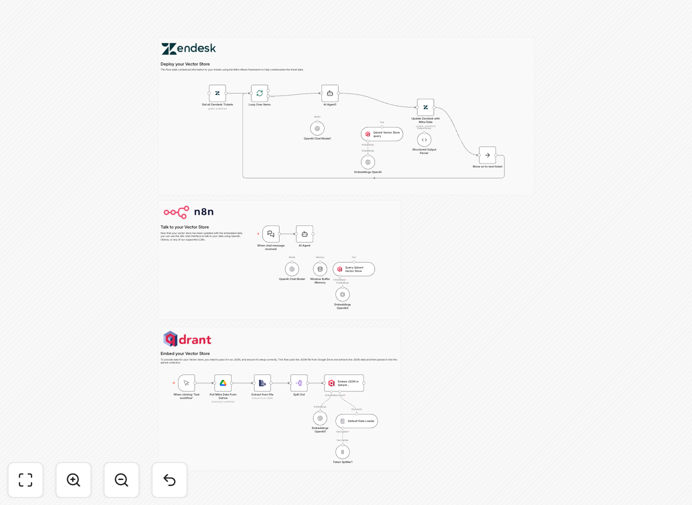
What This Workflow Does
Security teams face overwhelming volumes of SIEM alerts daily, often lacking context about potential threats. This n8n workflow automatically enriches raw security alerts with MITRE ATT&CK framework data and Qdrant vector search results, then creates properly prioritized Zendesk tickets with all relevant threat intelligence.
The automation reduces mean time to respond (MTTR) by providing SOC analysts with pre-processed alerts that include attack patterns, techniques, and recommended responses from the MITRE knowledge base. Qdrant's vector search adds similarity matching against known threat patterns.
How It Works
1. Alert Ingestion
The workflow triggers when your SIEM system (like Splunk, Sentinel, or Wazuh) detects a security event. n8n receives the raw alert data including event details, timestamps, and affected systems.
2. MITRE ATT&CK Enrichment
The workflow queries the MITRE ATT&CK framework API to identify relevant attack techniques based on alert signatures. This adds contextual threat intelligence including tactics, techniques, and procedures (TTPs).
3. Qdrant Vector Search
Alert details are converted to vector embeddings and searched against your Qdrant database of known threat patterns. This finds similar historical incidents and their resolutions.
4. Ticket Creation
All enriched data is compiled into a structured Zendesk ticket with proper priority based on threat severity. The ticket includes MITRE references, similar threats found in Qdrant, and recommended actions.
Who This Is For
This workflow is ideal for cybersecurity teams and SOC analysts who need to:
- Reduce alert fatigue with automated enrichment
- Accelerate incident response with contextual data
- Standardize threat classification using MITRE ATT&CK
- Improve ticket quality for support teams
- Document threat patterns in Qdrant for future reference
What You'll Need
- An n8n instance (cloud or self-hosted)
- SIEM system with webhook/API capabilities
- MITRE ATT&CK API access
- Qdrant vector database instance
- Zendesk account with API access
Quick Setup Guide
- Download the JSON template file
- Import into your n8n instance
- Configure your SIEM webhook trigger
- Add MITRE ATT&CK API credentials
- Connect your Qdrant database
- Set up Zendesk API authentication
- Test with sample alert data
Key Benefits
Reduce MTTR by 60-80%: Analysts get pre-enriched alerts with all necessary context, eliminating manual lookup steps.
Improve threat classification: Standardized MITRE ATT&CK mapping ensures consistent threat categorization across your organization.
Build institutional knowledge: Qdrant stores resolved threat patterns for future similarity matching and trend analysis.
Reduce false positives: Vector similarity scoring helps distinguish real threats from noise.
Audit-ready documentation: Every ticket includes authoritative MITRE references for compliance reporting.
Pro tip: Train your Qdrant database with historical resolved incidents to improve future alert matching accuracy.