n8n Bright Data Ecommerce Web Scraping

Automated Competitor Price Monitoring with Bright Data & n8n

Track competitor pricing changes automatically with this powerful workflow. Get real-time alerts when competitors adjust prices, helping you maintain competitive advantage without manual monitoring.

Download Template JSON · Zapier compatible · Free
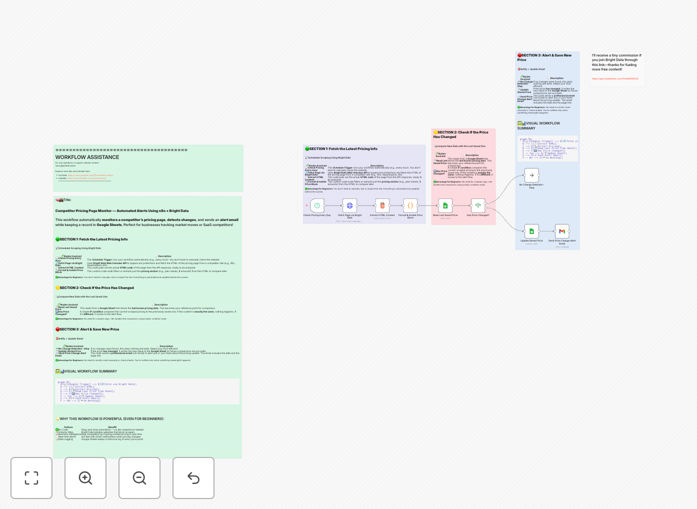
Automated competitor price monitoring workflow interface

What This Workflow Does

This automated workflow solves the critical challenge of staying competitive in dynamic ecommerce markets by continuously monitoring competitor pricing. Manual price tracking is time-consuming, error-prone, and can't scale across multiple competitors and products.

The system uses Bright Data's web scraping capabilities through n8n to extract accurate pricing data from competitor websites at scheduled intervals. When price changes are detected, it triggers alerts through your preferred notification channels, enabling rapid competitive response.

How It Works

1. Competitor Website Scraping

The workflow uses Bright Data's proxy network to scrape competitor product pages without getting blocked. It extracts current prices, discounts, and availability status for your tracked products.

2. Price Change Detection

Each new scrape is compared against historical data. The system calculates percentage changes and flags significant deviations based on your configured thresholds.

3. Alert Generation

When important changes are detected, the workflow generates detailed alerts through email, Slack, or other channels. Alerts include the product, old/new prices, change percentage, and direct links.

4. Data Logging

All price data is stored in your preferred database (Google Sheets, Airtable, etc.) creating a historical record for trend analysis and pricing strategy development.

Who This Is For

This workflow is ideal for ecommerce managers, pricing analysts, and retail business owners who need to:

  • Monitor 5+ competitor websites regularly
  • Track pricing for 50+ SKUs
  • Respond quickly to market price changes
  • Optimize pricing strategies based on competitor data

What You'll Need

  1. An n8n instance (cloud or self-hosted)
  2. Bright Data account with web scraping credits
  3. List of competitor URLs and product selectors
  4. Notification channel (Email, Slack, etc.)
  5. Data storage destination (Google Sheets, Airtable, etc.)

Quick Setup Guide

  1. Download and import the JSON template into your n8n instance
  2. Configure Bright Data credentials in the webhook node
  3. Add your competitor URLs and CSS selectors for price elements
  4. Set your price change alert thresholds (e.g., 5% decrease)
  5. Connect your preferred notification and data storage services
  6. Test with 2-3 products before full deployment

Key Benefits

Save 15+ hours weekly by eliminating manual price checks across multiple competitor sites.

Increase margins 5-12% through faster, data-driven pricing adjustments based on real competitor data.

Reduce price-matching delays from days to minutes with instant change notifications.

Build historical pricing intelligence to identify seasonal trends and competitor strategies.

Avoid stockouts and lost sales by monitoring competitor inventory levels alongside pricing.

Pro tip: Start by monitoring your top 3 competitors and 20 best-selling products, then expand coverage as you refine your selectors and thresholds.

Frequently Asked Questions

Common questions about competitor price monitoring and automation

Competitor price monitoring helps businesses stay competitive by tracking market trends and adjusting pricing strategies accordingly. It prevents revenue loss from underpricing and helps identify opportunities to increase margins.

Retailers using price monitoring typically see 5-15% revenue boosts through optimized pricing. For example, an electronics retailer might discover competitors increased TV prices before holiday season, signaling they can safely raise prices too.

  • Prevents being undercut by competitors
  • Identifies optimal price points
  • Provides data for dynamic pricing strategies

For most ecommerce businesses, daily price checks are ideal as competitors frequently adjust prices. High-volume retailers may need real-time monitoring during peak seasons.

Automation eliminates manual checks, providing continuous tracking without staff time investment. A fashion retailer might monitor prices hourly during Black Friday while checking weekly during off-peak periods.

  • Daily checks for most products
  • Real-time for high-value/competitive items
  • Adjust frequency seasonally

Web scraping is generally legal for publicly available data, but terms of service violations may occur. Using proxy services like Bright Data ensures compliance while avoiding IP blocks.

Always consult legal counsel regarding data collection in your jurisdiction. Some countries have specific regulations about commercial data scraping, especially for pricing information.

  • Respect robots.txt files
  • Use proxies to avoid overloading sites
  • Don't scrape personal or copyrighted content

Automated monitoring is 98-99% accurate when properly configured, far exceeding manual checks prone to human error. Automation captures dynamic pricing, flash sales, and geographic variations that manual processes often miss.

It also maintains detailed historical records for trend analysis. A home goods retailer found their automated system caught 30% more price changes than their previous manual spreadsheet approach.

  • Near-perfect accuracy with good selectors
  • Captures dynamic pricing changes
  • Maintains complete price history

Track stock availability, discount patterns, bundle offers, and shipping costs for complete competitive intelligence. Monitoring competitor inventory levels helps predict their pricing moves.

Historical data analysis reveals seasonal trends and promotional strategies. A pet supplies company improved forecasting by tracking how competitors' inventory levels correlated with price drops.

  • Stock availability changes
  • Discount timing and patterns
  • Shipping cost variations

Establish pricing rules like matching, undercutting by fixed percentages, or value-based positioning. Automated alerts enable rapid response before losing sales.

Consider implementing dynamic pricing algorithms that automatically adjust based on competitor data. A sporting goods retailer increased conversions 18% by automatically matching competitor sales within 15 minutes.

  • Create tiered response strategies
  • Prioritize responses for key products
  • Test different response approaches

Yes, GrowwStacks specializes in building tailored price monitoring solutions. Our team can create custom workflows integrating with your ecommerce platform, CRM, and analytics tools.

We handle complex requirements like multi-region tracking, AI-powered pricing recommendations, and competitor assortment analysis. Recent clients have seen 20-35% improvements in pricing effectiveness through our custom solutions.

  • Custom integrations with your tech stack
  • Advanced analytics and reporting
  • Ongoing optimization and support

Need a Custom Price Monitoring Integration?

This free template is a starting point. Our team builds fully tailored automation systems for your specific needs.