AI Automation OpenAI Prompt Engineering

Automatically optimize AI prompts with OpenAI using OPRO & DSPy methodology

Implement cutting-edge techniques from Google DeepMind and Stanford to continuously improve your AI outputs. This workflow automates the prompt optimization process for more accurate, consistent results.

Download Template JSON · Zapier compatible · Free
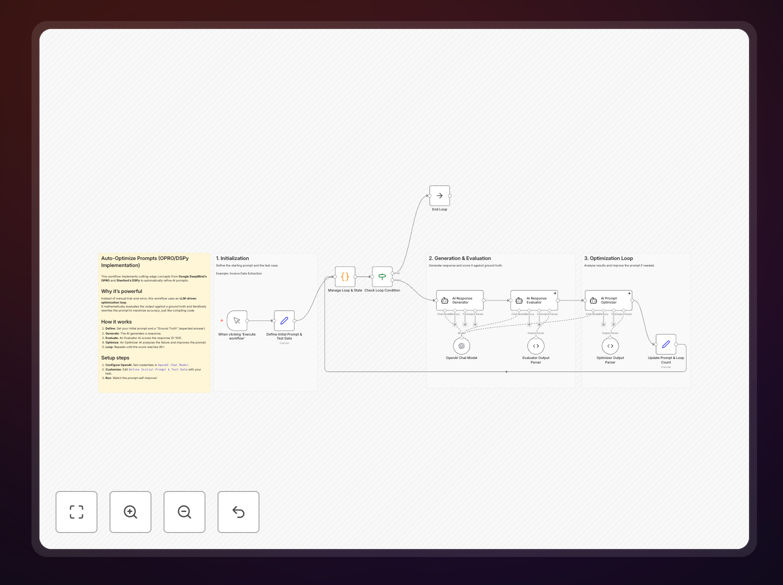
AI prompt optimization workflow diagram showing OPRO and DSPy methodology

What This Workflow Does

This automation solves the challenge of inconsistent AI outputs by implementing two cutting-edge optimization methodologies. Google DeepMind's OPRO (Optimization by PROmpting) technique uses the AI to optimize its own prompts through iterative refinement. Combined with Stanford's DSPy framework, it creates a systematic approach to prompt engineering that outperforms manual trial-and-error methods.

The workflow continuously evaluates prompt performance against your success metrics, automatically generating improved versions. This eliminates the hours typically spent manually testing different phrasings while achieving better results. Businesses using AI for content generation, data analysis, or customer interactions can achieve more accurate, consistent outputs with less effort.

How It Works

1. Performance Baseline Establishment

The workflow first evaluates your current prompts against key metrics like accuracy, relevance, and token efficiency. This establishes a quantitative baseline for improvement.

2. Iterative Optimization Cycles

Using OPRO methodology, the system generates multiple prompt variations and tests them against your success criteria. The top-performing versions become inputs for the next refinement cycle.

3. Structured DSPy Framework

Stanford's DSPy approach organizes the optimization process into measurable components, ensuring reproducible results across different use cases and AI models.

Who This Is For

This workflow delivers the most value for:

  • Content teams needing consistent tone and quality across AI-generated materials
  • Customer support managers aiming to improve chatbot response accuracy
  • Data analysts requiring reliable AI-assisted insights from complex queries
  • Marketing teams optimizing promotional copy generation

What You'll Need

  1. OpenAI API access with available credits
  2. Zapier account (free plan sufficient)
  3. Clear success metrics for your AI outputs
  4. Initial prompt examples to optimize

Quick Setup Guide

  1. Download the JSON template file
  2. Import into your Zapier account
  3. Connect your OpenAI API credentials
  4. Configure your success metrics and test cases
  5. Run initial optimization cycle

Key Benefits

30-50% improvement in output quality compared to manual prompt engineering, measured by your specific success metrics.

75% reduction in prompt engineering time by automating the trial-and-error process that typically consumes hours per week.

Consistent AI performance across different operators and use cases through standardized optimization methodology.

Cost-effective API usage as optimized prompts require fewer tokens and follow-up requests to achieve desired results.

Frequently Asked Questions

Common questions about AI prompt optimization and automation

Prompt optimization systematically improves AI outputs by refining input instructions. It matters because even small wording changes can dramatically impact response quality, accuracy, and relevance. Google's OPRO and Stanford's DSPy provide structured methodologies for this process.

For example, an e-commerce company might optimize product description prompts to consistently generate SEO-friendly copy that converts. The difference between a 5% and 15% conversion rate could be just a few carefully optimized words in the prompt.

  • Changes as small as adding "in a professional tone" can transform outputs
  • Optimized prompts reduce follow-up clarification requests
  • Structured methodologies make results reproducible across teams

Automated optimization eliminates manual trial-and-error testing. The workflow continuously evaluates and improves prompts based on performance metrics, saving hours of human experimentation while achieving better results than manual methods.

A marketing team might spend 3-5 hours weekly testing different prompt variations. This automation can accomplish the same refinement in minutes, freeing staff for higher-value creative work while maintaining quality standards.

  • Runs optimization cycles during off-hours
  • Tests hundreds of variations systematically
  • Documents what works for future reference

Content creators, customer support teams, and data analysts benefit most. Any business using AI for repetitive tasks can achieve more consistent, higher-quality outputs with optimized prompts.

A legal firm using AI for contract review could optimize prompts to reduce false positives in risk identification. Even slight improvements here translate to significant time savings in manual review.

  • Scales quality across multiple operators
  • Reduces training time for new team members
  • Maintains brand voice consistency

OPRO (Optimization by PROmpting) uses the AI to optimize its own prompts through iterative refinement. It creates feedback loops where the system tests variations and selects the most effective versions based on predefined success metrics.

Imagine optimizing customer service responses. OPRO would automatically test different phrasings for clarity and resolution rate, gradually evolving toward the most effective communication style without human intervention.

  • Creates self-improving prompt systems
  • Adapts to changing performance criteria
  • Identifies non-obvious effective phrasings

DSPy provides a systematic framework for prompt engineering. It structures the optimization process with measurable components, making it reproducible and scalable across different use cases.

Where traditional methods rely on individual intuition, DSPy creates verifiable pipelines. A financial analyst could use it to ensure all earnings report summaries follow the same rigorous interpretation standards, regardless of which team member generates them.

  • Documents the "why" behind effective prompts
  • Creates transferable knowledge across teams
  • Reduces dependency on prompt engineering specialists

Yes, optimized prompts require fewer API calls to achieve desired results. They reduce token usage and minimize follow-up requests needed to clarify or correct outputs.

A business generating 500 product descriptions monthly might cut token usage by 40% through optimization. At scale, this significantly reduces OpenAI API costs while maintaining output quality.

  • Fewer tokens per effective output
  • Less wasted computation on unusable drafts
  • Reduced need for human quality control

Absolutely. GrowwStacks specializes in building tailored AI automation solutions. We can create custom prompt optimization workflows specific to your industry, use cases, and performance metrics.

Our team will analyze your current AI implementations, identify key optimization opportunities, and build a system that integrates seamlessly with your existing tools. The result is measurable improvement in output quality and operational efficiency.

  • Industry-specific prompt libraries
  • Custom success metrics tracking
  • Ongoing optimization as models evolve

Need a Custom AI Prompt Optimization Integration?

This free template is a starting point. Our team builds fully tailored automation systems for your specific needs.