AI Automation Engineering OpenAI Multi-Agent n8n

Create a Complete AI Engineering Department with OpenAI O3

Automate your technical operations with an AI-powered engineering team. This n8n workflow uses a CTO agent and specialized AI engineers for software development, DevOps, security, QA, and full-stack projects.

Download Template JSON · n8n compatible · Free
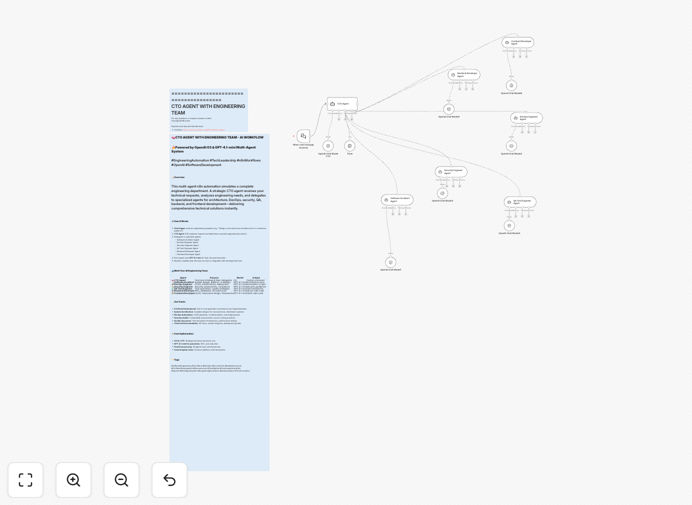
AI Engineering Department workflow diagram showing CTO agent and specialized engineering agents

What This Workflow Does

This automation creates a virtual engineering department powered by AI agents. It solves the problem of high technical labor costs, slow development cycles, and the difficulty of hiring specialized engineering talent. Instead of building a human team, you deploy an AI CTO that orchestrates six specialized agents: Software Architect, DevOps Engineer, Security Engineer, QA Test Engineer, Backend Developer, and Frontend Developer.

When you submit a technical request—like designing a microservices architecture or creating a secure deployment pipeline—the CTO agent analyzes it and delegates tasks to the appropriate specialists. Each agent produces deliverables: architectural diagrams, infrastructure scripts, security assessments, test suites, API code, and UI designs. This gives you a complete engineering output without the overhead of a full team.

The workflow is particularly valuable for startups, scale-ups, and businesses with fluctuating technical needs. It provides consistent, high-quality technical work at a fraction of the cost, while allowing your human team to focus on strategic innovation and business logic.

How It Works

Step 1: Request Analysis by CTO Agent

You send a technical request via chat or webhook. The CTO agent, powered by OpenAI O3 for complex decision-making, analyzes the request's scope, requirements, and priorities. It determines which specialized agents are needed and breaks the project into delegated tasks.

Step 2: Parallel Agent Execution

The CTO triggers the relevant specialist agents simultaneously. Each agent uses GPT-4.1-mini for efficient, cost-optimized execution. The Software Architect creates system designs, the DevOps Engineer generates CI/CD pipelines, the Security Engineer performs vulnerability scans, the QA Engineer builds test automation, the Backend Developer writes server-side code, and the Frontend Developer produces UI components.

Step 3: Output Consolidation and Delivery

All agent outputs are consolidated into a comprehensive technical deliverable. This includes documentation, code snippets, configuration files, security reports, and deployment instructions. The workflow can integrate with your development platforms (GitHub, Jira) to push these outputs directly into your toolchain.

Who This Is For

This automation is ideal for technology startups needing to prototype quickly without a large engineering budget. It's perfect for scale-ups expanding their tech stack who need consistent architectural guidance and security compliance. IT departments managing multiple projects can use it to automate routine technical work. SaaS companies building new features can leverage it for rapid backend and frontend development.

Consulting firms delivering technical solutions to clients can deploy this workflow to standardize their output quality and reduce delivery time. Even established enterprises with internal engineering teams can use it to augment human capacity, handling overflow work and specialized tasks that their team lacks expertise in.

Pro tip: Start with smaller, well-defined technical requests to calibrate the agents' outputs. Provide clear acceptance criteria in your initial prompt to guide the AI toward your desired quality standards.

What You'll Need

  1. A running n8n instance (cloud or self-hosted) with LangChain nodes installed.
  2. OpenAI API access with credits for both O3 (CTO) and GPT-4.1-mini (specialists) models.
  3. Webhook capability to receive technical requests via chat or API.
  4. Optional integrations with your development tools (GitHub, GitLab, Jira, Slack) for seamless output delivery.

Quick Setup Guide

  1. Download the template JSON file and import it into your n8n workspace.
  2. Configure OpenAI API credentials in all chat model nodes—set the CTO agent to use O3 and specialists to use GPT-4.1-mini.
  3. Deploy the webhook node to receive incoming technical requests.
  4. Test with a simple request like "Design a REST API for a user management system."
  5. Review the outputs and adjust agent prompts if needed to match your quality expectations.
  6. Connect optional integration nodes to your development platforms for automated delivery.

Key Benefits

Reduce engineering costs by 70–90%. You pay for API calls instead of salaries, benefits, and overhead. The cost-optimized model selection (O3 for strategy, GPT-4.1-mini for execution) maximizes value per dollar.

Speed up development cycles from weeks to hours. Parallel agent execution means architectural design, DevOps scripting, security auditing, and code generation happen simultaneously, compressing project timelines dramatically.

Access specialized expertise without hiring niche engineers. The security agent knows compliance frameworks, the DevOps agent understands cloud infrastructure, the QA agent builds test suites—all without adding expensive specialists to your payroll.

Ensure consistency across technical projects. AI agents follow the same patterns and standards every time, eliminating variability and human error that can creep into manual engineering work.

Scale technical capacity instantly with fluctuating demand. When project load increases, you simply send more requests through the workflow. No hiring delays, no team ramp-up time, no capacity planning headaches.

Frequently Asked Questions

Common questions about AI engineering automation and integration

An AI-powered engineering department uses multiple AI agents to simulate a complete technical team. A CTO agent analyzes incoming requests and delegates tasks to specialized agents for architecture, DevOps, security, QA, backend, and frontend work. This automation allows businesses to handle complex technical projects without hiring a full human team, dramatically reducing costs and speeding up development cycles.

For example, a startup needing a microservices architecture can submit a request. The CTO agent identifies the need for architectural design, infrastructure scripts, security compliance, and API code. It triggers the relevant specialists simultaneously, producing a complete technical blueprint in hours instead of weeks.

AI agents automate repetitive tasks in software development and DevOps, such as code reviews, infrastructure provisioning, security scanning, and test automation. They can generate deployment scripts, create architectural diagrams, and provide compliance frameworks. This reduces human error, ensures consistency across projects, and allows your existing team to focus on strategic innovation rather than routine implementation work.

In practice, your DevOps engineer agent can automatically produce Kubernetes configurations, Terraform scripts, and monitoring dashboards based on your requirements. Your software architect agent can generate system diagrams that adhere to best practices, saving your human architects hours of manual drawing and documentation.

Using AI agents for technical tasks can reduce engineering costs by 70–90%. You pay for API calls instead of salaries, benefits, and overhead. Specialized agents handle niche expertise without requiring expensive specialists on staff. The CTO agent makes strategic decisions using OpenAI O3, while cheaper GPT-4.1-mini agents execute tasks, optimizing cost per operation. This model is ideal for startups, scale-ups, and businesses with fluctuating technical needs.

Consider a security engineer specialist: hiring a human with compliance expertise costs $150,000+ annually. The AI security agent performs vulnerability assessments and generates compliance reports for a few dollars per request. You get the expertise without the permanent financial commitment.

Yes, AI security agents can perform vulnerability assessments, review code for security flaws, generate compliance documentation, and recommend secure coding practices. They can scan infrastructure configurations against industry standards and produce audit-ready reports. While they don't replace human security experts for critical decisions, they automate the bulk of routine security work, freeing your team to focus on threat response and strategic security planning.

For GDPR compliance, the security agent can review your data handling code, identify potential breaches, and generate privacy impact assessments. For cloud security, it can audit your AWS configurations against CIS benchmarks and produce remediation recommendations.

AI engineering agents integrate via APIs with platforms like GitHub, GitLab, Jira, Slack, and cloud providers. They can pull code repositories, create issues, generate CI/CD pipelines, and post updates to communication channels. Using n8n's workflow automation, you connect these agents to your existing toolchain, creating a seamless automated engineering pipeline that works alongside your human team without disrupting current processes.

For example, after the backend developer agent generates API code, it can automatically commit it to a GitHub repository and create a Jira ticket for your human team to review. The DevOps agent can push infrastructure scripts directly to your AWS CloudFormation or Azure Resource Manager.

AI engineering automation excels at prototyping, documentation generation, test automation, infrastructure setup, security scanning, and routine code maintenance. It's ideal for startups building MVP applications, companies scaling their tech stack, teams managing multiple microservices, and businesses requiring consistent technical outputs across projects. It's less suited for highly creative, novel research or deeply contextual business logic that requires extensive human intuition.

Use it for generating standard REST APIs, creating Docker configurations, writing unit test suites, producing architectural diagrams for common patterns, and auditing existing code for security vulnerabilities. Avoid using it for groundbreaking algorithm development or business logic that depends on deep domain knowledge not available in training data.

Implement a human-in-the-loop review system where AI outputs are validated by your engineers before deployment. Use the QA test engineer agent to create automated test suites for AI-generated code. Establish clear acceptance criteria and templates that guide agent outputs. Regularly audit agent performance and adjust prompts based on results. Combining AI automation with human oversight creates a high-quality, efficient hybrid engineering model.

Start with a review gate: all AI-generated code must pass automated tests and a brief human review before merging. Provide detailed prompt templates that include your coding standards, architectural principles, and security requirements. Track accuracy metrics over time and refine your approach.

Yes, GrowwStacks specializes in building custom AI automation systems tailored to your specific technical requirements. We can design multi-agent workflows that integrate with your unique toolset, align with your development processes, and address your exact cost and efficiency goals. Our team configures agents for your industry's compliance needs, optimizes model selection for accuracy and cost, and provides ongoing support to ensure your automated engineering department delivers maximum value.

We'll work with you to identify which technical tasks are most repetitive and costly, design agent prompts that match your quality standards, integrate the automation with your existing platforms, and establish monitoring to ensure continuous improvement. This turns AI engineering from a generic template into a strategic asset for your business.

Need a Custom AI Engineering Automation?

This free template is a starting point. Our team builds fully tailored automation systems for your specific business needs.