What This Workflow Does
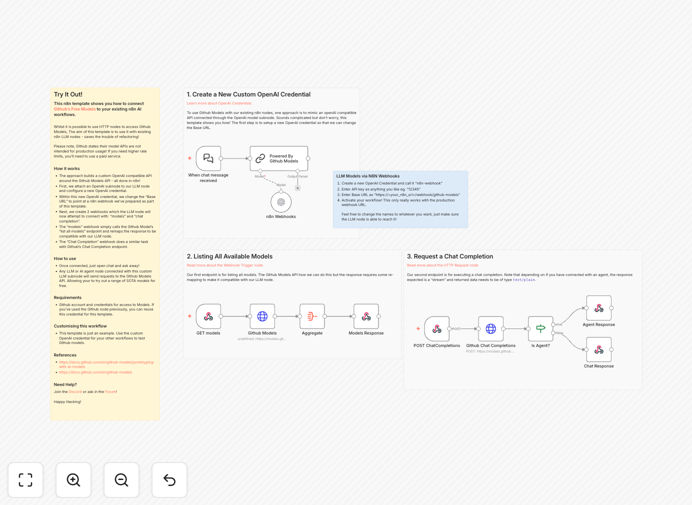
This n8n template solves the challenge of accessing powerful AI capabilities without the high costs associated with commercial AI APIs. It creates an OpenAI-compatible API endpoint that connects to GitHub's free AI models, allowing you to use familiar OpenAI-style requests while leveraging GitHub's cost-free infrastructure.
The workflow acts as a bridge between your existing AI-powered automations and GitHub's models, handling the translation of requests and responses. This means you can continue using the same code and workflows you've built for OpenAI, but with zero API costs. It's particularly valuable for businesses running multiple AI automations where costs can quickly escalate.
How It Works
1. API Request Handling
The workflow receives API requests formatted for OpenAI's API and extracts the essential parameters like prompt, temperature, and max tokens. It validates these inputs and prepares them for GitHub's model API.
2. GitHub Model Integration
The processed request is sent to GitHub's AI models using their API endpoint. The workflow handles authentication and proper formatting of the request to match GitHub's expected input structure.
3. Response Transformation
GitHub's response is then transformed back into the OpenAI-compatible format that your applications expect. This includes restructuring the JSON output, adding expected metadata, and ensuring consistent field names.
4. Result Delivery
The final transformed response is returned to the original caller in the exact same format as an OpenAI API response would be, making the switch transparent to your existing applications.
Who This Is For
This template is ideal for developers, startups, and businesses that want to:
- Reduce costs on AI API usage without rewriting existing integrations
- Prototype AI features before committing to paid services
- Run background AI tasks where premium model capabilities aren't required
- Maintain OpenAI compatibility while exploring alternative AI providers
What You'll Need
- An n8n instance (cloud or self-hosted)
- GitHub account with access to their AI models
- Basic understanding of API concepts
- Existing OpenAI-powered workflows (optional for migration)
Quick Setup Guide
- Download and import the JSON template into your n8n instance
- Configure the GitHub credentials in the HTTP Request nodes
- Deploy the workflow as a webhook or internal API endpoint
- Update your existing OpenAI API calls to point to this new endpoint
- Test with sample prompts to verify proper transformation
Key Benefits
Cost Elimination: Completely removes API costs for AI model usage, saving hundreds or thousands per month depending on usage volume.
Seamless Migration: Works as a drop-in replacement for OpenAI API endpoints, requiring no changes to your existing application code or workflows.
Flexible Deployment: Can be hosted internally or exposed as a public endpoint, giving you control over access and scaling.
Future-Proofing: The adapter pattern makes it easy to switch between different AI providers as your needs evolve.
Pro tip: Use this workflow alongside OpenAI as a fallback mechanism - route non-critical requests to GitHub's free models while keeping premium capabilities for mission-critical tasks.