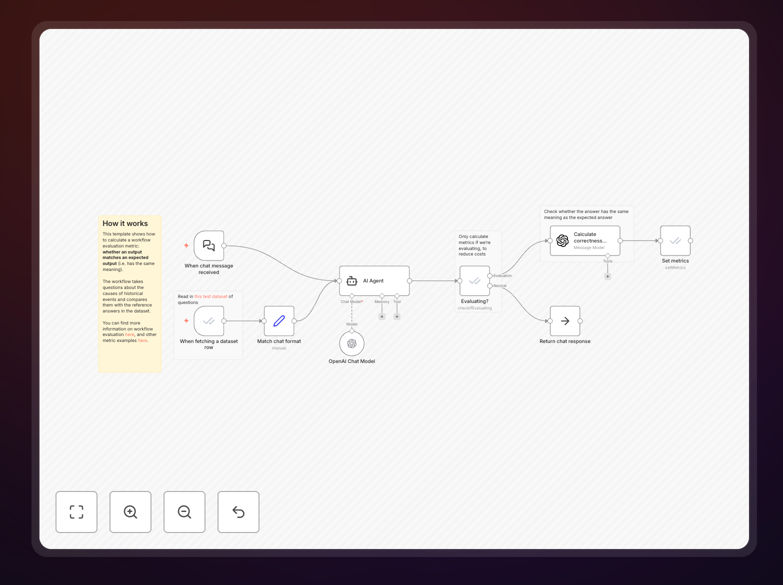
What This Workflow Does
This template automates quality assessment for AI-generated content using measurable correctness criteria. It solves the critical challenge of validating automated outputs before they impact business operations - preventing inaccurate data, misleading information, or inconsistent results from reaching customers or decision-makers.
The workflow evaluates three dimensions of correctness: factual accuracy against reference sources, logical consistency within the output, and contextual appropriateness for the intended use case. Scores are generated for each dimension with configurable thresholds that trigger alerts or automatic corrections.
How It Works
1. Input Processing
The workflow receives AI-generated content through Zapier triggers or direct API calls, normalizing the input format for consistent evaluation.
2. Reference Comparison
Key claims are extracted and cross-checked against designated knowledge bases, databases, or approved content repositories to verify factual accuracy.
3. Logical Analysis
AI judges the internal consistency of arguments, data relationships, and narrative flow to identify contradictions or non-sequiturs.
4. Scoring & Routing
Results are compiled into a composite correctness score that determines automatic approval, revision requests, or human review requirements.
Who This Is For
This template benefits any business using AI for content-sensitive applications:
- Marketing teams automating blog posts or product descriptions
- Customer support departments deploying AI chatbots
- Research organizations processing data summaries
- Legal/Compliance teams reviewing automated document generation
Pro tip: Combine this correctness evaluation with style and sentiment metrics for comprehensive AI quality control.
What You'll Need
- Active n8n instance (cloud or self-hosted)
- Zapier account for trigger integration
- Reference data sources (knowledge bases, style guides, product databases)
- AI service API keys (OpenAI, Claude, etc.)
Quick Setup Guide
- Import the JSON template into your n8n dashboard
- Configure your AI service credentials in the workflow settings
- Connect reference data sources to the comparison nodes
- Set score thresholds for automatic actions
- Test with sample outputs to calibrate evaluation criteria
Key Benefits
Risk reduction by catching inaccurate AI outputs before publication or decision-making.
Quality consistency through standardized evaluation metrics applied across all automated content.
Process efficiency by automating what would otherwise require manual review.
Continuous improvement with performance tracking that informs AI model refinements.