AI Automation Content Evaluation Quality Assurance n8n Free Template

AI Summarization Evaluation Metric

Automatically measure the accuracy and faithfulness of AI-generated summaries against original transcripts

Download Template JSON · n8n compatible · Free
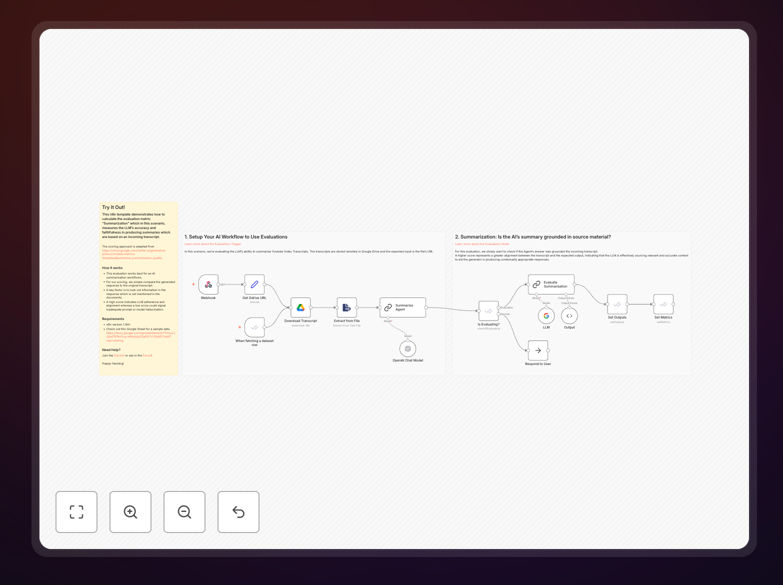
AI summarization evaluation workflow showing quality scoring interface

What This Workflow Does

This n8n automation template solves a critical problem for businesses using AI to summarize content: how do you know if the AI is accurate? When you use AI to summarize meeting transcripts, YouTube videos, research papers, or customer conversations, you need confidence that the summary faithfully represents the original content without hallucinations or omissions.

The workflow automatically evaluates AI-generated summaries by comparing them against source transcripts. It calculates a quality score based on factual accuracy, completeness, and faithfulness to the original material. This gives you quantitative metrics to assess your AI's performance, identify when prompts need improvement, and ensure reliable automated summarization at scale.

Businesses using this template can automate quality control for AI content production, reducing manual review time by 60-80% while preventing costly errors from incorrect summaries. It's particularly valuable for content agencies, research teams, customer support departments, and any organization processing large volumes of information through AI.

How It Works

The evaluation follows an adapted version of Google's Vertex AI summarization quality metrics, providing standardized scoring that aligns with industry best practices.

Step 1: Input Processing

The workflow accepts source transcripts (from YouTube, meetings, documents) and AI-generated summaries. It can process multiple files simultaneously, making it scalable for batch operations.

Step 2: Comparative Analysis

The system compares each summary against its corresponding transcript, looking for key information matches, factual consistency, and potential hallucinations where the AI invents content not present in the source.

Step 3: Scoring Calculation

Based on the comparison, the workflow calculates a quality score from 0-100. High scores indicate strong LLM adherence and alignment with the source material, while low scores signal inadequate prompts or model hallucination.

Step 4: Results Delivery

Evaluation results are delivered to your preferred destination: Google Sheets for analysis, databases for tracking, or communication platforms like Slack/email for immediate alerts about low-quality summaries.

Who This Is For

This template is ideal for content creators, research analysts, customer experience teams, and business intelligence professionals who rely on AI summarization. Marketing agencies using AI to summarize campaign performance data, legal firms summarizing case documents, educational institutions processing lecture content, and product teams analyzing user feedback will find immediate value.

Teams that need to scale their AI content production while maintaining quality standards benefit most. If you're currently manually checking AI outputs or worrying about whether your automated summaries are accurate, this workflow provides the systematic quality assurance you need.

What You'll Need

  1. n8n instance (version 1.94 or higher) - either self-hosted or n8n.cloud
  2. AI model access - OpenAI, Google Gemini, or another LLM provider for generating summaries
  3. Source content - YouTube transcripts, meeting recordings, documents, or other text to summarize
  4. Destination for results - Google Sheets, database, or communication tool to receive evaluations
  5. Sample data - Initial transcripts and summaries to test the evaluation logic

Pro tip: Start with a small batch of manually reviewed summaries to establish your quality baseline. Use these to calibrate the evaluation thresholds in the workflow before scaling to full automation.

Quick Setup Guide

  1. Download and import the template JSON file into your n8n instance
  2. Configure AI connections by adding your API keys for OpenAI, Google Gemini, or your preferred LLM
  3. Set up input sources - connect YouTube, transcription services, or document repositories
  4. Configure output destinations - connect Google Sheets, databases, or communication tools
  5. Test with sample data - use the provided Google Sheet template with example transcripts
  6. Adjust scoring thresholds based on your quality requirements and initial test results
  7. Activate the workflow and begin processing your actual content

Key Benefits

Reduce manual review time by 60-80% while improving consistency. Automated evaluation provides standardized scoring that doesn't suffer from human fatigue or inconsistency across team members.

Prevent costly errors from AI hallucinations by catching inaccurate summaries before they reach decision-makers. This is especially critical for legal, medical, and financial applications where incorrect information has serious consequences.

Scale AI content production confidently with systematic quality control. As you increase the volume of automated summarization, the evaluation workflow ensures quality doesn't degrade with quantity.

Create feedback loops to improve AI performance by identifying patterns in low-scoring summaries. Use these insights to refine your prompts, choose better models, or adjust your source material preparation.

Generate quality metrics for reporting and optimization that demonstrate ROI on AI investments. Track improvement over time and make data-driven decisions about your AI strategy.

Frequently Asked Questions

Common questions about AI summarization evaluation and automation

AI summarization evaluation measures how accurately and faithfully an AI model summarizes content compared to the original source. It's crucial for businesses using AI to generate reports, meeting notes, or content summaries, as it ensures the AI isn't hallucinating or omitting critical information that could lead to poor decisions.

Without evaluation, you're trusting AI outputs blindly. This workflow provides quantitative metrics to validate summary quality, creating confidence in automated content production and preventing errors before they impact your business operations.

Quality is measured by comparing the AI-generated summary to the original transcript or document. Key metrics include factual accuracy, completeness, and faithfulness to the source. The evaluation looks for information in the summary that isn't mentioned in the original (hallucinations) and checks if important points from the source are missing.

This workflow uses an adapted version of Google's Vertex AI summarization quality metrics, providing standardized scoring that aligns with industry best practices. The scoring approach balances precision (avoiding hallucinations) with recall (capturing key information).

Common problems include model hallucinations where the AI invents information not in the source, omission of critical details, bias in what information is selected for the summary, and factual inaccuracies. Evaluation helps identify these issues so you can improve your prompts or choose better models.

Other issues include verbosity (summaries that are too long), oversimplification (losing nuance), and format inconsistencies. Automated evaluation catches these patterns systematically, whereas manual review might miss them due to fatigue or inconsistency.

  • Hallucinations - AI invents facts not in source
  • Omission - Critical information left out
  • Bias - Selective inclusion favoring certain perspectives

Yes, automation tools like n8n can evaluate summaries at scale. You can automatically process transcripts from meetings, videos, or documents, generate summaries with AI, then evaluate their quality against the original content. This creates a feedback loop to continuously improve your AI summarization processes.

The automation handles the entire pipeline: ingesting source material, triggering AI summarization, comparing outputs to sources, calculating quality scores, and routing results to appropriate teams or systems. This eliminates manual steps while providing consistent, data-driven quality assessment.

Automated evaluation provides consistent, scalable scoring based on predefined metrics, while human review catches nuanced context and intent. The best approach combines both: use automation for initial screening and quality control, then have humans review borderline cases or high-stakes summaries where context matters most.

Automation excels at processing volume and applying consistent standards 24/7. Humans excel at understanding subtlety, cultural context, and intent. Together they create a robust quality assurance system that's both efficient and effective.

Businesses can automate the review of AI-generated content, reducing manual quality checks by 60-80%. This is valuable for content agencies, research teams, customer support departments, and any organization processing large volumes of information. It prevents costly errors from incorrect summaries while scaling AI content production.

Additional savings come from improved decision-making (based on accurate summaries), reduced liability (catching errors before publication), and optimized AI spending (identifying which models or prompts work best for your use case). The evaluation data helps continuously improve your AI strategy.

The best tools include AI platforms like OpenAI, Google Gemini, and Anthropic for generation; YouTube and podcast platforms for source content; Google Sheets and databases for storing results; and communication tools like Slack or email for alerting teams about low-quality summaries. Automation platforms connect these tools into seamless workflows.

n8n provides pre-built integrations with all these services, making it ideal for creating end-to-end summarization evaluation systems. The platform's visual workflow builder lets you connect services without coding, while still offering custom code nodes for specialized logic when needed.

  • AI Platforms: OpenAI, Google Gemini, Anthropic
  • Content Sources: YouTube, Zoom, Google Drive
  • Destinations: Google Sheets, Slack, Email, Databases

Yes, GrowwStacks specializes in building custom AI automation solutions for businesses. We can create tailored summarization workflows that integrate with your specific content sources, AI models, and quality standards. Our team handles everything from workflow design to implementation and ongoing optimization.

We start by understanding your unique requirements, content types, and quality thresholds. Then we design and build a solution that fits your existing tools and processes. Whether you need basic summarization with quality checks or complex multi-stage evaluation pipelines, we can deliver a solution that saves time and improves accuracy.

  • Custom integration with your existing tools
  • Tailored quality metrics for your industry
  • Ongoing support and optimization

Need a Custom AI Summarization Automation?

This free template is a starting point. Our team builds fully tailored automation systems for your specific business needs.