Google Cloud AI & NLP Content Analysis SEO Automation Market Research

Automate Web Page Entity Extraction with Google Natural Language API

Transform unstructured web content into structured business intelligence. Automatically identify people, organizations, locations, and key entities from any webpage.

Download Template JSON · n8n compatible · Free
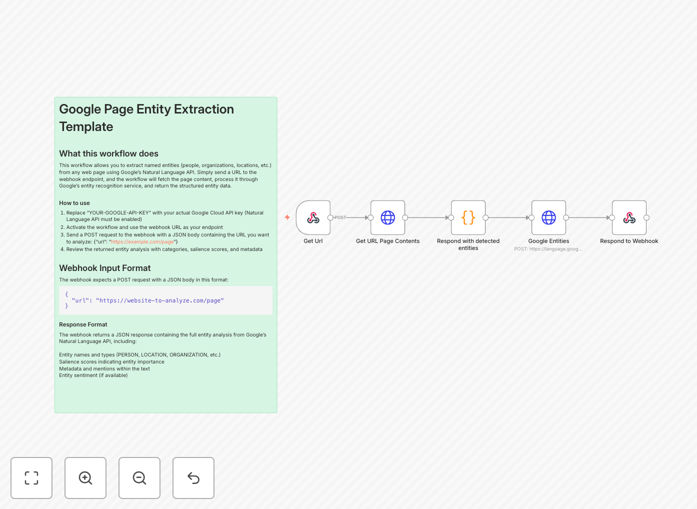
Visualization of web page entity extraction workflow showing Google Natural Language API processing content

What This Workflow Does

Manually analyzing web content to identify key entities—people, companies, locations, products—is incredibly time-consuming and inconsistent. This automation solves that by creating a seamless pipeline between any webpage and Google's powerful Natural Language API.

The workflow receives a URL via webhook, fetches the HTML content, cleans and prepares it, then sends it to Google's AI for sophisticated entity recognition. It returns structured data with entity types, salience scores, and metadata that can be immediately used for analysis, reporting, or integration with other business systems.

This transforms hours of manual research into seconds of automated processing, enabling consistent, scalable content intelligence across thousands of pages without human intervention.

How It Works

1. Webhook Trigger

The workflow starts with a webhook endpoint that accepts URLs for analysis. You can trigger it manually via API call, schedule it for regular monitoring, or connect it to other systems that discover web content.

2. Content Fetching & Cleaning

An HTTP Request node retrieves the webpage HTML, then a function node strips unnecessary markup, scripts, and styles to extract clean text content optimized for entity recognition.

3. Google Natural Language Processing

The core Google Entities node sends the cleaned text to Google's API, which uses advanced machine learning to identify entities, categorize them, and calculate their importance within the text.

4. Structured Data Output

Results are formatted into clean JSON with entity names, types (PERSON, ORGANIZATION, LOCATION, etc.), salience scores, and metadata. This structured data is returned via the webhook response for immediate use.

Who This Is For

SEO Professionals analyzing competitor content strategies and keyword targeting. Content Strategists researching topic coverage and entity relationships across industries. Market Researchers tracking company mentions, product launches, and industry trends.

Data Analysts needing structured data from unstructured web sources. Digital Agencies providing client intelligence reports. Business Intelligence Teams building automated market monitoring systems. Anyone who currently spends hours manually reading and categorizing web content.

Pro tip: Combine this workflow with a scheduler to automatically monitor competitor websites weekly. The historical entity data will reveal shifting focus areas and emerging trends in your industry.

What You'll Need

  1. n8n instance (cloud or self-hosted) to run the workflow
  2. Google Cloud Platform account with billing enabled
  3. Google Natural Language API enabled on your project
  4. API key with access to the Natural Language API
  5. Basic understanding of webhooks and API integrations

Quick Setup Guide

Step 1: Import the downloaded JSON into your n8n instance. Step 2: Create a Google Cloud project and enable the Natural Language API. Step 3: Generate an API key and add it to the Google Entities node credentials.

Step 4: Activate the workflow to generate your webhook URL. Step 5: Test with a POST request containing a URL in JSON format. Step 6: Integrate the webhook into your monitoring systems or scheduling tools.

Pro tip: Start with a small batch of test URLs from different domains to understand the API's entity recognition patterns before scaling to production volumes.

Key Benefits

Save 20+ hours monthly per analyst by eliminating manual content reading and entity tagging. What used to take days now happens in minutes with consistent, repeatable results.

Improve decision accuracy with data-driven insights from structured entity analysis rather than subjective human interpretation. Track exact entity frequency and importance scores.

Scale effortlessly from analyzing ten pages to ten thousand without additional human resources. The automation handles volume increases with minimal cost impact.

Integrate intelligence directly into your CRM, marketing automation, or BI tools. Extracted entities can trigger follow-up actions like lead creation or content recommendations.

Gain competitive advantage by monitoring industry trends and competitor movements in near real-time rather than through quarterly manual analysis cycles.

Frequently Asked Questions

Common questions about web content analysis and entity extraction automation

Named entity extraction identifies and categorizes key information in text, like people, organizations, locations, dates, and products. For businesses, it automates content analysis, competitor research, and data organization, saving hundreds of manual hours in market intelligence and SEO strategy.

Instead of employees reading through websites and manually noting mentioned companies, this technology does it instantly and consistently. The structured output feeds directly into business intelligence systems, enabling data-driven decisions about market opportunities and competitive positioning.

Google's API is highly accurate, using advanced machine learning models trained on vast datasets. It excels at recognizing entities in diverse contexts and web content, providing salience scores to indicate importance. It's considered industry-leading for general-purpose entity recognition tasks.

For most business content—news articles, blog posts, company websites—accuracy exceeds 90% for common entity types. The API handles ambiguous references well and provides confidence scores so you can filter results by reliability threshold for critical applications.

Key use cases include: SEO analysis of competitor content, market research by tracking mentions of companies and products, content strategy by understanding topic coverage, lead generation by identifying potential partners, and data enrichment for CRM or knowledge management systems.

Marketing teams use it to analyze industry trends, sales teams to identify prospect mentions, product teams to monitor competitive features, and executive teams to track brand perception. The automation turns web content from passive information into active business intelligence.

  • Competitor monitoring across hundreds of sources
  • Content gap analysis for SEO strategy
  • Market intelligence dashboard creation

Automation processes thousands of pages in minutes versus days manually, ensures consistent categorization without human bias, scales effortlessly with business growth, and integrates extracted data directly into other systems for immediate action. Manual methods can't match this speed or consistency.

Human analysts might miss subtle entity mentions or apply inconsistent categorization rules. Automation provides standardized output that's perfect for trend analysis over time. The cost per analyzed page drops dramatically, enabling comprehensive monitoring previously too expensive to consider.

The API identifies people, organizations, locations, events, products, dates, prices, percentages, and more. It provides metadata like salience (importance), sentiment, and mentions count. This structured data transforms unstructured web content into actionable business intelligence.

Beyond basic categories, it recognizes specific entity subtypes—distinguishing between educational institutions and corporations, or between cities and countries. This granularity enables sophisticated analysis, like tracking startup funding rounds versus corporate announcements across industry publications.

Yes, extracted entities can feed directly into CRM systems, marketing automation platforms, data warehouses, BI tools, and content management systems. This creates automated pipelines where web intelligence triggers business actions like lead creation, content recommendations, or market alerts.

For example, when a competitor is mentioned in industry news, the workflow could automatically create a task for your competitive intelligence team. Or when your company is mentioned with positive sentiment, it could trigger social media sharing or sales outreach to the mentioning publication.

Limitations include: technical or niche terminology may be missed, context-dependent meanings require human verification, API rate limits for high-volume processing, and legal considerations when analyzing third-party content. Best practice combines automation with periodic human review for critical decisions.

The technology works best with well-written content in major languages. Highly technical documents, sarcastic content, or poorly structured web pages may produce less accurate results. Always validate outputs for mission-critical applications before full automation deployment.

  • Set up validation samples for new content types
  • Implement confidence score filtering
  • Review API usage against rate limits

Yes, GrowwStacks specializes in custom automation solutions for web content analysis. We can build workflows tailored to your specific industry, data sources, and integration needs, whether for competitor monitoring, market intelligence, or content optimization at scale.

Our team designs systems that match your exact business processes—connecting entity extraction to your existing CRM, generating custom reports for your stakeholders, or creating real-time alerts for critical market movements. We handle the technical complexity so you get actionable intelligence without infrastructure headaches.

  • Industry-specific entity categorization
  • Integration with your existing tech stack
  • Custom dashboards and reporting

Need a Custom Web Content Analysis Automation?

This free template is a starting point. Our team builds fully tailored automation systems for your specific business needs.