eCommerce Facebook Ads n8n Conversion Tracking

Facebook/Meta Conversion API for eCommerce Leads & Orders

Automatically send purchase events from your eCommerce platform to Meta's Conversion API for accurate ad attribution. Perfect for Cash on Delivery businesses where traditional tracking often fails.

Download Template JSON · n8n compatible · Free
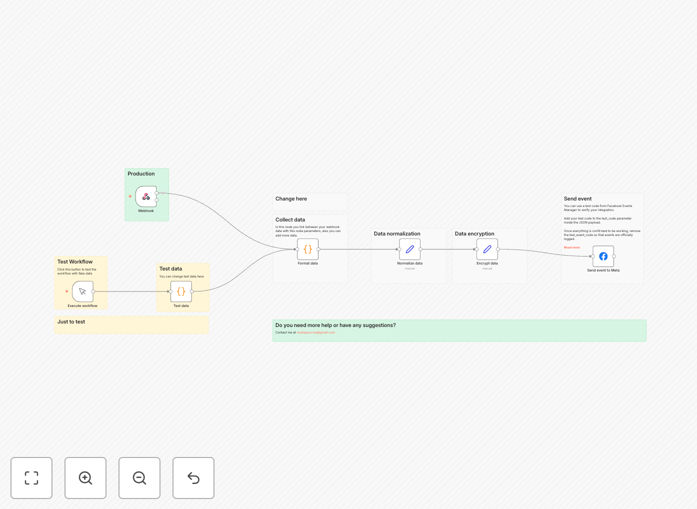
Meta Conversion API workflow diagram showing eCommerce order data flowing to Facebook

What This Workflow Does

This n8n workflow solves the critical problem of inaccurate ad attribution for eCommerce businesses, particularly those using Cash on Delivery (COD) payment methods. When customers don't complete transactions immediately (as with COD), traditional browser-based tracking often fails to connect the eventual purchase back to the original ad.

The workflow automatically sends order confirmation data directly from your eCommerce system to Meta's Conversion API, ensuring every sale is properly attributed to your Facebook and Instagram ads. This server-to-server connection bypasses browser tracking limitations, giving you more accurate ROI data and better ad optimization.

How It Works

1. Trigger on new orders

The workflow monitors your eCommerce platform for new orders, including COD orders that may be confirmed later. It can connect to Shopify, WooCommerce, or custom databases via API.

2. Prepare conversion event data

The system structures the order information into Meta's required Conversion API format, including customer details, product information, and transaction value. For COD orders, it waits for payment confirmation before sending the event.

3. Send to Meta Conversion API

The workflow securely transmits the conversion event directly to Meta's servers, including all necessary parameters for accurate attribution. It handles authentication and retries if needed.

4. Verify and log results

Each API response is checked for success, with failed attempts automatically retried. All events are logged for reconciliation with your ad reports.

Who This Is For

This workflow is ideal for:

  • eCommerce stores using Cash on Delivery payment options
  • Businesses seeing discrepancies between reported ad conversions and actual sales
  • Merchants running Facebook/Instagram ads with iOS-heavy audiences
  • Companies wanting more accurate ROI measurement for their ad spend

What You'll Need

  1. An active Meta Business account with Ads Manager access
  2. Your Meta Pixel ID and Conversion API access token
  3. An eCommerce platform or database that can trigger on new orders
  4. n8n instance (self-hosted or cloud)

Quick Setup Guide

  1. Download the JSON template file
  2. Import into your n8n instance
  3. Configure the eCommerce platform connection
  4. Enter your Meta API credentials
  5. Test with sample order data
  6. Activate the workflow

Key Benefits

20-40% more tracked conversions: Server-side tracking captures purchases that browser-based methods miss, especially from iOS devices and privacy-focused browsers.

Better ad optimization: Meta's algorithm uses your accurate conversion data to find more high-value customers, reducing wasted ad spend.

Simplified COD tracking: Automatically attribute Cash on Delivery orders to the original ad, even when fulfillment happens days later.

Future-proof tracking: As browser privacy restrictions increase, server-side tracking becomes essential for maintaining visibility into ad performance.

Pro tip: For COD businesses, configure the workflow to send purchase events only after payment confirmation to avoid over-reporting conversions.

Frequently Asked Questions

Common questions about Meta Conversion API integration and automation

The Meta Conversion API helps track customer actions when browser cookies are blocked, providing more accurate ad attribution. For eCommerce, this means better visibility into which ads drive actual purchases, especially for Cash on Delivery orders where traditional tracking often fails.

Without the API, businesses may lose 20-40% of conversion data due to iOS privacy features and ad blockers. This blind spot makes it impossible to properly optimize ad campaigns or calculate true ROI.

Key events include purchases, add-to-cart actions, and lead submissions. Purchase events are most critical as they directly measure ROI. For Cash on Delivery businesses, sending purchase confirmations when orders are fulfilled (not just placed) provides the most accurate conversion data.

Prioritize events that represent real business value. For most eCommerce stores, this means focusing on completed purchases rather than just browsing activity. The more valuable the event, the more important it is to track accurately.

By providing direct server-to-server data, the API helps Meta's algorithm optimize ad delivery to people more likely to convert. This reduces wasted ad spend and can lower cost per acquisition by 15-30% compared to relying solely on pixel-based tracking.

The system uses your accurate conversion data to build better lookalike audiences and adjust bids in real-time. Businesses typically see improved campaign performance within 2-4 weeks of implementing the Conversion API.

Technical integration complexity and data mapping are common hurdles. The API requires properly structured event data including customer parameters, product details, and value. Many businesses struggle with triggering events at the right moment, especially for offline fulfillment like Cash on Delivery.

Other challenges include maintaining data privacy compliance and handling edge cases like refunds. Automated workflows help solve these by standardizing the event data and ensuring consistent delivery to Meta's servers.

Pixel tracking relies on browser cookies which are often blocked. Server-side tracking sends data directly from your systems, bypassing browser restrictions. This captures 20-40% more conversions on average, particularly valuable for iOS users and privacy-focused browsers.

While pixel tracking captures client-side interactions (clicks, page views), server-side tracking focuses on business-critical events (purchases, signups) from your backend systems. The two methods complement each other for complete visibility.

Yes, using both methods creates redundancy and improves data accuracy. The Pixel tracks client-side interactions while the API captures server-side events. Meta's system automatically deduplicates events, giving you the most complete picture of campaign performance.

This dual approach is particularly valuable for eCommerce, where you want to track both browsing behavior (via Pixel) and confirmed purchases (via API). The combined data helps optimize both top-of-funnel and bottom-of-funnel ad strategies.

Include customer parameters (email, phone), product details (IDs, categories), and transaction values. For Cash on Delivery, include confirmation timestamps. The more complete your event data, the better Meta can optimize your ads using its machine learning models.

Essential fields for eCommerce include: event name (e.g. Purchase), value, currency, content_ids (product SKUs), and customer information (where permitted by privacy laws). This enriched data helps Meta match conversions to users more accurately.

Yes, GrowwStacks specializes in building tailored Conversion API integrations. We can create custom workflows that match your eCommerce platform's data structure and business processes, ensuring maximum tracking accuracy and ad performance.

Our team handles the technical implementation while you focus on your business. We've built solutions for Shopify, WooCommerce, Magento, and custom platforms, with special expertise in Cash on Delivery tracking challenges.

  • Custom event mapping for your specific data
  • Automated reconciliation with ad reports
  • Ongoing maintenance and updates

Need a Custom Meta Conversion API Integration?

This free template is a starting point. Our team builds fully tailored automation systems for your specific needs.