n8n Google Sheets AI Classification SEO Automation

Fetch keyword from Google Sheet and classify them using AI

Automate keyword analysis with AI-powered classification for smarter content strategy and SEO optimization

Download Template JSON · n8n compatible · Free
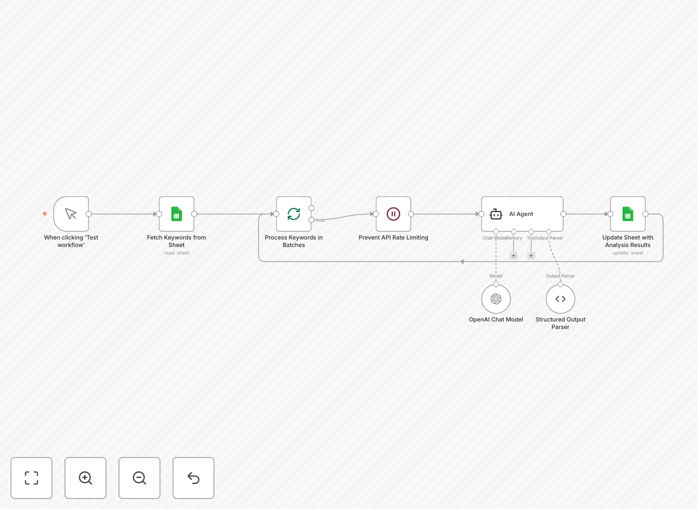
Keyword classification workflow diagram

What This Workflow Does

This automation solves the time-consuming challenge of manually analyzing and categorizing keyword lists for SEO and content marketing. Marketing teams often collect hundreds or thousands of keywords in spreadsheets, but actually making sense of them requires hours of tedious manual review.

The workflow automatically fetches keywords from your Google Sheet, sends them to an AI classification service, and returns organized results with proper categorization. It can identify search intent (informational vs. commercial), product categories, geographic relevance, or any custom classification system you define.
Screenshot of keyword classification workflow in n8n
The workflow showing keyword extraction from Google Sheets and AI classification process

How It Works

1. Fetch keywords from Google Sheets

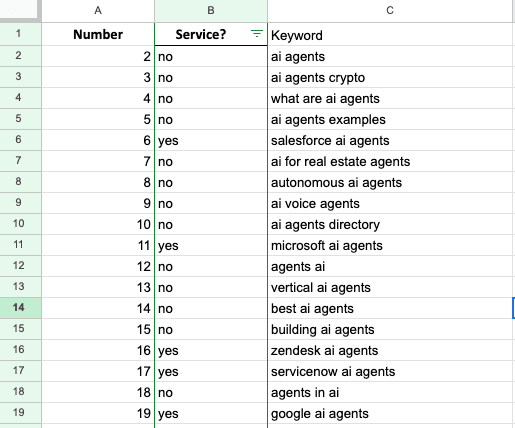
The workflow connects to your specified Google Sheet and extracts the keyword list from your designated columns. It handles authentication and can process multiple sheets or tabs within your document.

2. Send keywords for AI analysis

Each keyword gets sent to an AI classification service (like OpenAI or a custom model) with your predefined categorization rules. The AI examines semantic meaning, word patterns, and context to determine the most appropriate category.

3. Process and validate results

The workflow checks the AI's classification confidence scores and can flag uncertain results for human review. It formats the output into a structured dataset ready for use in your marketing systems.

4. Return classified keywords

The final step delivers the categorized keywords back to your preferred destination - either updating your original Google Sheet, sending to a database, or pushing to other marketing tools.

Pro tip: Start with a small sample of manually classified keywords to train your AI model before processing large lists. This improves accuracy significantly.

Who This Is For

This template is ideal for digital marketing teams, SEO specialists, and content managers who need to:

  • Organize large keyword research lists efficiently
  • Identify content gaps based on keyword categories
  • Align keyword strategy with buyer journey stages
  • Scale keyword analysis without adding staff
  • Maintain consistent classification standards

What You'll Need

  1. An n8n instance (cloud or self-hosted)
  2. Google Sheets with your keyword list
  3. Access to an AI service (OpenAI, Google AI, or similar)
  4. Clear classification categories defined
  5. Google service account credentials for API access

Quick Setup Guide

  1. Download the JSON template file
  2. Import into your n8n workspace
  3. Connect your Google Sheets account
  4. Configure your AI service credentials
  5. Define your classification categories
  6. Test with a small keyword sample
  7. Schedule or trigger the workflow as needed

Key Benefits

Save 10+ hours weekly by automating what would take days of manual keyword analysis. Process thousands of keywords in minutes instead of weeks.

Improve content strategy with data-driven insights from categorized keywords. See exactly what topics and intents your audience searches for.

Maintain consistency across teams with standardized, automated classification rather than subjective human judgment.

Scale effortlessly as your keyword lists grow. The workflow handles 100 or 100,000 keywords with equal efficiency.

Integrate with your stack by connecting classified keywords directly to your CMS, PPC tools, or analytics platforms.

Frequently Asked Questions

Common questions about keyword classification and AI automation

AI can analyze keywords contextually to categorize them by intent, topic, or relevance. Natural language processing identifies patterns humans might miss, grouping similar keywords automatically. For example, AI can distinguish between commercial ('buy running shoes') and informational ('best running shoes 2023') search intent.

The technology examines word relationships, modifiers, and phrasing to make intelligent categorization decisions. Unlike manual methods, AI applies the same logic consistently across all keywords without fatigue or inconsistency.

  • Identifies subtle semantic differences
  • Scales to any volume of keywords
  • Learns from corrections to improve

Automating keyword analysis saves hours of manual work while improving consistency. It processes thousands of keywords instantly with standardized criteria. Businesses gain faster insights for content strategy and SEO optimization without spreadsheet fatigue.

An ecommerce site might use automated classification to separate product searches from informational queries, then route them to different content teams. The system works 24/7, handling new keywords as they're discovered without delay.

  • Eliminates human error in categorization
  • Provides real-time keyword insights
  • Integrates with existing marketing tools

Modern AI achieves 85-95% accuracy for straightforward keyword classification when properly trained. Accuracy improves when providing clear classification rules and sample data. The system learns from corrections, becoming more precise over time.

For ambiguous keywords, the workflow can flag low-confidence results for human review. Most businesses find the time saved on clear-cut classifications outweighs the need to verify occasional uncertain cases.

  • Provide examples of each category
  • Review first 100 classifications
  • Adjust categories if needed

AI can classify keywords by search intent (informational, commercial, navigational), product categories, geographic relevance, urgency level, or custom business-specific categories. You define the classification framework that matches your marketing goals.

A travel company might categorize by destination, seasonality, and trip type. A software company could classify by feature, use case, and comparison terms. The flexibility allows precise alignment with your content strategy.

  • Start with 3-5 broad categories
  • Add subcategories as needed
  • Update categories quarterly

Monthly analysis works for most businesses, but high-volume sites should analyze weekly. Regular classification helps spot trending topics and shifting search intent. Automation makes frequent analysis practical without additional staffing.

Seasonal businesses may increase frequency during peak periods. The workflow can run automatically on schedule, ensuring fresh insights without manual intervention. Historical comparison reveals valuable trends in search behavior.

  • Align with content planning cycles
  • Monitor for sudden shifts
  • Compare seasonal patterns

Yes, the classified keywords can feed into content calendars, PPC campaigns, or SEO tools. The workflow can connect to platforms like SEMrush, Google Ads, or CMS systems to apply the classifications directly where they're needed.

For example, classified keywords might automatically populate different content brief templates based on their category. Or route high-intent commercial keywords to PPC campaigns while informational ones go to blog topics.

  • Push to Google Data Studio
  • Sync with Airtable content plans
  • Update HubSpot campaign lists

Absolutely! GrowwStacks specializes in building tailored keyword analysis systems that match your specific categorization needs and integrate with your existing tools. We can create custom AI models trained on your data and business terminology.

Our team will design a solution that fits your unique keyword taxonomy, connects to your preferred platforms, and delivers insights in your existing workflows. We handle everything from initial setup to ongoing optimization.

  • Custom category definitions
  • Integration with your tech stack
  • Ongoing support and tuning

Need a Custom Keyword Analysis Automation?

This free template is a starting point. Our team builds fully tailored keyword classification systems for your specific needs.