n8n AI Automation GPT-4 Tavily Telegram

Generate job automation analysis with GPT-4, Tavily & Telegram

Automate job market research with AI-powered analysis delivered via Telegram

Download Template JSON · n8n compatible · Free
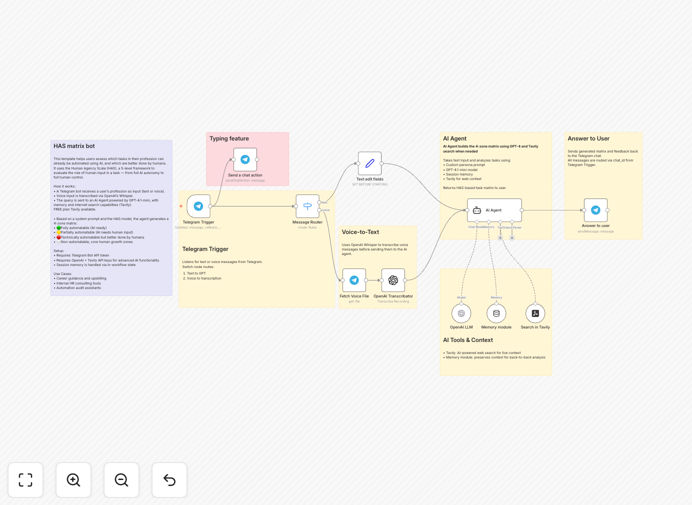
n8n workflow for job automation analysis

What This Workflow Does

This n8n workflow automates the process of analyzing job market trends using AI-powered research. It combines GPT-4's analytical capabilities with Tavily's web search functionality to generate comprehensive reports about automation potential in specific job roles or industries.

The system automatically delivers these insights via Telegram, making it ideal for recruiters, HR professionals, or business analysts who need to stay updated on evolving job automation trends without manual research.

How It Works

1. Trigger Setup

The workflow can be triggered manually or scheduled to run at regular intervals, depending on your analysis needs.

2. Web Research with Tavily

Tavily performs targeted web searches to gather the latest information about job automation trends from authoritative sources.

3. AI Analysis with GPT-4

The collected data is processed by GPT-4, which summarizes key findings, identifies automation potential, and provides actionable insights.

4. Telegram Notification

The final analysis is formatted and sent directly to your Telegram channel or private chat for easy access.

Who This Is For

This workflow is particularly valuable for:

  • Recruitment agencies tracking automation impacts on hiring
  • HR departments planning workforce transformations
  • Career coaches advising clients on future-proof skills
  • Business analysts researching industry automation trends

What You'll Need

  1. Self-hosted n8n instance (community nodes required)
  2. OpenAI API access with GPT-4 capability
  3. Tavily API credentials
  4. Telegram bot token and chat ID

Quick Setup Guide

  1. Download and import the JSON template into your n8n instance
  2. Configure API credentials for OpenAI, Tavily, and Telegram
  3. Set your search parameters and analysis criteria
  4. Test with sample job titles/industries
  5. Schedule regular runs or trigger manually as needed

Key Benefits

Save 10+ hours per month on manual job market research by automating data collection and analysis.

Get AI-powered insights that identify automation risks and opportunities you might miss manually.

Stay ahead of trends with regular automated updates delivered directly to your preferred messaging platform.

Make data-driven decisions about hiring, training, and workforce planning based on current automation trends.

Pro tip: Use this workflow to create a library of automation analyses for different roles, helping you build a knowledge base over time.

Frequently Asked Questions

Common questions about job automation analysis and AI integration

AI can process vast amounts of job market data to identify automation patterns that humans might miss. GPT-4 analyzes job descriptions, skills requirements, and industry reports to assess which tasks can be automated.

For example, AI can compare current job postings with automation case studies to predict which roles are most vulnerable to automation. This helps businesses prepare workforce transitions proactively.

  • Identifies repetitive tasks prime for automation
  • Highlights emerging technologies impacting specific roles
  • Provides recommendations for upskilling opportunities

Jobs involving repetitive, rule-based tasks are most susceptible to automation. Roles in data entry, basic customer service, and routine manufacturing are currently being automated fastest.

However, AI analysis can reveal less obvious automation potential. For instance, some legal research tasks or medical diagnostics are now being augmented with AI. Regular automation analysis helps track these evolving trends.

  • Prioritize analysis of routine cognitive and manual tasks
  • Monitor automation in your specific industry
  • Combine AI insights with human expertise

AI predictions about automation are directional rather than definitive. Current models can identify automation potential with about 70-80% accuracy based on existing data patterns.

These predictions become more accurate when combined with human review. For example, an HR team might use AI-generated automation risk scores as a starting point for deeper workforce analysis.

  • Use AI as a screening tool, not final decision-maker
  • Combine with industry-specific knowledge
  • Update models regularly as technology evolves

Automated analysis processes more data faster and more consistently than manual methods. While humans might review a dozen sources, AI can analyze hundreds in the same time.

A real-world example: A recruitment firm automated analysis of 200 tech job descriptions weekly, identifying emerging skills gaps they used to advise clients on competitive hiring strategies.

  • 10x more data processed in same time
  • Consistent methodology across analyses
  • Scalable to multiple roles/industries

For most industries, quarterly automation analysis provides good coverage of evolving trends. Fast-changing fields like tech may benefit from monthly updates.

The frequency depends on your workforce planning cycle. Companies undergoing digital transformation might analyze automation potential more frequently to inform reskilling programs.

  • Tech industries: Monthly
  • Most businesses: Quarterly
  • During major transitions: Weekly

Yes, AI can identify emerging job categories created by automation. By analyzing hiring trends and technology adoption patterns, AI can spot new roles being created.

For instance, AI analysis might reveal growing demand for "automation coordinators" who oversee human-AI collaboration in previously manual processes.

  • Tracks complementary roles to automation
  • Identifies hybrid human-AI positions
  • Highlights skills for future job markets

Absolutely. GrowwStacks specializes in building custom automation solutions tailored to specific business needs. While this template provides general job analysis, we can create systems focused on your industry, roles, and specific decision-making requirements.

Custom solutions might integrate with your HR systems, include proprietary data sources, or generate reports formatted for your leadership team. We work closely with clients to understand their unique workforce challenges.

  • Industry-specific automation metrics
  • Integration with existing HR tools
  • Custom reporting dashboards

Need a Custom Job Automation Analysis System?

This free template is a starting point. Our team builds fully tailored automation systems for your specific needs.