Shopify AI Content SEO Automation Google Sheets n8n

Automate SEO-Optimized Shopify Blog Articles with AI

Generate and publish high-quality, search-optimized content automatically from keyword lists. Save 10+ hours weekly on content creation.

Download Template JSON · n8n compatible · Free
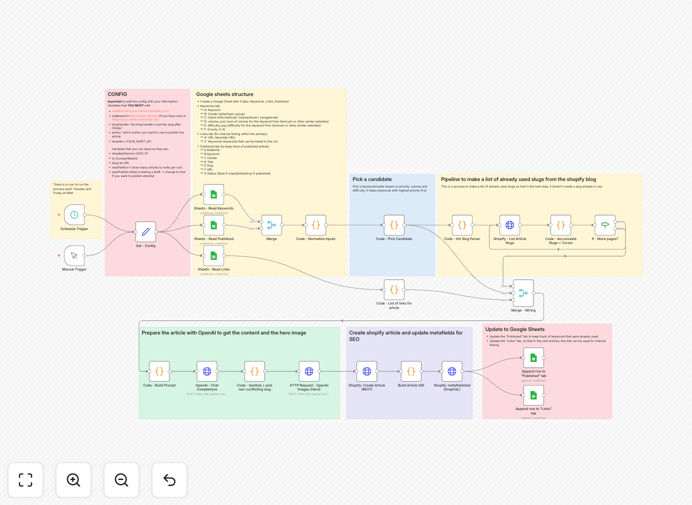
Automated Shopify blog content generation workflow showing AI integration with Google Sheets and Shopify

What This Workflow Does

This automation solves the time-consuming challenge of creating consistent, SEO-optimized blog content for Shopify stores. Manual content creation can take 5-10 hours per article between research, writing, optimization, and publishing. This workflow automates the entire process from keyword selection to live publication.

The system reads prioritized keywords from Google Sheets, checks for duplicate content in your existing Shopify blog, generates 900+ word articles optimized for both SEO and AEO (Answer Engine Optimization), creates relevant hero images using AI, publishes to Shopify with proper metadata, and logs everything for tracking and internal linking strategies.

How It Works

Step 1: Keyword Selection & Prioritization

The workflow reads from your Google Sheets "Keywords" tab, sorting by priority, search volume, and difficulty score. It selects the highest-value keyword that hasn't been covered yet, ensuring you're always targeting the most valuable topics first.

Step 2: Duplicate Prevention

Before creating content, the system paginates through your existing Shopify blog via GraphQL API to collect all article handles (slugs). This prevents duplicate content and ensures each new article has a unique URL structure.

Step 3: AI Content Generation

Using structured prompts that include SEO guidelines, target keywords, semantic terms, and internal linking opportunities, the AI generates comprehensive 900+ word articles. The prompt is engineered to produce content that satisfies both search engines and human readers.

Step 4: Image Creation & Optimization

Simultaneously, the workflow generates a relevant hero image using AI image generation. The image is optimized for web performance and includes proper alt text based on the article topic and primary keyword.

Step 5: Shopify Publication

The article is created in Shopify via REST API, with proper categorization, tags, and author attribution. Immediately after creation, GraphQL updates the SEO metafields (title_tag and description_tag) to ensure perfect on-page optimization.

Step 6: Tracking & Link Building

The system logs the published article to the "Published" tab in Google Sheets for performance tracking. It also updates the "Links" tab with internal linking suggestions, creating a growing link graph that improves your site's SEO architecture over time.

Who This Is For

This automation is ideal for Shopify store owners, e-commerce marketers, content teams, and solo founders who need consistent blog content but lack the time or resources for manual creation. It's particularly valuable for:

  • E-commerce businesses targeting 2+ blog posts per week
  • Content teams wanting to scale production without hiring additional writers
  • SEO agencies managing multiple Shopify client blogs
  • Founders wearing multiple hats who need to maintain content marketing alongside other responsibilities
  • Businesses in competitive niches needing consistent content to maintain search visibility

What You'll Need

  1. Shopify Store with blog functionality and API access (Admin token required)
  2. OpenAI API Key for GPT-4 content generation and DALL-E image creation
  3. Google Service Account with access to Google Sheets API (enabled via Google Cloud Console)
  4. Google Sheet with three tabs: Keywords, Links, and Published (template structure provided)
  5. n8n Instance (cloud or self-hosted) to run the workflow

Pro tip: Use Semrush or Ahrefs to generate your initial keyword list with priority scores, search volume, and difficulty metrics. This data-driven approach ensures your automated system targets the most valuable opportunities first.

Quick Setup Guide

  1. Download the template using the button above and import it into your n8n instance
  2. Configure the "Set – Config" node with your Shopify domain, blog ID, Google Sheet ID, and author information
  3. Create your Google Sheet with the three required tabs using the column structure explained in the workflow documentation
  4. Add credentials for Shopify (Admin token), OpenAI API, and Google Service Account in n8n
  5. Set your schedule in the Schedule Trigger node (weekly is recommended for most businesses)
  6. Test with one keyword before enabling full automation to ensure everything works correctly

Key Benefits

Save 10-15 hours weekly per writer by automating research, writing, optimization, and publishing. What used to take a full day now happens automatically while you focus on strategy and promotion.

Improve SEO consistency with every article following the same optimization standards. No more forgetting meta descriptions, skipping internal links, or inconsistent heading structures that hurt your search rankings.

Scale content production infinitely without increasing headcount. The system can produce 5, 10, or 20 articles weekly with the same effort as one, allowing you to dominate your niche through content volume.

Maintain brand voice consistently through carefully engineered AI prompts. Unlike human writers who might drift in tone, the automated system applies the same brand guidelines to every piece of content.

Build intelligent internal linking automatically as your content library grows. The system tracks all published articles and suggests relevant internal links, creating a powerful SEO architecture that improves all your content's performance.

Frequently Asked Questions

Common questions about Shopify content automation and AI integration

Automating Shopify blog content creation saves 10-15 hours weekly per writer, ensures consistent SEO optimization, and allows you to scale content production without increasing headcount. Businesses using automated content systems typically see 40-60% more organic traffic within 3-6 months.

The real value comes from consistency and scalability. While a human writer might produce 2-4 quality articles weekly, an automated system can produce 10-20 while maintaining perfect SEO standards. This content volume advantage often leads to dominating search results in your niche.

Modern AI-generated content with proper optimization can perform equally well or better for SEO when combined with human oversight. The key is using structured prompts, SEO guidelines, and quality checks. Many businesses use AI for initial drafts and human editors for final polish.

Search engines like Google evaluate content based on relevance, expertise, and user satisfaction—not authorship. Well-optimized AI content that thoroughly addresses search intent and provides value performs excellently in search rankings when properly structured and optimized.

Google Sheets integration allows non-technical team members to manage keyword lists, track performance metrics, and control content scheduling without touching the automation system. It creates a collaborative workflow where marketers can update priorities and writers can track published articles.

The spreadsheet becomes your content command center. Marketing teams can add new keywords based on trends, SEO specialists can adjust priority scores, and content managers can track publication dates—all without needing technical skills or accessing the automation platform directly.

Most businesses save 8-12 hours per article when automating the entire process from keyword research to publishing. For a weekly blog schedule, this translates to 30-50 hours monthly saved per writer, allowing them to focus on strategy and promotion instead of manual writing.

These time savings compound significantly. A team producing 4 articles weekly saves 160-200 hours monthly—equivalent to a full-time employee's workload. This freed-up capacity can be redirected to higher-value activities like content promotion, link building, and conversion optimization.

Best practices include: 1) Using structured prompts with target keywords and semantic terms, 2) Implementing proper heading hierarchy (H1-H4), 3) Adding internal links to existing products/pages, 4) Optimizing meta titles and descriptions, and 5) Including relevant images with alt text.

Successful implementations also incorporate E-E-A-T principles by citing expert sources, including original data or insights, and maintaining consistent author authority signals. The workflow template includes these optimization elements in its prompt engineering and publication process.

Yes, when implemented correctly. Automated systems can maintain consistent author bios, include expert citations, link to authoritative sources, and ensure factual accuracy through verification steps. The key is combining automation with human expertise in your niche.

For maximum E-A-T benefits, configure your automation to reference your team's credentials, cite industry research, link to authoritative .edu or .gov sources, and include customer success stories or case studies that demonstrate real-world expertise.

Implement duplicate checking against existing blog slugs, use varied sentence structures in AI prompts, incorporate unique data points or case studies, and regularly update your keyword research. The workflow includes built-in duplicate prevention by checking existing Shopify article handles.

Additional strategies include using multiple AI models for variation, incorporating your proprietary data or insights, and implementing semantic analysis to ensure content covers unique angles even on similar topics. The system's Google Sheets integration also tracks what's been published to prevent repetition.

Yes, GrowwStacks specializes in building custom Shopify content automation systems tailored to your specific products, audience, and SEO strategy. We can integrate with your existing tools, create custom AI prompts for your brand voice, and set up advanced tracking and optimization workflows.

Our custom solutions include multi-language content generation, integration with your product catalog for contextual recommendations, advanced analytics dashboards, and ongoing optimization based on performance data. We work with you to create a system that grows with your business.

  • Custom AI prompts trained on your brand voice and style guide
  • Integration with your existing CRM, email, and analytics tools
  • Advanced performance tracking and ROI measurement
  • Ongoing optimization based on content performance data

Need a Custom Shopify Content Automation?

This free template is a starting point. Our team builds fully tailored automation systems for your specific business needs.