What This Workflow Does
This automation solves the biggest bottleneck for YouTube creators: script writing. Instead of spending hours researching and drafting, you provide a single video topic, and the workflow generates two complete, research-backed scripts—one optimized for YouTube Shorts (under 60 seconds) and another for long-form videos (8+ minutes).
The system uses Google Gemini AI for creative writing and Tavily AI for real-time web research, ensuring your scripts contain current information and trends. Both scripts are automatically saved to Google Docs, ready for your review and filming. This effectively multiplies your content output while maintaining quality and relevance.
How It Works
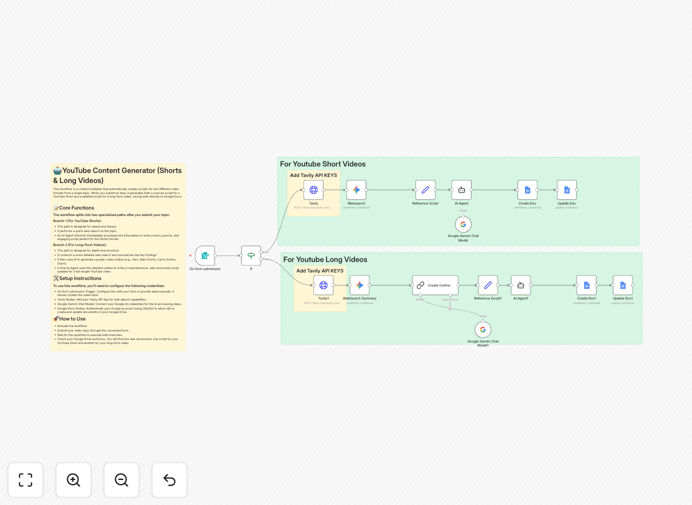
The workflow operates through parallel processing paths after receiving your topic submission:
1. Topic Submission & Initial Processing
You submit a video topic through a connected form. The workflow captures this input and prepares it for both script generation paths simultaneously.
2. Shorts Script Generation Path
This branch performs a quick web search via Tavily AI to gather key facts, then immediately uses a Gemini AI agent to write a concise, attention-grabbing script structured for YouTube Shorts' fast-paced format.
3. Long-Form Script Generation Path
This branch conducts more comprehensive research, uses Gemini AI to create a detailed outline with sections and talking points, then generates a complete long-form script based on that structured outline.
4. Document Creation & Delivery
Both scripts are automatically created as separate Google Docs in your designated Drive folder, with clear titles indicating format and topic for easy organization.
Who This Is For
This automation is ideal for YouTube creators, content agencies, marketing teams, and educators who produce regular video content. It's particularly valuable for:
Individual Creators who want to maintain consistent upload schedules without burning out on script writing. Content Agencies managing multiple YouTube channels who need scalable script production. Businesses using YouTube for marketing or training who require professional, researched scripts. Educators & Trainers creating instructional content who need well-structured explanations.
Pro tip: Use this workflow to batch-create scripts for a month's worth of content in one sitting. Submit 4-5 related topics, and you'll have 8-10 scripts ready for filming, creating a content buffer that reduces daily pressure.
What You'll Need
- An active n8n instance (cloud or self-hosted)
- A form trigger (built-in n8n form or external form connected via webhook)
- API key for Tavily AI (for web research)
- API key for Google Gemini AI (for script generation)
- Google OAuth2 credentials configured in n8n (for Google Docs integration)
- A Google Drive folder for script storage
Quick Setup Guide
Follow these steps to implement this automation in your n8n environment:
- Import the template using the download button above
- Configure your form trigger to accept a "topic" field
- Add your Tavily API key to both Tavily nodes in the credentials section
- Add your Google Gemini API key to the AI Agent and Create Outline nodes
- Set up Google OAuth2 credentials for all Google Docs nodes
- Test with a sample topic and check your Google Drive for the generated scripts
- Activate the workflow and connect it to your production form
Key Benefits
Save 3-8 hours per video by automating research and initial draft creation. What typically takes a full day of work can be reduced to minutes of review time.
Maintain consistent quality with AI-assisted writing that follows proven script structures for both Shorts and long-form formats, ensuring your content meets platform best practices.
Scale content production without increasing team size. One creator can produce 2-5x more content, or a team can focus on higher-value creative tasks rather than manual writing.
Stay current with trends through real-time web research integration. Your scripts will reference recent developments, statistics, and examples that make content more relevant and engaging.
Reduce creative burnout by handling the repetitive aspects of script writing. You maintain creative direction while the automation handles the heavy lifting of research and initial drafting.