What This Workflow Does
Healthcare organizations operate in a constantly changing regulatory environment where missing a policy update can mean compliance violations, financial penalties, or operational disruptions. Manual monitoring of government websites, health department portals, and regulatory bodies is time-consuming, inconsistent, and prone to human error.
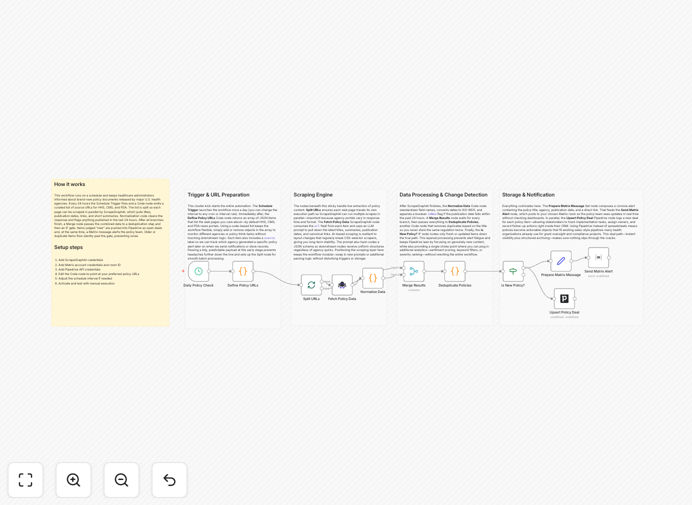
This automation solves that problem by creating a systematic, 24/7 monitoring system that uses AI-powered web scraping to detect policy changes, logs them as structured deals in Pipedrive for tracking and assignment, and sends real-time alerts to your team via Matrix or other communication platforms. It transforms what was traditionally a reactive, manual process into a proactive, automated compliance asset.
The workflow specifically targets healthcare administrators, compliance officers, policy analysts, and operations teams who need to stay ahead of regulatory changes without dedicating full-time staff to website monitoring. It's particularly valuable for organizations with multiple locations, complex compliance requirements, or those operating in heavily regulated healthcare markets.
How It Works
The automation follows a logical sequence that mimics how an attentive human monitor would work, but with machine precision and around-the-clock availability.
Step 1: Scheduled Monitoring Trigger
The workflow activates on a configurable schedule (typically every 6 hours) to check designated government and healthcare policy websites. This regular cadence ensures timely detection without overwhelming your systems or hitting website rate limits.
Step 2: AI-Powered Content Extraction
Using ScrapeGraphAI, the system intelligently scrapes target websites, extracting policy titles, publication dates, summary content, and identifying what's new or changed since the last check. The AI component understands page structure and can adapt to different website layouts.
Step 3: Change Detection & Filtering
Each scraped page is compared against previous versions using content hashing. Only genuinely new or modified policies proceed through the workflow, eliminating noise from unchanged content and focusing attention on what matters.
Step 4: CRM Integration & Deal Creation
Detected policy changes are automatically created as deals in Pipedrive, complete with relevant details, priority levels, assigned team members, and follow-up dates. This creates an auditable trail and integrates policy monitoring directly into your operational workflow.
Step 5: Real-Time Team Notification
Critical policy changes trigger immediate alerts in your Matrix room (or other communication platforms), providing your team with instant notification, context, and direct links to source materials for rapid assessment and response planning.
Pro tip: Configure the workflow to monitor not just government sites but also industry association updates, insurance provider policy changes, and accreditation body announcements for comprehensive coverage.
Who This Is For
This automation delivers maximum value to healthcare organizations where regulatory compliance is mission-critical. Ideal users include:
Healthcare Providers & Hospital Systems: Track Medicare/Medicaid policy changes, licensing requirements, and operational regulations across multiple facilities and jurisdictions.
Health Insurance Companies: Monitor coverage policy updates, reimbursement rate changes, and regulatory guidance from insurance commissioners and federal agencies.
Medical Device & Pharmaceutical Manufacturers: Stay current with FDA guidance, approval process changes, manufacturing standards, and international regulatory developments.
Healthcare IT & Software Companies: Track HIPAA updates, interoperability standards, cybersecurity requirements, and certification criteria that affect product development and compliance.
Healthcare Consulting & Legal Firms: Maintain competitive advantage by being first to identify regulatory changes that create consulting opportunities or require client advisories.
What You'll Need
- n8n Instance: Either self-hosted or n8n.cloud account with appropriate permissions for workflow execution and credential management.
- ScrapeGraphAI Community Node: Installed in your n8n environment (available via Community Nodes) with valid API credentials for AI-powered web scraping.
- Pipedrive Account: Active subscription with API access and at least one pipeline configured for policy tracking and deal management.
- Matrix Account: Access to a Matrix homeserver with appropriate room permissions for sending automated alerts and notifications.
- Target Website List: Curated list of government health department sites, regulatory portals, and policy repositories relevant to your specific healthcare focus area.
Quick Setup Guide
Follow these steps to implement this policy monitoring automation in your environment:
- Install Community Node: In your n8n settings, navigate to Community Nodes and install the ScrapeGraphAI node. This provides the AI scraping capabilities central to the workflow.
- Configure Credentials: Set up credentials for ScrapeGraphAI (API key), Pipedrive (OAuth2 or API token), and Matrix (homeserver URL and access token) in n8n's credential management system.
- Customize Monitoring Targets: Edit the initial configuration node to specify your policy website URLs, Pipedrive pipeline IDs, Matrix room identifier, and alert thresholds appropriate for your organization.
- Adjust Schedule Frequency: Review and modify the schedule trigger based on your monitoring needs—balance between timely detection and system load considerations.
- Test with Activation: Activate the workflow and verify initial execution by checking Pipedrive for test deals and Matrix for notification messages to confirm proper integration.
- Refine & Scale: Once basic functionality is confirmed, expand monitoring to additional websites, customize deal fields in Pipedrive, and establish escalation procedures for critical policy changes.
Pro tip: Start with 3-5 high-priority policy websites during initial implementation, then gradually expand your monitoring scope as you refine the scraping selectors and workflow logic.
Key Benefits
Eliminate Manual Monitoring Overhead: Save 15-20 hours per week previously spent manually checking websites by automating the entire detection and logging process with consistent, reliable coverage.
Reduce Compliance Risk Exposure: Minimize the chance of missing critical policy updates that could lead to violations, penalties, or operational disruptions through systematic, documented monitoring.
Accelerate Response Time: Cut the policy-to-action gap from days to minutes with real-time alerts that enable immediate assessment, stakeholder communication, and implementation planning.
Centralize Policy Intelligence: Transform scattered website monitoring into structured, searchable policy intelligence within your CRM, creating a single source of truth for regulatory tracking.
Scale Monitoring Effortlessly: Monitor hundreds of policy sources with the same efficiency as monitoring one, enabling comprehensive coverage without proportional increases in staff time or costs.