What This Workflow Does
Staying current with AI research is essential but time-consuming. Manually browsing ArXiv daily, reading dozens of abstracts, and filtering for relevant papers can consume 5-10 hours per week. This intelligent automation solves that problem by creating a personalized research assistant that works 24/7.
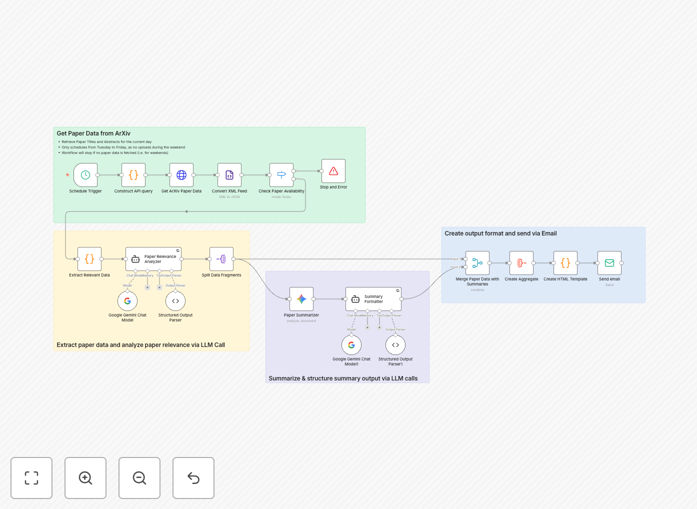
The system implements a three-stage pipeline: it automatically fetches new publications from ArXiv's AI category, uses Google Gemini to analyze each paper's relevance based on your specific criteria, and generates structured summaries delivered via professional email digests. This eliminates manual monitoring while ensuring you only receive papers genuinely advancing your work.
How It Works
1. Automated Paper Retrieval
The workflow runs on a configurable schedule (Tuesday-Friday) to fetch new papers from ArXiv's API. It queries the cs.AI category for recent publications, extracting titles, abstracts, authors, and links for processing.
2. AI-Powered Relevance Filtering
Each paper is analyzed by Google Gemini using structured output parsing. The AI evaluates relevance based on your defined criteria—such as specific methodologies, applications, or novelty—assigning a relevance score and justification for each paper.
3. Intelligent Summarization & Aggregation
Papers meeting your threshold are passed to a separate LLM call for concise summarization. Key findings, methodology, and potential applications are extracted and formatted into readable summaries.
4. Formatted Email Delivery
The system aggregates the top relevant papers (typically 3-5) into a single, professionally formatted HTML email. Each entry includes the paper title, authors, relevance score, AI-generated summary, and direct link to the full paper.
Who This Is For
This automation is ideal for academic researchers, ML practitioners, data scientists, AI enthusiasts, and technical teams who need to stay current with AI developments. It's particularly valuable for PhD students tracking literature reviews, industry teams monitoring competitive intelligence, research labs maintaining awareness of emerging techniques, and anyone who wants curated, digestible research updates without daily manual effort.
What You'll Need
- n8n instance (cloud or self-hosted)
- Google Gemini API key for AI analysis and summarization
- Email service credentials (SMTP, Gmail, SendGrid, etc.) for sending digests
- ArXiv API access (no authentication required)
- Basic understanding of your research interests to configure relevance criteria
Quick Setup Guide
1. Download the template and import it into your n8n instance. 2. Configure the Schedule Trigger node to run on your preferred days (Tuesday-Friday recommended). 3. Add your Google Gemini API credentials to the AI nodes. 4. Set up your email service credentials in the Send Email node. 5. Customize the "Paper Relevance Analyzer" criteria in the Google Gemini node to match your research interests. 6. Test the workflow with a manual trigger to verify email delivery and formatting. 7. Activate the workflow and start receiving automated research digests.
Pro tip: Start with broad relevance criteria and refine them over 2-3 weeks based on which papers the system selects. This iterative approach helps the AI better understand your specific research domain and priorities.
Key Benefits
Saves 60+ minutes daily by eliminating manual ArXiv browsing and abstract reading. Researchers typically spend 1-2 hours daily on literature review—this automation handles it instantly.
Reduces information overload by 80-90% through intelligent AI filtering. Instead of scanning dozens of irrelevant papers, you receive only those genuinely relevant to your work.
Ensures you never miss important papers with consistent, scheduled monitoring. The system works even during busy periods, conference deadlines, or vacations.
Provides structured, actionable summaries instead of raw abstracts. AI-generated highlights make papers easier to evaluate and share with colleagues.
Fully customizable to your research domain with adjustable relevance criteria. The system adapts as your interests evolve, maintaining relevance over time.