AI Automation Content Creation SEO Multi-agent n8n

Multi-agent AI Content Creator for SEO Blogs & Newsletters

Automate high-quality, research-backed content production using specialized AI agents. Generate blog posts and newsletters with SEO optimization, save hours weekly.

Download Template JSON · n8n compatible · Free
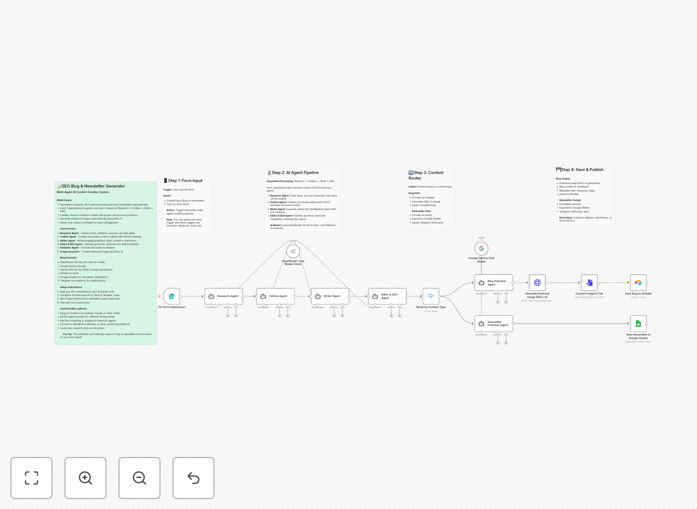
Multi-agent AI content creator workflow visualization

What This Workflow Does

This automation solves the time-intensive problem of creating consistent, high-quality content for SEO blogs and email newsletters. Manual content creation requires hours of research, writing, editing, and formatting—tasks that become repetitive and scale poorly with business growth.

The workflow employs a team of four specialized AI agents that collaborate sequentially. The Research Agent gathers factual information and credible sources. The Outline Agent structures the content logically. The Writer Agent produces engaging, Medium-style prose. Finally, the Editor Agent polishes the text and optimizes it for search engines. Based on your input, the system automatically routes output to either blog format (with DALL-E generated featured images) or newsletter format, then saves everything to Airtable or Google Sheets for management.

How It Works

Step 1: Topic Input & Research

You submit a content topic through a form or trigger. The Research Agent uses OpenRouter (with Grok AI) to search for relevant facts, statistics, and authoritative sources, building a foundation of credible information.

Step 2: Outline Generation

The Outline Agent analyzes the research and creates a logical structure with headings, subheadings, and key points. This ensures the content follows best practices for readability and SEO hierarchy.

Step 3: Content Writing

The Writer Agent, powered by Google Gemini, transforms the outline into engaging, human-like prose. It adopts a conversational yet professional tone suitable for blog readers or newsletter subscribers.

Step 4: Editing & SEO Optimization

The Editor Agent reviews the draft, improves flow, checks grammar, and inserts SEO keywords naturally. It ensures the content meets both quality standards and search engine requirements.

Step 5: Formatting & Distribution

The system branches based on your selection: blog posts receive a DALL-E generated featured image and are saved to Airtable; newsletters are formatted for email and saved to Google Sheets. Optional Telegram notifications alert you when content is ready.

Who This Is For

This workflow is ideal for content creators, digital marketers, bloggers, and businesses that need to produce SEO-optimized content at scale. Marketing teams at agencies can use it to serve multiple clients. Solopreneurs and small business owners can maintain consistent blogging without hiring writers. Content departments at larger companies can augment their human writers with AI assistance. Anyone spending 10+ hours weekly on content creation will benefit significantly.

What You'll Need

  1. OpenRouter API key – for accessing Grok AI model used by the Research Agent.
  2. Google Gemini API key – powers the Writer Agent for high-quality prose generation.
  3. OpenAI API key – enables DALL-E image generation for blog post featured images.
  4. Airtable account – stores finalized blog posts with metadata for easy management.
  5. Google Sheets account – serves as a content calendar and repository for newsletter drafts.
  6. Telegram bot token (optional) – sends notifications when content generation completes.

Quick Setup Guide

  1. Import the downloaded JSON workflow file into your n8n instance.
  2. Add your OpenRouter, Google Gemini, and OpenAI API credentials to the respective language model nodes.
  3. Configure your Airtable base ID and table ID in the "Save Blog to Airtable" node.
  4. Set your Google Sheets document ID in the "Save Newsletter to Google Sheets" node.
  5. If using notifications, add your Telegram bot token and chat ID to the Telegram node.
  6. Test the workflow by submitting a sample topic through the form trigger and verify output appears in your Airtable/Sheets.

Pro tip: Start with simple topics like "benefits of remote work" or "intro to cryptocurrency" to see how the agents collaborate. Once confident, expand to complex subjects requiring deeper research.

Key Benefits

Save 10–20 hours weekly on content creation. Eliminate manual research, drafting, and basic editing. Focus your time on strategy, distribution, and engagement instead of repetitive writing.

Maintain consistent quality and SEO standards. Each AI agent specializes in one aspect, ensuring every piece meets predefined criteria for accuracy, structure, readability, and keyword optimization.

Scale content output without increasing team size. Produce multiple blog posts and newsletters simultaneously. Grow your content library as your audience expands, without hiring additional writers.

Integrate seamlessly with your existing tools. The workflow connects with Airtable for content management, Google Sheets for calendars, and can be extended to CMS platforms like WordPress or email services like Mailchimp.

Adapt easily to your brand voice and audience. Customize agent prompts to match your tone, target demographic, and content goals. Swap AI models if you prefer Claude, GPT-4, or Llama.

Frequently Asked Questions

Common questions about AI content automation and integration

AI automation can dramatically improve SEO content creation by generating research-backed articles, optimizing for keywords, and ensuring consistent publishing schedules. It reduces manual research time, maintains quality standards, and scales output without increasing team size.

For example, a marketing agency can produce client blog posts faster while ensuring each piece includes relevant keywords, proper heading structure, and authoritative citations. Automation handles the repetitive tasks while humans focus on strategic direction.

Using multiple AI agents allows specialization: one agent researches facts, another structures outlines, a third writes engaging prose, and a final agent optimizes for SEO. This division of labor produces higher-quality, more accurate content than a single AI model working alone.

Specialized agents reduce errors and improve coherence. The research agent verifies facts, the outline agent ensures logical flow, the writer agent maintains tone consistency, and the editor agent catches grammatical issues. Together they mimic a human editorial team.

To ensure originality, use AI agents that cite sources, incorporate your unique brand voice, and add human review steps. Automation workflows can include plagiarism checks, fact verification nodes, and manual approval gates before publishing.

Best practices include training agents on your company's previous content, using plagiarism detection APIs within the workflow, and having a human editor review final drafts. This hybrid approach maintains originality while leveraging automation efficiency.

  • Include a plagiarism check node using services like Copyscape
  • Add a manual approval step before publishing
  • Train AI models on your existing content library

Yes, AI automation can create both blog posts and newsletter content by routing the same research through different formatting agents. Newsletters benefit from condensed summaries, personalized insights, and engagement hooks that differ from long-form blog structure.

A single research foundation can branch into a detailed blog post for your website and a concise newsletter edition for email subscribers. This maximizes content utility while minimizing duplicate effort.

Most valuable integrations include CMS platforms like WordPress or Webflow for publishing, email services like Mailchimp for newsletters, spreadsheet tools like Google Sheets for content calendars, and social media APIs for distribution.

Connecting your automation to these platforms creates a seamless pipeline from research to publication. Finished content automatically appears on your blog, gets scheduled in your email campaign, and is logged in your content calendar.

Businesses can save 10-20 hours per week on content creation tasks. Research, drafting, editing, and formatting become automated, allowing teams to focus on strategy, distribution, and engagement rather than repetitive writing tasks.

A small business producing two blog posts and one newsletter weekly might spend 15 hours manually. Automation reduces that to 2-3 hours of oversight and refinement, freeing 12 hours for higher-value activities.

Common pitfalls include over-reliance on AI without human oversight, generic content lacking brand personality, inconsistent quality without proper agent tuning, and failure to update SEO keywords regularly. Successful implementation requires balanced human-AI collaboration.

Avoid these pitfalls by maintaining editorial review cycles, customizing agent prompts with your brand voice, regularly testing output quality, and updating keyword libraries as search trends evolve.

  • Always include a human review step
  • Regularly update AI prompts with new brand guidelines
  • Monitor content performance and adjust agents accordingly

Yes, GrowwStacks specializes in building custom AI content automation systems tailored to your brand voice, target audience, and publishing platforms. We integrate your preferred AI models, CMS systems, and distribution channels into a seamless workflow.

Our team analyzes your content needs, designs specialized agent roles, connects your existing tools, and provides ongoing optimization. Whether you need blog automation, newsletter generation, or social media content, we create solutions that scale with your business.

  • Custom agent prompts matching your brand tone
  • Integration with your CMS and email platforms
  • Ongoing performance monitoring and updates

Need a Custom AI Content Automation?

This free template is a starting point. Our team builds fully tailored automation systems for your specific business needs.