n8n Bright Data OpenAI Job Data Automation

Real-time extract of job, company, salary details via Bright Data MCP & OpenAI

Automate competitive intelligence gathering from job boards with AI-powered analysis

Download Template JSON · n8n compatible · Free
Job data extraction workflow diagram

What This Workflow Does

This automation solution solves the challenge of manually collecting and analyzing job market data. It combines Bright Data's MCP (Managed Cloud Proxy) technology with OpenAI's natural language processing to extract and interpret job listings at scale.

The workflow automatically gathers detailed information from multiple job boards including position titles, company names, salary ranges, required qualifications, and benefit offerings. It then structures this unstructured data into standardized formats for competitive analysis and market intelligence.
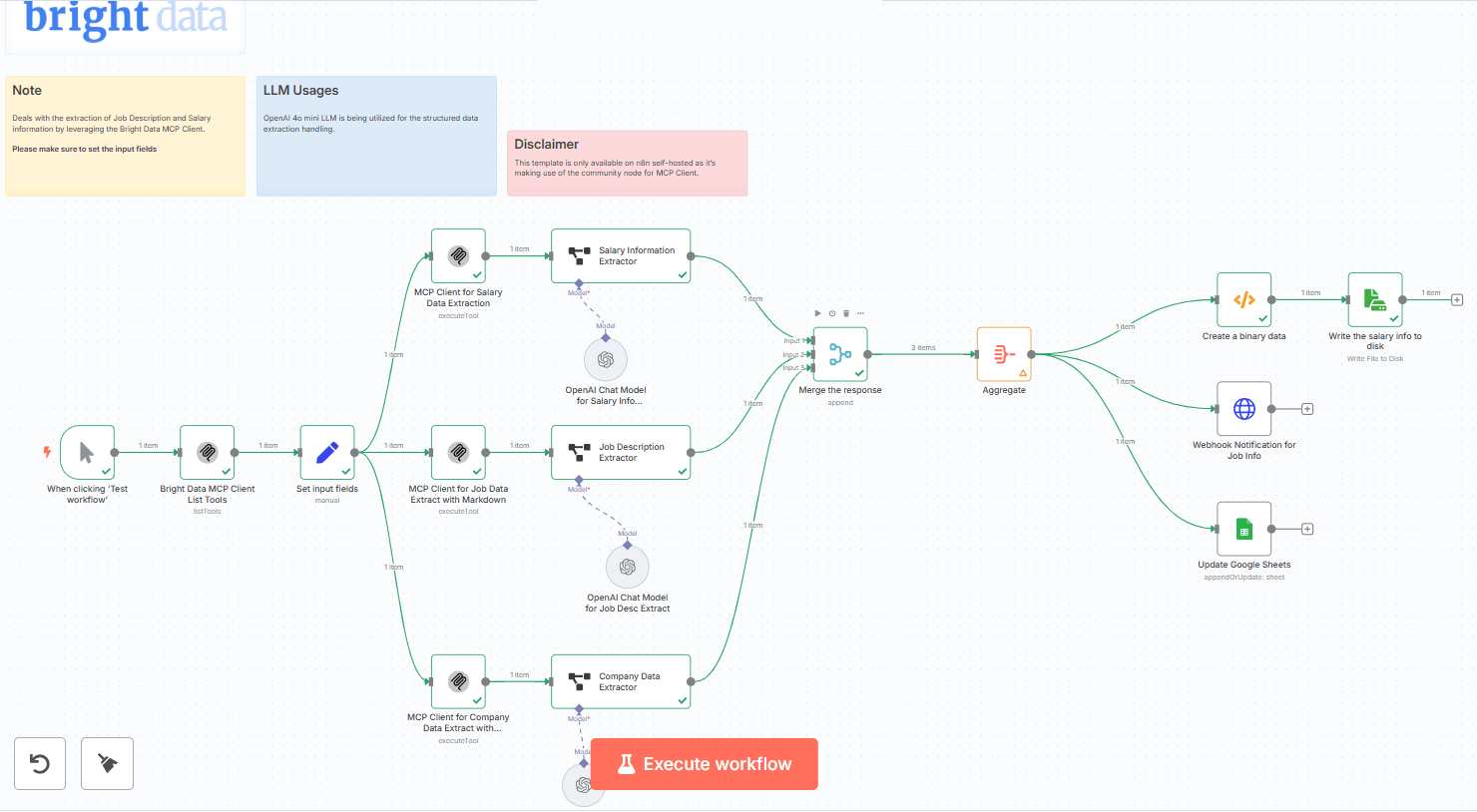
Workflow visualization showing data extraction process
The workflow architecture showing data flow from sources to analysis

How It Works

1. Job Listing Collection

Bright Data MCP accesses targeted job boards and career pages using rotating proxies to avoid detection. It extracts raw HTML content while handling CAPTCHAs and anti-bot measures automatically.

2. Data Structuring

The workflow parses HTML to identify key data fields (job title, company, location) using XPath selectors and regular expressions. Structured data is normalized into consistent formats.
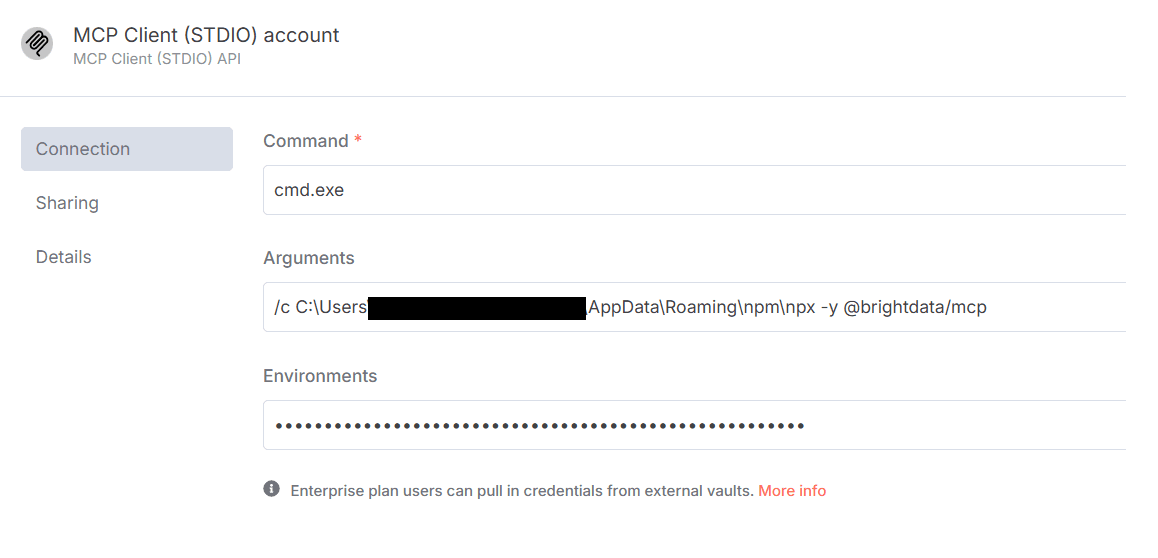
Bright Data MCP configuration
Bright Data MCP configuration for reliable web scraping

3. AI Analysis

OpenAI processes unstructured job descriptions to extract skills, experience requirements, and compensation details. It categorizes roles and summarizes key position aspects that aren't explicitly stated.

4. Output Generation

Final data is formatted into CSV reports, database entries, or API responses for integration with HR systems, compensation tools, or market analysis platforms.

Who This Is For

This automation benefits recruitment agencies tracking hiring trends, HR departments conducting compensation benchmarking, and business intelligence teams analyzing labor market conditions. It's particularly valuable for:

  • Talent acquisition specialists monitoring competitor hiring
  • Compensation analysts building salary band models
  • Business strategists identifying emerging skill demands
  • Academic researchers studying labor market dynamics

What You'll Need

  1. A self-hosted n8n instance (community nodes required)
  2. Bright Data MCP account with API access
  3. OpenAI API key with GPT-4 access
  4. Target job board URLs or search parameters
  5. Output destination (database, spreadsheet, or HR system)

Pro tip: Start with a small test set of job postings to validate your data extraction patterns before scaling to high-volume collection.

Quick Setup Guide

  1. Import the JSON template into your n8n instance
  2. Configure Bright Data MCP credentials in the HTTP Request nodes
  3. Add your OpenAI API key to the AI processing nodes
  4. Adjust XPath selectors for your target job board structures
  5. Map output fields to your preferred destination format
  6. Test with sample URLs before activating the full workflow

Key Benefits

90% time reduction in job market research by eliminating manual data collection and entry processes.

Real-time intelligence on competitor hiring activity instead of relying on outdated reports.

Standardized analysis across multiple job sources using consistent evaluation criteria.

Actionable insights from AI-powered interpretation of unstructured job description content.

Scalable solution that grows with your data needs without proportional staffing increases.

Frequently Asked Questions

Common questions about job data extraction and automation

Bright Data MCP (Managed Cloud Proxy) is used for reliable web scraping of job listings while avoiding IP blocks. It handles proxy rotation and CAPTCHAs, ensuring continuous data collection from job boards and company career pages without interruption.

For HR teams, this means getting complete market data without manual searching. The system automatically retries failed requests and rotates IP addresses to mimic organic traffic patterns from different geographic locations.

  • Maintains high success rates for data collection
  • Automatically bypasses anti-scraping measures
  • Provides geographic targeting capabilities

OpenAI analyzes unstructured job descriptions to extract standardized data points like required skills, experience levels, and compensation ranges. It can also categorize roles, identify key qualifications, and summarize position details from varied job posting formats.

Where traditional parsing might miss implicit requirements, AI understands context. For example, it can distinguish between "5+ years experience preferred" and "senior-level position" as equivalent seniority indicators despite different phrasing.

  • Interprets nuanced language in job ads
  • Identifies equivalent requirements across postings
  • Extracts unstated position requirements

Recruitment agencies, HR departments, compensation analysts, and job market researchers gain significant benefits. Automated data collection eliminates manual entry while providing real-time competitive intelligence on hiring trends and salary benchmarks across industries.

Staffing firms use this to identify companies actively hiring. Tech companies monitor competitor engineering team growth. Compensation specialists build accurate salary ranges without costly surveys.

  • Reduces labor-intensive market research
  • Provides early indicators of industry shifts
  • Supports data-driven compensation decisions

Modern extraction tools achieve 90-95% accuracy for structured data fields. OpenAI's NLP capabilities improve accuracy by interpreting context in job descriptions. Regular validation checks against known data points help maintain quality control in automated systems.

For example, location fields might show "Remote - US" while the description mentions "East Coast preferred." The system reconciles these into accurate geographic parameters through contextual analysis.

  • Higher accuracy than manual data entry
  • Context-aware interpretation reduces errors
  • Configurable validation rules catch outliers

Always check robots.txt files and terms of service before scraping. Focus on public job boards rather than private profiles. Ethical scraping practices include rate limiting, respecting opt-out requests, and using data only for permitted purposes like market analysis.

Many job boards explicitly allow aggregation for non-commercial research. Commercial users should review API licensing options or consider purchasing official data feeds where available.

  • Respect robots.txt directives
  • Follow published rate limits
  • Use data only for permitted purposes

For competitive intelligence, refresh data weekly or bi-weekly. Compensation benchmarks should be updated quarterly. High-volume recruiters may need daily updates for in-demand roles. Automation allows continuous monitoring without manual effort.

Tech roles often turn over faster than other positions. Configure your workflow to prioritize high-velocity job categories with more frequent refresh cycles based on your hiring needs.

  • Align refresh rates with hiring urgency
  • Prioritize high-demand roles
  • Automate seasonal adjustment factors

Yes, GrowwStacks specializes in tailored job market intelligence systems. We can build custom scrapers targeting specific job boards, enhance data analysis with your proprietary algorithms, and integrate results with your HR systems.

Our solutions adapt to your unique data requirements and compliance needs. We implement enterprise-grade monitoring, alerting for data anomalies, and scheduled reporting tailored to your decision cycles.

  • Custom integrations with your HR tech stack
  • Proprietary analysis algorithms
  • Compliance with your data policies

Need a Custom Job Data Extraction Solution?

This free template is a starting point. Our team builds fully tailored automation systems for your specific needs.