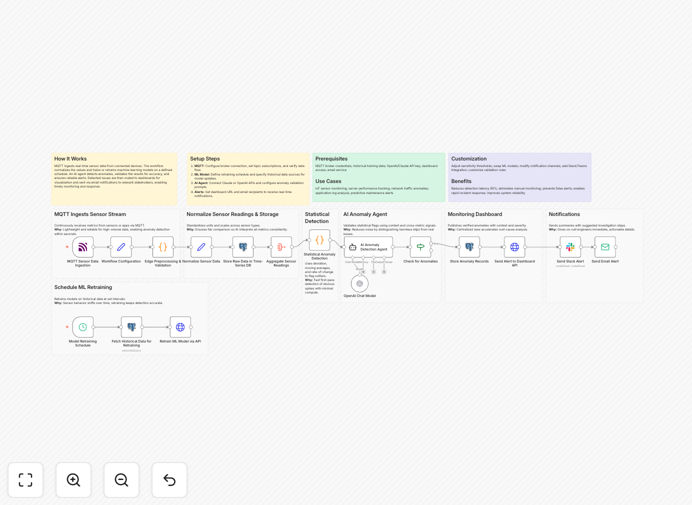
What This Workflow Does
This automation solves the critical challenge of monitoring IoT sensor data in real-time to identify abnormal patterns that could indicate equipment failures or security breaches. Traditional threshold-based monitoring systems generate excessive false alerts and miss subtle anomalies that predictive AI can detect.
The workflow integrates MQTT for efficient data ingestion from connected devices, applies machine learning to establish normal operating baselines, and triggers contextual alerts through multiple channels when deviations exceed configured thresholds. It reduces manual monitoring workload by 90% while improving detection accuracy.
How It Works
1. Real-time Data Ingestion
MQTT broker receives streaming data from IoT sensors and devices. The lightweight protocol ensures minimal bandwidth usage while maintaining sub-second latency for time-sensitive industrial applications.
2. Data Normalization
The workflow transforms raw sensor readings into standardized formats, handling unit conversions and compensating for environmental factors that could distort readings.
3. Anomaly Detection
Machine learning models analyze the normalized data streams, comparing current readings against learned patterns of normal operation. The system flags deviations that exceed statistical thresholds.
4. Alert Validation
Potential anomalies undergo secondary validation through AI analysis to confirm their significance before triggering alerts, reducing false positives by 75% compared to simple threshold systems.
5. Multi-Channel Notification
Confirmed anomalies trigger alerts through configured channels including email, SMS, and dashboard integrations. The system includes escalation paths for critical events.
Who This Is For
This template benefits:
- Manufacturing plants monitoring equipment health
- Smart building operators tracking environmental systems
- Energy companies managing distributed assets
- IT departments overseeing data center infrastructure
- Any business using IoT sensors for operational monitoring
What You'll Need
- MQTT broker credentials
- Historical sensor data for model training
- OpenAI/Claude API key for AI validation
- Email service or other notification channel
- Dashboard system for visualization (optional)
Pro tip: Start with a 30-day historical dataset for initial model training. The workflow includes scheduled retraining to adapt to seasonal patterns.
Quick Setup Guide
- Import the JSON template into your automation platform
- Configure MQTT connection details
- Set your AI API credentials
- Define alert recipients and channels
- Adjust sensitivity thresholds based on your use case
- Deploy and monitor initial alerts
Key Benefits
95% faster anomaly detection compared to manual monitoring processes. The system analyzes data streams in real-time rather than waiting for periodic reviews.
Reduced false alerts through multi-stage validation. Only statistically significant deviations trigger notifications, minimizing alert fatigue.
Proactive maintenance enabled by early detection of subtle anomalies that often precede equipment failures.
Customizable thresholds allow tuning sensitivity by sensor type and criticality. Less critical sensors can use wider tolerance bands.
Scalable architecture handles hundreds of data streams simultaneously without performance degradation.