What This Workflow Does
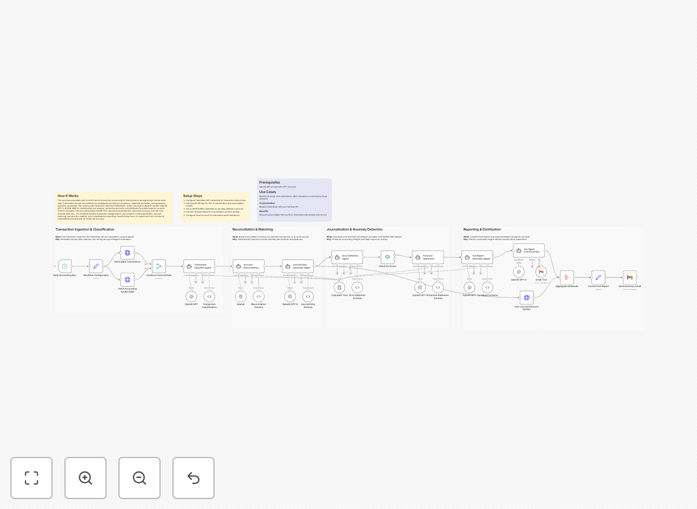
Manual bank reconciliation is one of the most time-consuming and error-prone tasks in finance. This workflow automates the entire process—from pulling transaction data to generating insightful reports. It connects to banking data sources, uses AI to categorize transactions and detect anomalies, reconciles accounts automatically, and distributes polished financial summaries via email.
For finance teams, this means transforming what used to be hours of tedious work into minutes of automated processing. The system handles high-volume transaction data with precision, reduces human error by up to 90%, and provides real-time visibility into financial health. Whether you're closing monthly books or monitoring daily cash flow, this automation ensures accuracy and saves valuable time.
How It Works
1. Transaction Data Collection
The workflow begins by connecting to your banking API or importing transaction files. It securely pulls recent transactions, including dates, amounts, descriptions, and counterparty information. This data is standardized and prepared for analysis, regardless of the original format.
2. AI-Powered Classification & Analysis
Using AI models like GPT-4, each transaction is intelligently categorized (e.g., "Software Subscription," "Office Supplies," "Client Payment"). The system learns from your historical data to improve accuracy over time. Simultaneously, anomaly detection algorithms flag unusual transactions that might indicate errors or fraud.
3. Automated Reconciliation
The workflow matches bank transactions against your internal accounting records. Discrepancies are automatically identified and can be routed for review. Successful matches are marked as reconciled, creating a clear audit trail and ensuring your books always match your bank statements.
4. Report Generation & Distribution
Once reconciliation is complete, the system generates comprehensive financial reports. These include cash flow summaries, expense breakdowns, anomaly alerts, and executive summaries. Reports are formatted professionally and distributed automatically via email to stakeholders on a scheduled basis.
Pro tip: Start with weekly reconciliations to build confidence in the automation, then move to daily processing for real-time financial visibility.
Who This Is For
This automation is ideal for small to medium businesses, accounting firms, finance managers, and solopreneurs who spend significant time on manual bookkeeping. Specifically:
- Finance teams at growing companies needing to scale processes without adding headcount
- Accounting professionals who want to offer more value-added services to clients
- E-commerce businesses with high transaction volumes across multiple payment processors
- Startup founders who need accurate financial data without dedicated accounting staff
- Non-profits requiring strict financial oversight and reporting for grant compliance
What You'll Need
- Banking API access or regular transaction export files (CSV, OFX, QFX formats)
- OpenAI API key for GPT-4 transaction categorization and analysis
- Gmail account or email service for report distribution
- n8n instance (self-hosted or cloud) to run the workflow
- Basic understanding of your chart of accounts and expense categories
Quick Setup Guide
Follow these steps to implement this automation in your business:
- Download and import the template JSON file into your n8n instance
- Configure banking credentials in the HTTP Request or Webhook nodes to connect to your financial data source
- Add your OpenAI API key to enable AI-powered transaction analysis
- Set up Gmail integration with appropriate security permissions for sending reports
- Customize report templates to match your company branding and information requirements
- Test with historical data to verify accuracy before going live with current transactions
- Schedule the workflow to run daily, weekly, or monthly based on your reconciliation needs
Pro tip: Run the automation in "test mode" for one full cycle before fully implementing it. Compare its results with your manual reconciliation to build trust in the system.
Key Benefits
Reduce reconciliation time by 80-90%. What used to take hours each month now happens automatically in minutes, freeing your finance team for strategic work.
Improve accuracy and reduce errors. Automated matching eliminates human mistakes in data entry and calculation, ensuring your financial records are consistently accurate.
Gain real-time financial insights. With daily automated reconciliation, you always know your exact cash position and can make informed decisions faster.
Enhanced fraud detection. AI algorithms continuously monitor for unusual patterns that might indicate fraudulent activity, providing an additional layer of security.
Scalable financial processes. As your transaction volume grows, the automation scales effortlessly without requiring additional manual effort or staff.