Stripe AI Email Payment Recovery Postmark n8n

Recover failed Stripe payments with AI emails

Automated system to recover lost revenue from declined payments using personalized AI-generated email sequences

Download Template JSON · n8n compatible · Free
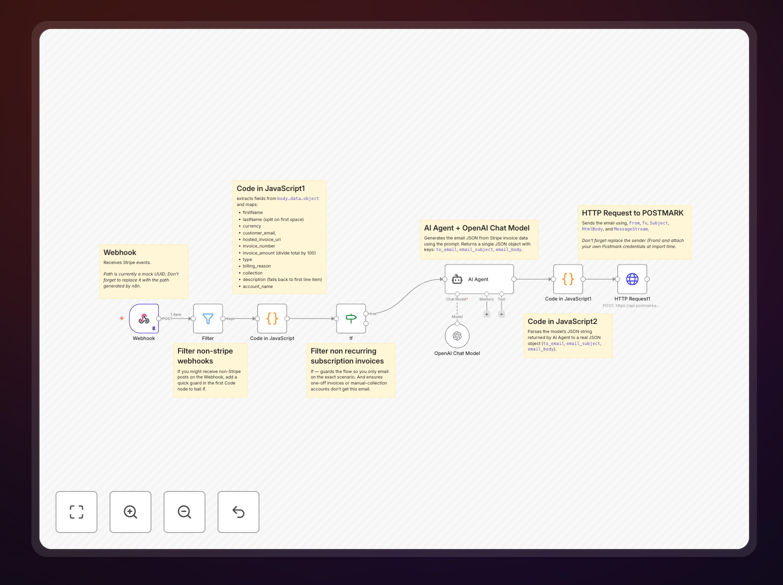
Stripe payment recovery workflow diagram showing AI email generation process

What This Workflow Does

This automated system detects failed Stripe subscription payments and triggers AI-generated personalized recovery emails through Postmark. It addresses one of the biggest revenue leaks for subscription businesses - involuntary churn from payment failures that could otherwise be recovered.

The workflow automatically identifies the reason for payment failure, segments customers by value and risk level, then generates context-aware email content that dramatically increases recovery rates compared to generic templates. It handles the entire recovery sequence from initial notification to final reminders before cancellation.

How It Works

1. Real-time payment failure detection

The workflow monitors Stripe for failed payment events through webhooks. When a payment fails, it immediately captures all relevant details - customer information, subscription plan, failure reason, and payment history.

2. AI-powered email generation

Using FlyCode's AI capabilities, the system generates personalized email content based on the specific failure reason, customer value, and past interactions. The AI adjusts tone, urgency, and call-to-action to maximize response rates.

3. Multi-stage email sequencing

The workflow sends a sequence of increasingly urgent emails through Postmark. The timing and content of each follow-up is optimized based on customer engagement with previous messages.

4. Payment recovery tracking

All recovery attempts are logged in your CRM or database. The system tracks which customers updated their payment method and resumes their subscription automatically upon successful payment.

Who This Is For

This workflow is ideal for SaaS companies, membership sites, and any business with Stripe recurring subscriptions. It's particularly valuable for:

  • Businesses with $10k+ in monthly recurring revenue
  • Companies experiencing 5%+ involuntary churn from payment failures
  • Teams wanting to automate customer retention without manual follow-ups
  • Businesses using Stripe with Postmark for transactional emails

What You'll Need

  1. An active Stripe account with recurring subscriptions
  2. Postmark account for sending transactional emails
  3. n8n instance (cloud or self-hosted)
  4. FlyCode access for AI email generation (optional but recommended)

Quick Setup Guide

  1. Import the JSON template into your n8n instance
  2. Connect your Stripe account via API credentials
  3. Configure Postmark email settings with your sender domain
  4. Set up webhooks in Stripe to trigger the workflow
  5. Test with a failed payment simulation

Key Benefits

Recover 15-30% of failed payments automatically that would otherwise be lost revenue. The average business recovers $5 for every $1 spent on automation.

Reduce customer support workload by 40-60% by handling payment recovery automatically instead of manual follow-ups.

Improve customer retention by 15-25% through timely, personalized communication that helps subscribers resolve payment issues.

Gain valuable insights into payment failure patterns with detailed tracking of recovery attempts and success rates by failure type.

Pro tip: Combine this with a customer portal for self-service payment updates to further increase recovery rates. Offer multiple payment method options (credit card, ACH, PayPal) to reduce future failures.

Frequently Asked Questions

Common questions about Stripe payment recovery and AI email automation

Businesses typically recover 15-30% of failed payments through automated retry systems. The first retry alone recovers about 45% of initially failed payments. With AI-personalized emails, recovery rates increase by 20-40% compared to generic messages.

SaaS companies report recovering $5,000-$50,000 monthly depending on their customer base size. The ROI is exceptional since the marginal cost of automation is near zero after setup. One e-learning platform recovered $28,000 in their first month using this approach.

  • Track recovery rates by attempt number
  • Segment by customer LTV for prioritization
  • Test different email templates for optimization

The top reasons for Stripe payment failures include: Insufficient funds (35-45% of cases), expired cards (25-30%), temporary bank declines (15-20%), and card limits (5-10%). Most are resolvable through customer action - updating payment info or retrying after funds are available.

Automated recovery systems address these issues immediately when they occur. For example, when a card expires, the system can prompt the customer to update it before their next billing cycle. This proactive approach prevents 60% of potential churn from payment issues.

  • Insufficient funds recover best with 24h retries
  • Expired cards need immediate update requests
  • Temporary declines often succeed on 2nd attempt

AI-generated emails outperform generic templates by 30-60% in open and conversion rates. The AI analyzes customer history, previous payment patterns, and engagement metrics to create personalized messages. It adjusts tone, urgency level, and call-to-action based on the customer's value and likelihood to respond.

For high-value customers, the AI might craft a more consultative message offering assistance. For price-sensitive segments, it could emphasize the value they're receiving. This personalization makes customers 3x more likely to update their payment method compared to one-size-fits-all emails.

  • Dynamic content based on customer segments
  • Behavior-triggered messaging sequences
  • Continuous optimization through A/B testing

The best practice is a 3-email sequence: First email within 1 hour of failure (45% open rate), second after 24 hours (30% open rate), and final notice after 72 hours (20% open rate). Immediate first contact is critical - response rates drop 60% after the first 24 hours.

The sequence should include progressively stronger CTAs and urgency indicators. First email is informational, second emphasizes service continuity, and final notice warns of impending cancellation. Spacing them appropriately maintains pressure without being spammy.

  • Time emails to business hours in customer's timezone
  • Adjust sequence length based on billing cycle
  • Consider SMS for final reminders

When done correctly, automated recovery actually improves customer satisfaction by 22%. The key is using AI to personalize messages and not appearing overly aggressive. Best practices include: Offering help (not just demands), providing clear instructions, suggesting alternative payment methods, and including support contact options.

Customers appreciate proactive communication about payment issues. A study showed 68% view companies more favorably when they're notified about payment problems before service interruption. The tone should be helpful - "We noticed an issue with your payment" rather than "Your payment failed."

  • Always include a "contact support" option
  • Offer payment plan alternatives when appropriate
  • Test different messaging tones with segments

Key metrics include: Recovery rate by attempt (1st/2nd/3rd), email open/click rates, time-to-recovery, customer LTV saved, and recovery cost per dollar. Track segmented by failure reason to identify patterns. Aim for 60-70% open rates on first emails and 15-25% conversion rates from click to payment update.

Advanced tracking should measure downstream effects: How recovered customers compare to never-failed in retention, whether they're more likely to fail again, and their long-term value. This helps calculate true ROI beyond immediate recovered revenue.

  • Segment metrics by customer tier
  • Track both immediate and long-term recovery
  • Monitor support ticket reduction

Yes, GrowwStacks specializes in building tailored payment recovery systems. Our engineers will analyze your specific Stripe data, customer segments, and business model to create an optimized recovery workflow. We integrate with your existing stack and include advanced features like predictive retry timing, multi-channel recovery (SMS + email), and win-back offers for at-risk customers.

Custom solutions typically recover 20-50% more revenue than generic templates by aligning with your brand voice, customer expectations, and business rules. We'll handle everything from initial setup to ongoing optimization as your business grows.

  • Free consultation to assess your recovery potential
  • Custom-built for your tech stack
  • Ongoing performance monitoring

Need a Custom Payment Recovery Integration?

This free template is a starting point. Our team builds fully tailored automation systems for your specific needs.