What This Workflow Does
This workflow solves a critical challenge facing businesses using multiple AI services: balancing cost-efficiency with output quality. When you're paying for premium AI models like Anthropic Claude and OpenAI, using them for every single query—regardless of complexity—quickly becomes financially unsustainable. Yet, you can't compromise on quality for important customer interactions or complex analytical tasks.
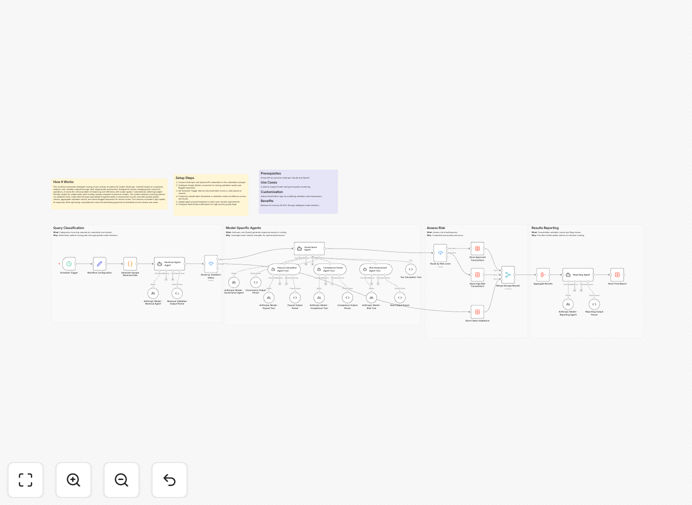
The system automates intelligent routing of user queries to optimal AI models based on real-time complexity analysis, then validates outputs through multi-stage quality assessment. It analyzes incoming queries via validation tools, routes them through specialized AI agents based on assessment scores, executes parallel quality checks across compliance, bias, and risk dimensions, aggregates validation results, and stores flagged responses for human review.
This ensures consistent, high-quality AI responses while optimizing computational costs and maintaining governance standards across diverse use cases—from simple customer inquiries to complex financial analysis.
How It Works
1. Query Analysis & Complexity Scoring
Incoming user queries are analyzed using validation tools that assess complexity, intent, and required response quality. The system scores each query based on multiple factors including technical difficulty, compliance requirements, and potential business impact.
2. Intelligent Model Routing
Based on the complexity score and predefined business rules, queries are automatically routed to the most appropriate AI model. Simple, routine queries go to cost-effective models, while complex, high-stakes requests are directed to premium AI services like Anthropic Claude for sophisticated analysis.
3. Parallel Quality Assessment
Once AI responses are generated, the system executes simultaneous quality checks across multiple dimensions: factual accuracy, compliance with regulations, potential bias detection, risk assessment, and tone appropriateness. This multi-layered validation happens in parallel to minimize processing time.
4. Results Aggregation & Flagging
Validation results from all quality checks are aggregated into a comprehensive quality score. Responses that fall below threshold scores or trigger specific risk flags are automatically routed to human review queues with detailed assessment reports.
5. Continuous Optimization
The system tracks routing decisions, quality outcomes, and cost metrics to continuously refine its routing logic. Over time, it learns which types of queries produce the best results from each AI model, optimizing both cost and quality performance.
Who This Is For
This workflow is ideal for businesses managing high-volume AI operations across customer support, financial services, healthcare, legal services, and education sectors. It's particularly valuable for teams balancing multiple AI service subscriptions, compliance officers needing governance oversight, operations managers controlling AI expenditure, and quality assurance teams monitoring AI output consistency.
Companies experiencing escalating AI costs without corresponding value increases will find immediate benefits, as will organizations struggling to maintain consistent quality across diverse AI interactions. The system scales from startups managing their first AI implementations to enterprises coordinating multiple AI services across departments.
What You'll Need
- Active API accounts for Anthropic Claude and OpenAI with appropriate usage credits
- n8n instance (cloud or self-hosted) with access to credential management
- Google Sheets or database connection for storing validation results and flagged responses
- Defined quality thresholds and routing rules based on your business requirements
- Team members designated for reviewing flagged responses (if implementing human review escalation)
Quick Setup Guide
Follow these steps to implement this intelligent AI routing system in your n8n environment:
- Import the template into your n8n instance using the downloaded JSON file
- Configure API credentials for Anthropic Claude and OpenAI in n8n's credential manager
- Set up data storage by connecting Google Sheets or your preferred database for results logging
- Customize validation thresholds in the assessment nodes to match your quality standards
- Define routing rules based on your cost constraints and quality requirements
- Test with sample queries to verify routing decisions and quality assessments
- Deploy and monitor initial performance, adjusting thresholds as needed based on real outcomes
Pro tip: Start with conservative routing rules and gradually expand as you gather performance data. It's better to route more queries to premium models initially while you establish baseline quality metrics, then optimize for cost once you have confidence in the system's assessment accuracy.
Key Benefits
Reduce AI operational costs by 40-60% through intelligent model selection that matches query complexity with appropriate—and cost-effective—AI resources. This immediate financial impact often pays for implementation within the first month of use.
Maintain consistent quality standards across all AI interactions with automated multi-dimensional assessment that would require multiple human reviewers to achieve manually. The system applies the same rigorous standards to every query, regardless of volume.
Scale AI operations efficiently without proportional increases in cost or quality oversight requirements. The automated routing and assessment system handles increased query volumes while maintaining both financial and quality control.
Gain detailed analytics on AI performance, cost distribution, and quality trends that inform strategic decisions about AI investment and deployment. The system provides actionable insights that help optimize your entire AI strategy.
Ensure compliance and risk management through automated checks that would be impractical to perform manually at scale. The system proactively identifies potential issues before they impact customers or violate regulations.