n8n RSS Content Distribution

RSS Feed News Processing and Distribution Workflow

Automatically monitor multiple RSS feeds, filter relevant content, and distribute updates across your channels. Save hours of manual tracking while ensuring you never miss important industry updates.

Download Template JSON · Zapier compatible · Free
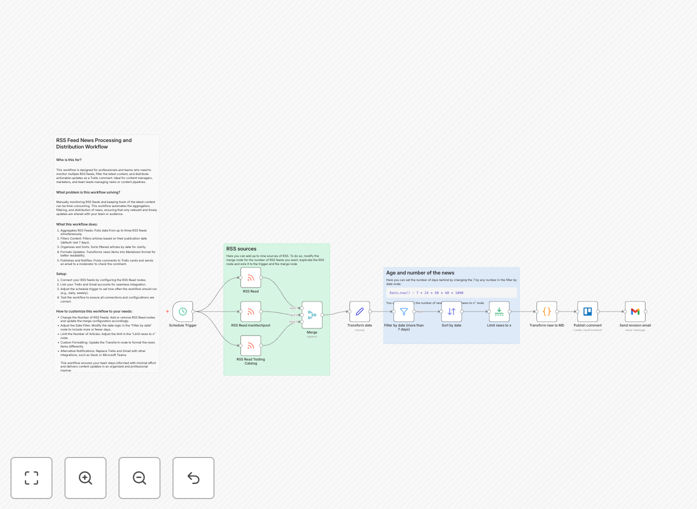
RSS feed processing workflow diagram

What This Workflow Does

This automation solves the time-consuming challenge of manually monitoring multiple RSS feeds for relevant content. Professionals in marketing, research, and competitive intelligence often waste hours each week checking various news sources, filtering irrelevant items, and distributing important updates to their teams or channels.

The workflow automatically aggregates content from all your configured RSS feeds, applies your custom filters to surface only the most relevant items, then distributes them through your preferred channels like email, Slack, or social media. It eliminates the need for constant manual checking while ensuring you never miss critical updates.

How It Works

1. Feed Aggregation

The workflow periodically checks all your configured RSS feeds for new content. It handles different feed formats and can process hundreds of sources simultaneously without missing updates.

2. Content Filtering

Using your predefined rules, the system filters out irrelevant items based on keywords, source reputation, content length, or other criteria you specify. This ensures only valuable content proceeds to distribution.

3. Content Enhancement

The workflow can add metadata, apply formatting, extract specific data points, or combine related items before distribution. This step transforms raw feed items into polished, actionable content.

4. Multi-Channel Distribution

Filtered content gets automatically sent to your configured destinations - whether that's email newsletters, Slack channels, social media queues, or internal knowledge bases.

Who This Is For

This workflow benefits content marketers who need to stay on top of industry news, research teams tracking academic publications, PR professionals monitoring brand mentions, and competitive intelligence specialists following market movements. Any professional who currently spends significant time manually checking multiple news sources will find this automation valuable.

What You'll Need

  1. A list of RSS feed URLs you want to monitor
  2. Your filtering criteria (keywords, sources, etc.)
  3. Destination channels configured (email, Slack, etc.)
  4. n8n or Zapier account for workflow execution

Quick Setup Guide

  1. Download the template file
  2. Import into your n8n or Zapier account
  3. Configure your RSS feed URLs
  4. Set up your content filters
  5. Connect your distribution channels
  6. Test with sample feeds
  7. Activate the workflow

Key Benefits

Save 5-10 hours weekly by eliminating manual RSS feed checking and content sorting. The automation handles this continuously in the background.

Never miss important updates with 24/7 monitoring that checks feeds more frequently than any human could.

Improve content relevance through consistent application of your filtering rules across all sources.

Scale effortlessly as your monitoring needs grow - add unlimited feeds without additional workload.

Frequently Asked Questions

Common questions about RSS feed integration and automation

Automating RSS feed processing saves significant time by eliminating manual monitoring of multiple sources. It ensures you never miss important updates while filtering irrelevant content. Businesses use this to maintain real-time industry awareness without constant manual checking.

For example, marketing teams automate competitor news tracking while filtering out unrelated industry content. The system works 24/7, checking feeds more frequently than any employee could while applying consistent filtering rules.

  • Reduces human error in content monitoring
  • Enables faster response to critical updates
  • Scales effortlessly as monitoring needs grow

Most businesses check RSS feeds every 15-60 minutes for time-sensitive content. Less critical feeds can be checked hourly or daily. The optimal frequency balances freshness with server load and API rate limits from feed providers.

Financial services firms might monitor market news feeds every 15 minutes, while HR teams could check job board RSS feeds twice daily. The automation allows different check frequencies per feed based on importance.

Effective RSS filters include keyword matching, sentiment analysis, source whitelisting, and content categorization. Advanced workflows can extract specific data points like stock prices or event dates from feed items for further processing.

Legal teams might filter for specific case references, while product teams could extract software version numbers from release notes. The most sophisticated systems use AI to understand context beyond simple keyword matching.

Yes, RSS automation commonly powers social media content calendars by filtering and formatting feed items for platforms like Twitter and LinkedIn. Many businesses add custom branding and commentary before automated distribution.

Marketing teams often configure workflows to queue approved content in social media management tools rather than posting directly. This maintains brand voice while automating the heavy lifting of content discovery.

Key metrics include new items processed per day, filter accuracy rates, click-through rates on distributed content, and time saved versus manual processing. Tracking helps optimize filters and distribution channels.

Successful implementations often show 70-90% reduction in irrelevant content reaching teams, along with 3-5x faster response times to critical updates compared to manual monitoring approaches.

For unstable RSS feeds, build redundancy with multiple parsing methods. Use AI tools to normalize varying formats, or maintain a library of parsing templates for different feed versions with automatic fallback options.

News sites that frequently redesign often break RSS parsers. Robust workflows include monitoring for parsing failures and automatically switching to alternative extraction methods when standard parsing fails.

Yes, GrowwStacks specializes in custom RSS automation solutions tailored to your specific sources, filters, and distribution needs. Our team designs workflows that integrate with your existing tools and processes for maximum efficiency.

We've built specialized RSS systems for legal case tracking, pharmaceutical research monitoring, and competitive product intelligence. Custom solutions handle unique requirements like regulatory compliance, multilingual content, or complex approval workflows.

Need a Custom RSS Feed Integration?

This free template is a starting point. Our team builds fully tailored automation systems for your specific needs.