n8n Brightdata Web Scraping AI Processing Hotel Data

Scrape hotel listings with prices from Booking.com using Brightdata & AI

Automate the collection of hotel availability, pricing, and amenities data for competitive analysis and dynamic pricing strategies

Download Template JSON · n8n compatible · Free
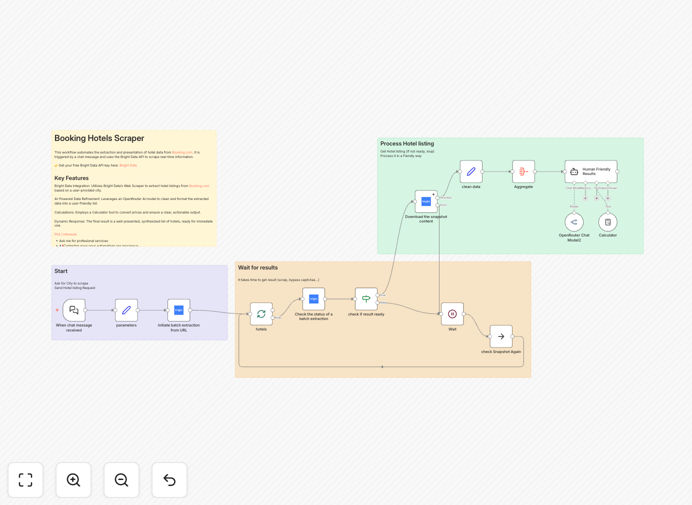
n8n workflow diagram for scraping Booking.com hotel data

What This Workflow Does

This n8n workflow automates the extraction of hotel listings, pricing, and availability data from Booking.com, combining Brightdata's professional web scraping capabilities with AI-powered data processing. It solves the time-consuming challenge of manually tracking competitor pricing and availability across multiple properties and dates.

The workflow is designed for travel businesses, hospitality providers, and market researchers who need reliable, up-to-date hotel data without manual effort. It handles the complexities of scraping a dynamic site like Booking.com that employs anti-bot measures, while transforming raw data into structured business intelligence.

How It Works

1. Trigger Setup

The workflow can be initiated manually or scheduled to run at specific intervals. Common triggers include receiving a chat message with search parameters or a scheduled cron job for regular data updates.

2. Search Parameter Configuration

Define the destination, check-in/out dates, room configurations, and other search criteria that would normally be entered on Booking.com. These parameters can be dynamically adjusted for each run.

3. Brightdata Web Scraping

Using Brightdata's residential proxies and browser automation, the workflow navigates Booking.com like a real user, collecting listing data while avoiding detection. It handles pagination to gather complete results.

4. AI Data Processing

Raw scraped data passes through AI modules that extract structured information from unstructured text - identifying room types, amenities, cancellation policies, and special offers that may affect pricing.

5. Output Generation

The final output is clean, structured data ready for analysis in your preferred format - typically CSV for spreadsheets or JSON for integration with other business systems.

Who This Is For

This workflow is ideal for:

  • Travel agencies monitoring competitor pricing
  • Hotel revenue management teams optimizing rates
  • Market research firms tracking hospitality trends
  • Travel tech startups building price comparison tools
  • Corporate travel managers optimizing accommodation budgets

Pro tip: Combine this data with your own booking patterns to identify when competitor price changes actually impact your conversion rates, allowing for more strategic pricing decisions.

What You'll Need

  1. An n8n instance (cloud or self-hosted)
  2. Brightdata account with web scraping capabilities
  3. Booking.com affiliate account (recommended for commercial use)
  4. Optional: AI service API key (like OpenAI) for advanced data processing

Quick Setup Guide

  1. Download the JSON template file
  2. Import into your n8n instance
  3. Configure your Brightdata credentials in the web scraping node
  4. Set your search parameters (or connect to dynamic inputs)
  5. Test with a single property before scaling up
  6. Configure your output format and destination

Key Benefits

Save 10+ hours weekly by automating what would otherwise require manual searches and data entry for each property and date combination.

Improve pricing accuracy with access to real-time competitor data rather than relying on periodic manual checks that quickly become outdated.

Scale your monitoring to track hundreds of properties across multiple markets without proportional increases in research time.

Enhance decision-making with structured data that can be analyzed for trends rather than raw listings that require interpretation.

Reduce human error by eliminating manual transcription mistakes in critical pricing and availability information.

Frequently Asked Questions

Common questions about hotel data scraping and automation

Automating hotel data collection saves hours of manual research while ensuring you get the most current pricing and availability information. For travel agencies, price comparison services, or hospitality businesses, having automated access to this data enables dynamic pricing strategies, competitive analysis, and real-time availability tracking without the need for manual searches.

The alternative - manually checking competitor prices - becomes impractical when tracking multiple properties across different dates. Automation provides consistent data collection at scale, allowing businesses to focus on strategy rather than data gathering.

  • Eliminates tedious manual price checking
  • Provides data consistency across all tracked properties
  • Enables timely response to market changes

Web scraping falls into a legal gray area that depends on how the data is collected and used. Using professional tools like Brightdata that respect rate limits and robots.txt rules helps ensure compliance. The data should be used for internal business purposes rather than republished directly. Always consult legal counsel regarding your specific use case.

Booking.com's terms of service prohibit scraping, but courts have ruled that publicly available data may be collected for certain purposes. The key factors are whether the scraping causes harm to the service (through server overload) and whether the data is used in ways that compete unfairly with the original site.

  • Use residential proxies to minimize detection
  • Limit request rates to avoid overloading servers
  • Never republish scraped content verbatim

Brightdata provides residential proxies that mimic real user behavior, reducing the chance of being blocked. Their infrastructure handles JavaScript rendering, CAPTCHAs, and anti-bot measures automatically. For hotel data specifically, Brightdata can maintain sessions across multiple pages to collect complete pricing details that often require user-like navigation patterns.

Unlike simple scraping tools, Brightdata's network can distribute requests geographically, which is valuable for hotel searches where prices may vary by user location. Their systems also automatically rotate IP addresses and user agents to prevent pattern detection that could trigger blocking mechanisms.

  • Residential IPs appear as regular users
  • Automatic handling of anti-bot challenges
  • Geotargeting for location-specific pricing

AI can clean and structure the raw scraped data, extract specific amenities from descriptions, categorize room types, detect price patterns, and even predict availability changes. This transforms raw listings into actionable business intelligence. For example, AI could identify when a hotel consistently offers last-minute discounts.

Natural language processing can interpret unstructured text about room features, policies, and promotions that would otherwise require manual review. Machine learning algorithms can then surface insights like which amenities correlate with price premiums or how far in advance prices tend to drop for specific property types.

  • Extracts structured data from free-text descriptions
  • Identifies patterns across multiple data points
  • Reduces manual data cleaning effort

Travel agencies use it for competitive pricing. Revenue management systems incorporate it for dynamic pricing strategies. Business travel platforms integrate it for cost optimization. Hospitality tech companies analyze market trends. The data also powers hotel recommendation engines and availability alert systems for customers.

Beyond direct travel applications, the data serves investment analysts tracking hospitality sector performance, event planners negotiating group rates, and tourism boards monitoring market capacity. The common thread is replacing guesswork with data-driven decisions about pricing, availability, and market positioning.

  • Dynamic pricing algorithms
  • Market trend analysis
  • Occupancy rate forecasting

For most business applications, daily updates are sufficient, but high-demand periods may require multiple daily scrapes. The ideal frequency balances data freshness with resource usage. Many businesses run morning and evening scrapes to catch price changes while avoiding peak booking times when website performance may suffer.

The optimal update frequency depends on your use case - revenue managers may need near-real-time data during high season, while market researchers might prioritize comprehensive weekly snapshots. Consider both the volatility of prices in your target markets and how quickly you can act on the information when setting your scraping schedule.

  • Base frequency on decision-making needs
  • Increase during high-demand periods
  • Monitor for patterns in price change timing

Yes, GrowwStacks specializes in building custom web scraping and data processing automations tailored to specific business needs. We can create solutions that integrate directly with your existing systems, add specialized data processing, and scale to handle your required volume while maintaining reliable data quality.

Our team develops complete solutions that go beyond simple scraping - we build the data pipelines, analysis tools, and reporting dashboards that turn raw hotel data into actionable business intelligence. Whether you need to track specific competitor sets, monitor particular rate types, or integrate with your revenue management system, we can design an automation solution that fits.

  • Tailored to your specific property portfolio
  • Integrated with your existing tech stack
  • Scalable as your monitoring needs grow

Need a Custom Hotel Data Automation?

This free template is a starting point. Our team builds fully tailored automation systems for your specific needs.