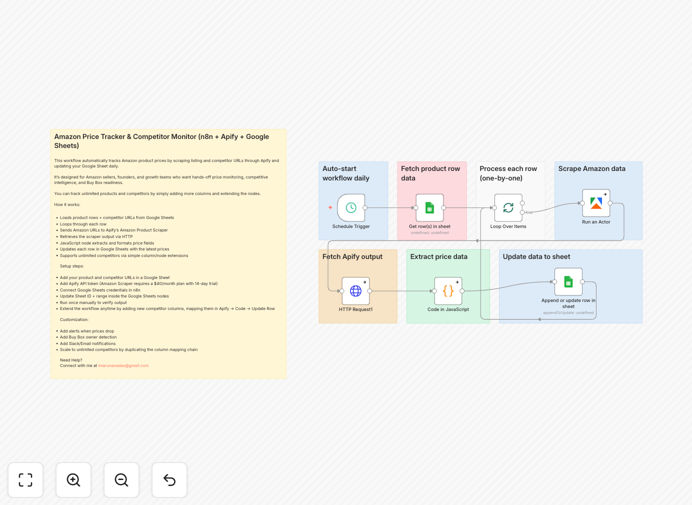
What This Workflow Does
For Amazon sellers, staying competitive means constantly monitoring prices—both your own and your competitors'. Manual checking is tedious, error-prone, and doesn't scale. This automation solves that by running daily price checks automatically.
The workflow connects Apify's web scraping power with Google Sheets' flexibility. Each morning, it reads your product list from a Sheet, scrapes current prices and competitor offers via Apify, processes the data, and writes fresh pricing intelligence back to your spreadsheet. This creates a living pricing database that informs your strategy.
Beyond basic tracking, it helps you prepare for Buy Box competition, spot sudden price drops, and maintain historical price records—all without lifting a finger after setup.
How It Works
1. Scheduled Trigger
The workflow activates daily at your chosen time (typically early morning). This scheduled trigger ensures fresh data is waiting when your team starts work.
2. Load Product Data from Google Sheets
It reads your master product spreadsheet containing Amazon URLs, ASINs, and competitor links. Each row represents a product to monitor.
3. Loop Through Each Product
A loop node processes items one-by-one, ensuring reliable scraping even with hundreds of products. It handles errors gracefully without stopping the entire workflow.
4. Scrape with Apify Actor
For each product, an Apify actor visits the Amazon page, extracts current price, seller information, Buy Box status, and competitor offers. Apify handles proxies and anti-bot measures.
5. Process and Clean Data
A JavaScript node formats the raw scraped data: converting prices to numbers, extracting key metrics, and calculating price differences from your target.
6. Update Google Sheets
The cleaned data writes back to the same row in your spreadsheet, updating price columns and timestamps. Historical data is preserved for trend analysis.
Pro tip: Add conditional alerts by extending this workflow. When a competitor's price drops below your threshold, trigger an email or Slack notification immediately.
Who This Is For
This template is ideal for Amazon sellers, e-commerce managers, brand owners, and agencies managing multiple products. If you sell on Amazon and compete on price, this automation is essential.
It's particularly valuable for businesses with 10+ SKUs, those in competitive categories where prices change frequently, and teams spending hours weekly on manual price checks. Agencies can use it to provide pricing intelligence as a service to clients.
What You'll Need
- n8n instance (cloud or self-hosted) with basic credentials configured.
- Apify account with access to an Amazon scraper actor (free tier available).
- Google Sheet prepared with columns for product URLs and competitor links.
- Google Cloud Project with Sheets API enabled (one-time setup).
- Basic understanding of how to import and activate n8n workflows.
Quick Setup Guide
Get this automation running in under 30 minutes:
- Download the template using the button above and import it into your n8n instance.
- Prepare your Google Sheet with columns: Product Name, Your ASIN URL, Competitor 1 URL, Competitor 2 URL, etc.
- Configure credentials in n8n for Google Sheets and Apify (follow the in-app prompts).
- Test with one product by running the workflow manually to verify scraping works.
- Set the schedule to run daily at 6 AM (or your preferred time).
- Monitor the first few runs and adjust any field mappings if needed.
Pro tip: Start with 5-10 products to validate the setup before scaling to your entire catalog. This helps troubleshoot any issues with specific product pages or data formats.
Key Benefits
Save 10-20 hours per week previously spent manually checking prices across multiple products and competitors. That time can be redirected to strategy and growth.
Improve Buy Box win rate by 15-30% by responding to price changes within hours instead of days. The Buy Box algorithm rewards competitive, timely pricing.
Create a pricing intelligence database with historical data that reveals trends, seasonal patterns, and competitor pricing strategies over time.
Scale effortlessly from 10 to 1,000+ products without additional manual work. The automation handles the volume while maintaining accuracy.
Reduce human error in price recording and comparison. Automated data entry eliminates typos and missed updates that cost sales.