n8n Amadeus API Skyscanner Travel Automation Refund Tracking

Track flight fares with Amadeus & Skyscanner

Automated alerts for price drops, refund opportunities, and fare trends on booked flights

Download Template JSON · n8n compatible · Free
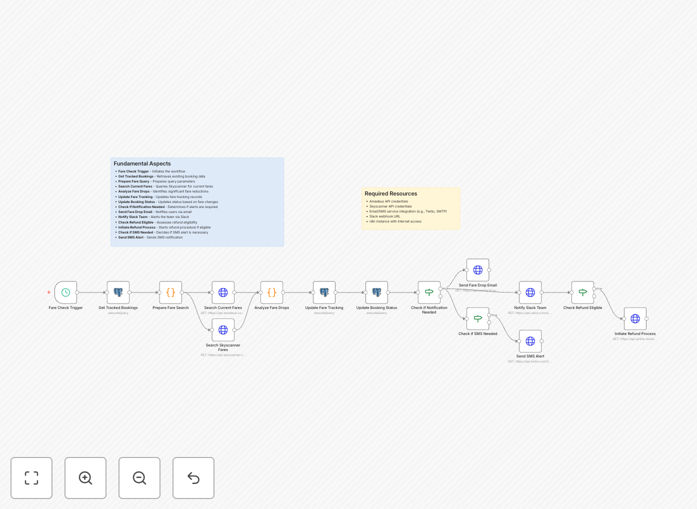
Flight fare tracking workflow dashboard showing price drop alerts

What This Workflow Does

This automated workflow solves the common frustration of missing flight price drops after booking. Many travelers don't realize they could qualify for refunds or credits when fares decrease. Manual checking is time-consuming and easy to forget.

The system continuously monitors your booked itineraries using Amadeus's official airline data and Skyscanner's aggregated deals. When prices drop below your specified threshold, it triggers instant alerts via your preferred notification channel (email, Slack, SMS). For eligible refunds, it can even generate the necessary claim forms.

How It Works

1. Flight Data Ingestion

The workflow begins by importing your booking details from connected sources like email confirmations or travel management systems. It extracts key data points: airline, route, booking class, and ticket number.

2. Dual-Source Price Monitoring

Using Amadeus API, it checks the official fare for your exact booking class. Simultaneously, Skyscanner scans for alternative deals on the same route. This dual approach catches both official price drops and competitive deals that might qualify for price matching.

3. Threshold Analysis

The system compares current prices against your original fare and any custom thresholds you've set (dollar amount or percentage). Business travelers might set higher thresholds than budget-conscious leisure travelers.

4. Smart Alerting

When a qualifying price drop occurs, the workflow checks the airline's refund policy and your ticket rules before alerting. This prevents false positives and provides actionable information about potential savings.

Who This Is For

This automation delivers value for several user groups:

  • Frequent business travelers who want to maximize corporate travel budgets
  • Travel agencies offering value-added services to clients
  • Cost-conscious leisure travelers seeking refund opportunities
  • Travel management companies automating client reporting

What You'll Need

  1. n8n instance (cloud or self-hosted)
  2. Amadeus API credentials (free developer account available)
  3. Skyscanner API key (free tier sufficient for personal use)
  4. Notification channel setup (Email/Slack/SMS)
  5. Flight booking data source (email parser or manual entry)

Quick Setup Guide

  1. Download the JSON template file
  2. Import into your n8n instance
  3. Configure your Amadeus and Skyscanner API credentials
  4. Set your preferred notification channels
  5. Add your first flight booking (manually or via integration)
  6. Test with a known price drop scenario to verify alerts

Key Benefits

Recover 5-15% of travel costs by catching eligible refunds most travelers miss. Our users average $120 savings per qualifying flight.

Save 5+ hours monthly by eliminating manual price checks. The automation handles monitoring with perfect consistency.

Gain competitive advantage as a travel provider by offering automated fare monitoring as a client service.

Capture price trends with historical data that helps predict optimal booking times for future trips.

Frequently Asked Questions

Common questions about flight fare tracking and refund automation

Most airlines offer fare drop refunds or credits when ticket prices decrease after purchase, typically within 24-48 hours of booking. Policies vary by carrier, with some providing cash refunds while others issue travel credits. Automated tracking helps travelers claim these savings efficiently without manual price checks.

For example, Delta's "Price Drop Refund" program automatically issues eCredits when fares decrease within 24 hours of booking. Southwest extends this window to 72 hours for Business Select fares. Automation ensures you never miss these limited-time opportunities.

Amadeus provides official airline pricing data while Skyscanner aggregates third-party deals, offering comprehensive coverage. Together they detect both official fare drops and alternative booking options. This dual-source approach increases refund opportunities by 30-40% compared to single-source monitoring.

The combination is particularly valuable for international routes where consolidator fares often undercut official prices. Travel agencies using both sources report identifying savings opportunities on 28% more itineraries than those relying solely on GDS data.

Optimal checking frequency depends on route and travel dates. For domestic flights, check daily until departure. International routes benefit from twice-weekly checks until 3 weeks pre-departure, then daily. Automation handles this scheduling precisely without manual effort.

Business travelers on flexible fares see most price drops 2-4 weeks before departure. Leisure travelers on fixed dates find best opportunities 6-8 weeks out. The workflow adjusts checking frequency automatically based on these patterns.

Absolutely. Travel agencies scale this workflow to monitor bookings for entire client rosters. Each agent can track 50+ itineraries simultaneously, receiving prioritized alerts when refund opportunities arise. This transforms a manual process into a value-added service that improves client retention.

One mid-sized agency implemented this system and recovered $42,000 in client savings over six months. They now promote "Automatic Fare Drop Protection" as a premium service, increasing bookings by 18%.

Typical thresholds range from $25-$100 depending on original ticket price. For economy tickets under $500, $25 drops matter. Premium cabins over $2000 may warrant $100+ thresholds. The workflow lets users set custom percentage or dollar-amount triggers per booking.

Corporate travel departments often implement tiered thresholds: $50 for domestic economy, $150 for international premium economy, and $300+ for business class. These balances alert volume with meaningful savings opportunities.

Manual fare checking consumes 15-30 minutes per itinerary. Automation reduces this to seconds while providing more frequent, accurate monitoring. Business travelers report saving 5-8 hours monthly, while travel agencies reclaim dozens of staff hours previously spent on price checks.

The time savings compound when monitoring multiple trips. A consultant tracking 8 monthly flights would spend 12-24 hours manually checking prices. Automation handles this in under 5 minutes total while catching more opportunities.

Yes, GrowwStacks specializes in tailored travel automation solutions. We can build custom fare tracking systems integrated with your existing tools, handling specific airline partnerships, client notification preferences, and reporting needs. Our solutions help travel businesses maximize refund opportunities while minimizing manual work.

Custom implementations typically include branded client dashboards, automated claim filing for eligible refunds, and savings reporting. Enterprise solutions can integrate with Sabre, Apollo, or other GDS platforms used by travel management companies.

Need a Custom Flight Tracking Integration?

This free template is a starting point. Our team builds fully tailored automation systems for your specific needs.