n8n Google Sheets GPT-4o Marketing Analytics

UTM Marketing Attribution Reports with Google Sheets, GPT-4o & Gmail

Automatically transform raw marketing data into actionable insights with this n8n workflow for UTM attribution and reporting.

Download Template JSON · n8n compatible · Free
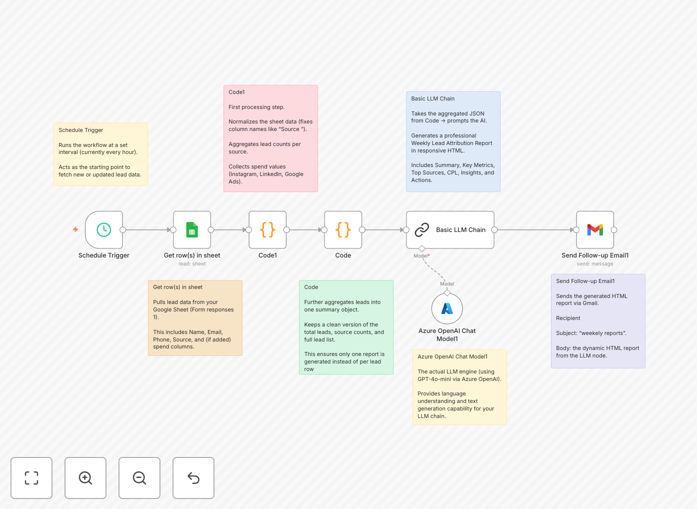
UTM marketing attribution report workflow dashboard in n8n

What This Workflow Does

This n8n workflow solves the common challenge of tracking and analyzing marketing campaign performance by automatically processing UTM parameters from your lead sources. Instead of manually compiling data from different channels, this system aggregates all your marketing attribution data into organized Google Sheets reports with AI-powered insights from GPT-4o.

The workflow collects UTM-tagged URLs from various sources (forms, emails, ads), categorizes them by campaign, source, and medium, then generates comprehensive reports that show which marketing efforts are driving conversions. You'll receive scheduled email summaries with key metrics and AI-generated recommendations for optimizing your campaigns.

How It Works

1. Data Collection

The workflow automatically captures UTM parameters from incoming leads across all your marketing channels. It identifies source, medium, campaign, term, and content parameters from URLs in form submissions, email clicks, and ad interactions.

2. Data Processing

Raw UTM data is cleaned and standardized, with missing values filled in based on your predefined rules. The system matches each lead to its appropriate campaign and marketing channel, ensuring consistent categorization.

3. AI Analysis

GPT-4o analyzes the aggregated data to identify trends, high-performing campaigns, and underperforming channels. It generates natural language insights that explain what's working and why, in business terms anyone can understand.

4. Report Generation

The system creates detailed Google Sheets reports with visualizations of key metrics like conversion rates by campaign, cost per lead by channel, and ROI calculations. Reports are automatically updated with fresh data on your preferred schedule.

5. Email Delivery

Finished reports are sent to your team via Gmail with executive summaries highlighting the most important findings. You can customize the frequency (daily, weekly, monthly) and recipient list for different report types.

Who This Is For

This workflow is ideal for marketing teams, agencies, and growth-focused businesses that run multiple campaigns across different channels. It's particularly valuable for:

  • Digital marketers who need to prove campaign ROI
  • Startups tracking growth marketing experiments
  • Agencies reporting to multiple clients
  • E-commerce businesses optimizing ad spend
  • SaaS companies measuring trial signup sources

What You'll Need

  1. An n8n instance (cloud or self-hosted)
  2. Google Sheets with edit permissions
  3. Gmail account for report delivery
  4. OpenAI API key for GPT-4o access
  5. UTM-tagged URLs in your marketing campaigns

Quick Setup Guide

  1. Download the JSON template file
  2. Import into your n8n dashboard
  3. Connect your Google Sheets, Gmail, and OpenAI credentials
  4. Configure your report templates and delivery schedule
  5. Map your existing UTM parameters to the workflow fields
  6. Test with sample data and activate the workflow

Key Benefits

Save 10+ hours weekly by eliminating manual data compilation from multiple sources. The workflow automatically aggregates all your marketing data in one place.

Make smarter budget decisions with clear visibility into which campaigns and channels deliver the highest quality leads and conversions.

Get AI-powered recommendations that go beyond basic metrics. GPT-4o analyzes patterns in your data to suggest specific optimizations.

Standardize reporting across your organization with consistent metrics and visualizations that everyone can understand.

Scale your tracking as you add new campaigns and channels - the system automatically incorporates new UTM parameters.

Frequently Asked Questions

Common questions about marketing attribution and UTM tracking

The five core UTM parameters provide different insights: source (where traffic comes from), medium (marketing channel type), campaign (specific promotion), term (paid keywords), and content (differentiates similar links). For most businesses, tracking source, medium and campaign provides 80% of the value, while term and content offer deeper paid campaign insights.

For example, an e-commerce store might track source=facebook, medium=social, campaign=spring_sale to understand which social campaigns drive purchases. Consistent naming conventions across teams ensure accurate aggregation in reports.

  • Source identifies the referring platform
  • Medium categorizes the channel type
  • Campaign groups related marketing efforts

UTM attribution reveals exactly which campaigns and channels drive conversions versus just clicks. By analyzing conversion rates and customer value by UTM parameters, you can shift budget to the highest-performing sources.

A SaaS company discovered through UTM tracking that their LinkedIn ads generated 3x more qualified demo requests than Facebook ads at the same cost. They reallocated 60% of their Facebook budget to LinkedIn, increasing conversions by 40% without spending more.

  • Identify highest-converting traffic sources
  • Calculate true ROI by marketing channel
  • Discover underperforming campaigns to pause

First-click attribution gives credit to the initial touchpoint that introduced a customer, while last-click attributes the conversion to the final interaction before purchase. Most analytics tools default to last-click, but first-click better reveals awareness-building channels.

For instance, a customer might first discover your product through an organic social post (first-click), then later convert after a retargeting ad (last-click). This workflow can track both to show the full customer journey and calculate multi-touch attribution.

  • First-click shows awareness drivers
  • Last-click reveals conversion triggers
  • Multi-touch models provide complete picture

AI like GPT-4o can identify complex patterns in attribution data that humans might miss, such as seasonal trends, audience segment performance variations, or interactions between different marketing channels. It explains findings in plain language with actionable recommendations.

An agency used AI analysis to discover their client's email campaigns performed 28% better when preceded by a specific blog post series. The AI recommended timing future campaigns to this content cadence, increasing conversions without additional ad spend.

  • Detects non-obvious performance patterns
  • Provides natural language explanations
  • Suggests specific optimization tactics

Most businesses benefit from weekly performance reviews with monthly deep dives. High-spend campaigns may need daily monitoring during critical periods. This workflow lets you set different schedules for different report types.

An e-commerce brand checks daily during holiday sales to quickly shift budgets, reviews weekly to adjust ongoing campaigns, and conducts monthly analysis to inform strategy. Automated reports ensure data is always fresh when needed.

  • Daily for high-budget time-sensitive campaigns
  • Weekly for most ongoing marketing activities
  • Monthly for strategic planning insights

Common UTM mistakes include inconsistent naming (Facebook vs fb), overly complex parameters, not documenting your schema, and failing to maintain historical data. This workflow helps avoid these by standardizing your tracking and preserving all raw data.

One company lost months of data when they changed UTM conventions without mapping to old parameters. Their reports became useless for trend analysis. The workflow's data cleaning and standardization prevents such issues while maintaining flexibility.

  • Document your UTM naming conventions
  • Keep parameter values simple and consistent
  • Preserve historical data for comparisons

Absolutely! GrowwStacks specializes in building custom marketing attribution systems tailored to your specific data sources, KPIs, and reporting needs. We can integrate with your CRM, ad platforms, and internal systems for complete visibility.

Our team has built custom attribution solutions for e-commerce brands, SaaS companies, and marketing agencies. We'll design a system that tracks your unique customer journey and provides the specific insights you need to optimize spend and grow revenue.

  • Custom integrations with your tech stack
  • Tailored to your business goals and KPIs
  • Ongoing support and optimization

Need a Custom Marketing Attribution System?

This free template is a starting point. Our team builds fully tailored automation systems for your specific needs.