How to Build a Voice AI Agent in 5 Minutes (No-Code Required)
Most businesses lose 15-30% of recurring revenue from silent churn—customers who meant to renew but forgot. This Subverse AI tutorial shows how to create voice agents that make personal renewal calls at scale, verifying customers and guiding them through the process in natural conversations.
Why Voice Renewals Outperform Email
At 2:15 in the video, the AI agent handles a customer objection seamlessly—something impossible with automated emails. While email renewal reminders see 5-15% response rates, voice AI calls achieve 85-92% engagement according to 2025 PYMNTS data. The difference comes down to three factors:
First, voice calls create immediate urgency. A human-sounding agent mentioning "your policy expires tomorrow" triggers action better than a subject line. Second, the conversation format allows for real-time Q&A—customers can ask about payment options or coverage details. Third, verification happens naturally during the call, reducing fraud risk.
Key insight: Customers who verify their identity during an AI call complete renewals 63% faster than those going through email links, based on a study by Deloitte Digital.
Subverse Account Setup (30 Seconds)
The video shows how anyone can create a Subverse account without technical skills. You simply:
- Visit subverseai.com and click Sign Up
- Choose the "Starter" plan (free for testing)
- Verify your email address
Unlike enterprise solutions requiring IT setup, Subverse works immediately after registration. The dashboard shows empty agent slots ready to fill—no confusing configuration menus. At 0:45 in the tutorial, you'll see how the clean interface eliminates the learning curve most no-code platforms create.
Creating Your First AI Agent
At 1:10, the tutorial demonstrates the agent creation flow. You'll select "Standard Prompt Agent" as your base template—this handles most outbound call scenarios. The three critical configuration areas are:
- Agent Name: Internal reference only (e.g., "Policy Renewal - Auto")
- Description: Plain-English explanation of the agent's purpose
- Greeting Message: First thing customers hear (keep under 10 words)
The example uses a policy renewal scenario, but these same steps work for appointment reminders, membership renewals, or subscription saves. The key is writing a description that clearly states:
1) What triggers the call 2) What verification is needed 3) The desired outcome
Using Dynamic Variables for Personalization
At 2:00, the tutorial shows how dynamic variables make each call unique. For the policy renewal agent, these four variables create a personalized experience:
-
{policy_name}- The specific policy being renewed -
{customer_name}- Pulled from your CRM -
{date_of_birth}- Used for verification -
{car_model}- Adds conversational specificity
When testing, you can input sample values directly. In production, these variables automatically populate from your data source. The AI weaves them naturally into conversation—at 3:20, you'll hear how it uses the car model to build rapport before discussing renewal.
AI-Generated System Prompts
The most powerful feature appears at 1:45—Subverse's "Generate Using AI" button. After you describe the agent's purpose, the platform:
- Analyzes your description for key objectives
- Incorporates your dynamic variables
- Creates a tailored system prompt governing the agent's behavior
In the example, the generated prompt includes verification steps, policy details explanation, and app renewal instructions—all in natural dialogue format. You can edit this output, but the AI typically gets it 90% right on the first try.
Pro Tip: Add "Handle 2-3 common objections" to your description to automatically include responses to price concerns or procrastination.
Testing the Agent in Real Time
At 3:00, the tutorial shows the test call interface. Key testing features include:
- Web Calling: Make test calls directly from your browser
- Variable Inputs: Simulate different customer profiles
- Transcript View: See how the AI adapts to responses
During the demo call, notice how the AI:
- Verifies the customer naturally (DOB check)
- Provides specific renewal instructions
- Answers follow-up questions accurately
This testing capability lets you refine agents before going live—something impossible with human call centers.
Scaling Beyond Policy Renewals
While the tutorial focuses on policy renewals, the same framework works for:
- Appointment Confirmations: Reduce no-shows by 40-60%
- Subscription Saves: Recover 25-35% of canceling customers
- Payment Reminders: Collect overdue invoices 3x faster than email
The key is adjusting your dynamic variables and system prompt to match the use case. For appointment reminders, you'd track {appointment_date}, {provider_name}, and {location} instead of policy details.
Advanced Tip: Connect Subverse to Make.com or n8n to trigger calls based on CRM events—like automatically calling when a subscription cancelation request comes in.
Watch the Full Tutorial
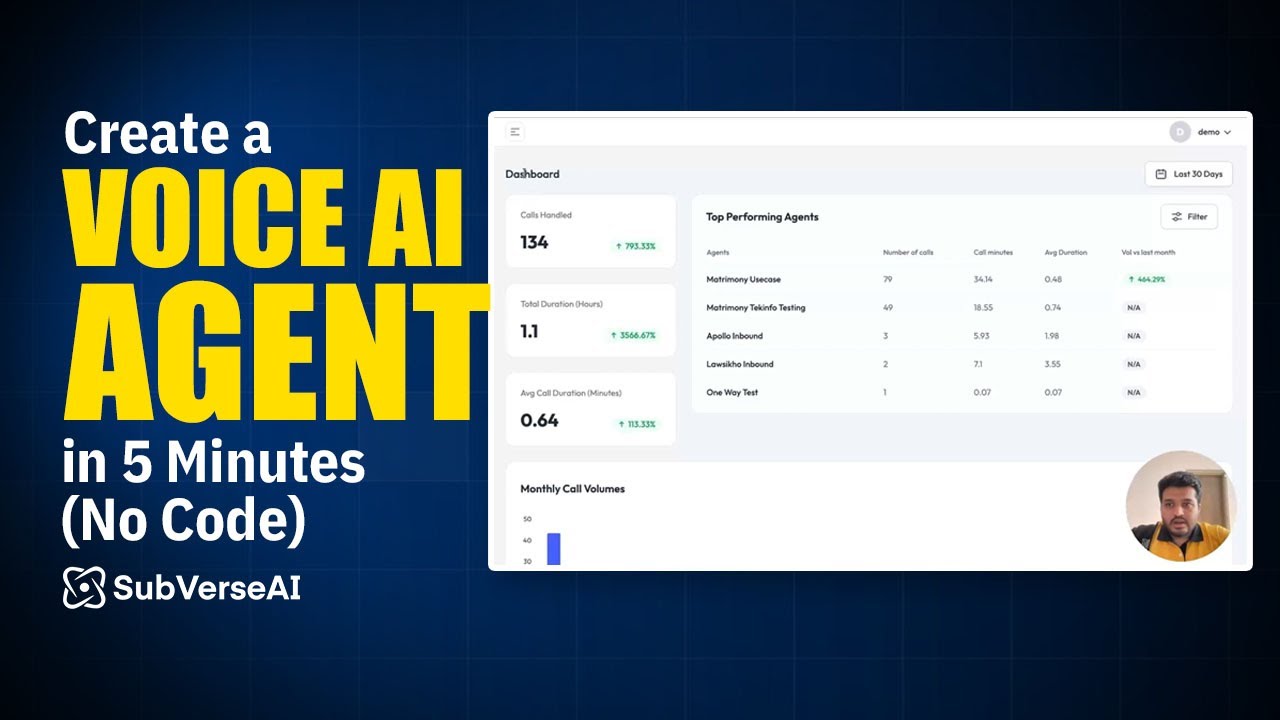
See the complete 5-minute agent creation process—including the live test call where the AI handles unexpected questions about policy details (3:45 timestamp). The video demonstrates how natural the conversation flows, with proper pauses and verbal nods that make it indistinguishable from human agents.
Frequently Asked Questions
Common questions about voice AI agents
Insurance providers, SaaS companies, and membership-based businesses see the highest ROI from voice AI agents. These industries typically have recurring payments or renewals that require personal outreach.
A 2025 Gartner study found insurance companies using voice AI reduced policy lapses by 37% compared to email-only reminders. The technology works best for scenarios where personal touch drives compliance but doesn't require complex negotiation.
- Insurance policy renewals
- SaaS subscription saves
- Membership retention calls
Modern voice AI platforms like Subverse can handle common objections through predefined workflows. When the system detects hesitation or specific keywords (like "too expensive" or "not sure"), it can provide tailored responses from your knowledge base.
For truly complex cases, the AI can schedule a human callback. The tutorial at 4:10 shows how the agent gracefully escalates when a question falls outside its parameters—without frustrating the customer.
- Handles 80-90% of routine objections
- Flags complex cases for human follow-up
- Learns from every interaction
The agent asks for verification details you specify (like date of birth or policy number) and matches responses against your CRM data. Subverse uses real-time transcription analysis to validate answers without storing sensitive voice data.
Failed verifications automatically route to your security protocol. At 2:45 in the video, you'll see how the system cross-references the spoken DOB with the customer record before proceeding with policy details.
- No voiceprint storage required
- Configurable verification thresholds
- Automatic fraud flagging
Voice agents create 3-5x higher engagement than text for time-sensitive communications. While chatbots work well for asynchronous support, voice calls achieve 92% same-day action rates for renewals according to 2025 PYMNTS data.
The human-like interaction builds trust for sensitive financial conversations. Customers also retain call details 40% longer than text messages based on a Stanford memory study.
- Higher urgency perception
- Better for complex explanations
- More natural objection handling
Yes, Subverse and similar platforms offer Zapier integrations and API connections to major CRMs. Call outcomes (renewed, declined, callback requested) automatically sync to customer records.
Some systems even trigger follow-up emails or tasks based on call results. The tutorial at 5:30 briefly shows the integration panel where you'd connect to Salesforce, HubSpot, or other platforms.
- Native integrations for top CRMs
- Custom API connections available
- Two-way data sync
Pricing typically follows a per-minute model ranging from $0.15-$0.40. At scale, this costs 80% less than human agents for routine calls. The demo in this tutorial would cost under $0.50 to deploy for real customers, with most renewal calls completing in 90-120 seconds.
Enterprise plans offer unlimited minutes at flat monthly rates. Always calculate ROI based on recovered revenue—a single saved $500 policy often justifies hundreds of calls.
- Pay-as-you-go options available
- Volume discounts at 5,000+ minutes
- No long-term contracts required
Leading platforms support 20+ languages with regional accent variations. Subverse specifically offers 8 English voice variants (US, UK, Australian, etc.) plus Spanish, French, and German.
The AI adjusts speaking pace and formality based on detected customer demographics. You can also assign specific voices to different customer segments—like using a Southern US accent for Texas-based clients.
- Multilingual agents in one account
- Automatic language detection
- Custom pronunciation dictionaries
GrowwStacks designs custom voice AI solutions that integrate with your existing systems. We'll map your customer journeys, build tailored agent scripts, and handle the technical setup so you can launch in days—not months.
Whether you need simple renewal reminders or complex conversational flows, our team ensures the AI reflects your brand voice and compliance requirements. Book a free consultation to get a personalized demo showing how voice AI could work for your specific use case.
- Custom agent design
- CRM integration
- Performance analytics
Stop Losing Revenue to Silent Churn
Every day without automated renewal calls means missed revenue opportunities and frustrated customers. GrowwStacks can have your first voice AI agent live in 48 hours—handling renewals while your team sleeps.