Google Sheets Slack AI Scraping Compliance Automation

Automate Financial Regulatory News Monitoring

Free n8n workflow template to automate daily regulatory news aggregation from SEC, FINRA, ESMA with AI scraping, Slack alerts & Google Sheets tracking.

Download Template JSON · n8n compatible · Free
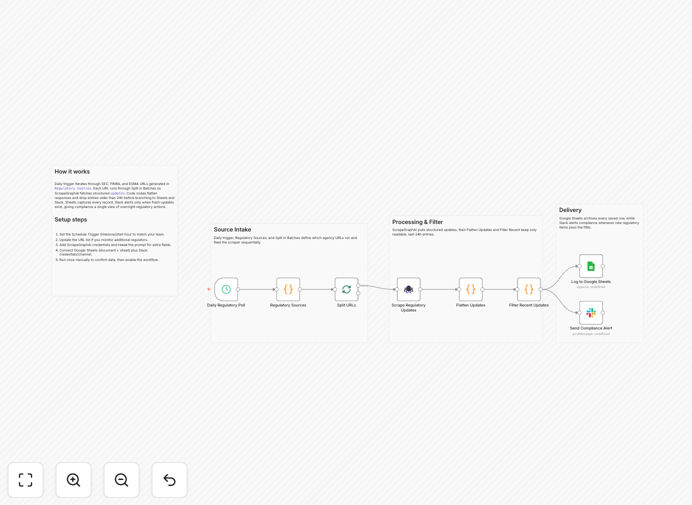
Financial regulatory news automation workflow diagram showing AI scraping, Slack alerts, and Google Sheets integration

What This Workflow Does

Compliance officers and regulatory teams spend hours daily manually checking SEC, FINRA, ESMA, and other regulatory websites for updates. Missing a critical announcement can lead to compliance violations, fines, or operational disruptions. This automation eliminates that manual burden.

The workflow automatically monitors regulatory news daily, uses AI-powered scraping to extract updates from multiple agencies, filters for announcements from the last 24 hours, sends instant Slack alerts to compliance teams, and logs all updates to Google Sheets for historical tracking. It transforms a time-consuming, error-prone manual process into a reliable, automated compliance system.

Financial services firms, investment advisors, risk management professionals, and corporate legal departments can maintain regulatory awareness without constant manual checking, ensuring timely responses to regulatory changes while creating audit-ready compliance records.

How It Works

1. Daily Schedule Trigger

The workflow automatically runs every 24 hours to check for regulatory updates. No manual initiation required—it becomes part of your daily compliance routine.

2. Regulatory Sources Configuration

A predefined list of regulatory agencies and their URLs (SEC, FINRA, ESMA) is processed. You can easily add additional sources like FCA, BaFin, or state regulatory bodies.

3. Batch Processing

The system iterates through regulatory sources one at a time for reliable processing, handling errors gracefully if one website is temporarily unavailable.

4. AI-Powered Scraping

ScrapeGraphAI intelligently extracts regulatory updates including title, summary, date, agency, and source URL. The AI understands webpage structure even when sites change layout.

5. Data Flattening & Time Filtering

Scraped data is transformed into individual update records and filtered to keep only those from the last 24 hours. Updates with unreadable or invalid dates are discarded.

6. Historical Tracking & Alerts

Filtered updates are logged to Google Sheets with timestamps for compliance records. Simultaneously, Slack notifications are sent to your designated compliance alerts channel.

Pro tip: Start with one regulatory source (like SEC) to test the workflow before adding multiple agencies. This ensures your scraping configuration works correctly before scaling.

Who This Is For

Compliance officers and regulatory teams in financial services firms who need to monitor multiple regulatory bodies daily.

Investment advisors and wealth managers tracking regulatory changes that affect client portfolios and investment strategies.

Risk management professionals needing timely awareness of regulatory developments that impact business operations.

Corporate legal departments in regulated industries (finance, healthcare, energy) requiring up-to-date regulatory intelligence.

Stock traders and analysts monitoring regulatory news that could affect market movements or specific securities.

Any business in a regulated industry where missing regulatory updates carries significant compliance or operational risk.

What You'll Need

  1. An n8n instance (cloud or self-hosted) with community nodes enabled
  2. ScrapeGraphAI API account and credentials for AI-powered web scraping
  3. Google Sheets API access (OAuth2) and a spreadsheet for regulatory update tracking
  4. Slack workspace with API access and a channel (like #compliance-alerts) for notifications
  5. Basic understanding of regulatory websites you want to monitor

Quick Setup Guide

  1. Install community nodes: Add the ScrapeGraphAI node to your n8n instance via npm or the community nodes manager.
  2. Configure credentials: Set up ScrapeGraphAI API credentials, Google Sheets OAuth2, and Slack API credentials in n8n.
  3. Customize regulatory sources: Update the "Regulatory Sources" code node with additional agency URLs if needed.
  4. Prepare Google Sheets: Create a spreadsheet with columns: Title, Summary, Date, Agency, Source URL, Scraped At.
  5. Set up Slack channel: Ensure your #compliance-alerts channel exists and the bot has permission to post messages.
  6. Adjust schedule: Modify the schedule trigger if you need monitoring more than once daily or at specific times.
  7. Test manually: Run the workflow once to verify all connections work and data appears correctly in Sheets and Slack.

Pro tip: Respect website terms of service and rate limits when scraping regulatory sites. Consider implementing polite delays between requests to avoid overwhelming servers.

Key Benefits

Saves 2-3 hours daily per compliance team member by eliminating manual website checking across multiple regulatory agencies. That time can be redirected to actual compliance implementation rather than monitoring.

Reduces risk of missed regulatory updates that could lead to violations, fines, or operational disruptions. Automated systems don't forget to check websites during busy periods.

Creates audit-ready compliance records in Google Sheets with timestamps, sources, and summaries. This documented history supports compliance processes during audits or reviews.

Provides instant team awareness via Slack alerts when new updates are detected. Everyone stays informed simultaneously without waiting for someone to manually share information.

Adapts to website changes through AI scraping that understands webpage structure. Unlike fixed RSS feeds, AI scraping can adjust when regulatory sites update their layout.

Frequently Asked Questions

Common questions about regulatory monitoring automation and integration

Automation eliminates manual monitoring of regulatory websites, saving compliance teams 2-3 hours daily. AI-powered scraping automatically extracts updates from SEC, FINRA, ESMA and other agencies, filters for recent announcements, and delivers instant alerts via Slack.

This ensures timely responses to regulatory changes and maintains compliance without constant manual checking. For example, a financial firm can automatically know about new SEC rules within hours of publication rather than days later through manual discovery.

  • Reduces human error in monitoring multiple sources
  • Ensures consistency even during team vacations or busy periods
  • Creates documented process for audit compliance

Google Sheets provides a centralized, historical record of all regulatory updates with timestamps, agency sources, and summaries. This creates an audit-ready compliance log that teams can reference for past announcements, track regulatory trends over time, and generate compliance reports automatically.

The spreadsheet format is accessible to non-technical team members and integrates easily with other compliance documentation. For instance, compliance officers can quickly filter by agency or date range when preparing quarterly compliance reports.

  • Historical data supports trend analysis and regulatory intelligence
  • Easy sharing with auditors, board members, or legal counsel
  • Can be extended with formulas for automated reporting

AI scraping understands webpage structure and extracts specific information like titles, summaries, dates, and agency names even when websites change layout. Traditional RSS feeds or manual checking often miss updates or require constant adaptation.

AI-powered scraping ensures consistent data extraction across multiple regulatory sources, handles date parsing intelligently, and filters only relevant compliance-related announcements. When FINRA updates their notices page design, the AI adapts without needing manual reconfiguration.

  • Adapts to website redesigns without manual intervention
  • Extracts structured data from unstructured web pages
  • Filters irrelevant content (events, newsletters) from actual regulatory updates

Automated monitoring mitigates risks of missed regulatory updates that could lead to compliance violations, fines, or operational disruptions. It ensures timely awareness of new rules, enforcement actions, and guidance changes.

By providing instant alerts and historical tracking, it supports documented compliance processes and reduces reliance on individual team members remembering to check multiple websites daily. For example, automated detection of a new ESMA trading rule prevents unintended violations in European operations.

  • Mitigates risk of human oversight during busy periods
  • Provides evidence of proactive compliance monitoring
  • Reduces dependency on specific individuals' diligence

Firms can add additional regulatory sources (state agencies, international regulators), customize alert channels (email alongside Slack), prioritize updates based on keywords, and integrate with internal compliance systems.

The workflow can be extended to include risk assessment scoring, sentiment analysis of regulatory language, and automated reporting to compliance committees or board members. A bank operating in multiple states could add all relevant state banking regulators to their monitoring list.

  • Add agency-specific parsing for complex regulatory websites
  • Integrate with internal compliance software via APIs
  • Create tiered alerts based on update severity or relevance

You need an n8n instance (cloud or self-hosted), ScrapeGraphAI API credentials for AI scraping, Google Sheets API access, and Slack workspace permissions. The template includes step-by-step configuration for these connections.

Estimated setup time is 15-20 minutes, with most time spent on API credential authorization. The workflow runs automatically daily once configured. No ongoing maintenance is required unless you add new regulatory sources.

  • Test with one source before adding multiple agencies
  • Monitor API usage to manage costs with scraping services
  • Ensure Google Sheets has proper column structure before first run

Yes, the same pattern works for monitoring legal updates, industry news, competitor announcements, or government policy changes. By modifying the scraping sources and alert channels, businesses can automate monitoring of any publicly available information that requires timely awareness.

The AI scraping adapts to different website structures, and the filtering logic ensures only recent, relevant updates are captured. A healthcare company could monitor FDA announcements, while a tech firm could track patent office updates.

  • Adaptable to any industry with regulatory or public information needs
  • Can monitor competitor press releases or product announcements
  • Useful for tracking government policy changes affecting business operations

Yes, GrowwStacks specializes in building tailored automation systems for compliance teams, financial firms, and legal departments. We can customize monitoring for your specific regulatory sources, integrate with your internal compliance software, add advanced filtering logic, and create comprehensive reporting dashboards.

Our team ensures the automation meets your audit requirements and scales with your compliance needs. We handle the technical implementation while you focus on compliance strategy. Custom solutions typically include priority alerting, multi-channel notifications, and integration with existing compliance workflows.

  • Tailored to your exact regulatory sources and internal processes
  • Integration with existing compliance software (ComplySci, etc.)
  • Advanced features like risk scoring, sentiment analysis, and automated reporting

Need a Custom Regulatory Monitoring Automation?

This free template is a starting point. Our team builds fully tailored automation systems for your specific compliance needs and regulatory sources.