What This Workflow Does
This automation solves a critical business problem: understanding customer sentiment at scale. Manually reading and categorizing hundreds of reviews on platforms like Trustpilot is slow, inconsistent, and misses hidden trends. This workflow automatically scrapes customer reviews, uses AI to analyze sentiment and extract key themes, and keeps both your Salesforce CRM and Google Sheets updated with these insights.
By bridging external feedback with internal systems, you empower sales teams with real-time customer perception directly in Salesforce account records, while providing executives with aggregated analytics in Google Sheets for strategic decision-making. It turns unstructured text into structured, actionable data.
How It Works
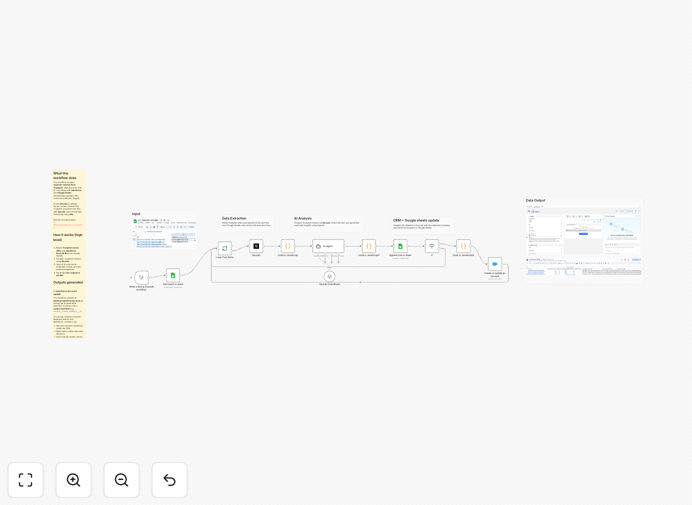
The workflow orchestrates data flow between multiple platforms to create a seamless feedback loop.
Step 1: Data Collection
The process begins by reading a list of Trustpilot review URLs and corresponding Salesforce Account IDs from a Google Sheets spreadsheet. This setup allows you to manage and update target reviews centrally.
Step 2: Review Scraping & AI Analysis
Using Decodo for reliable web scraping, the workflow extracts the full text of each review. This content is then sent to an AI model (like OpenAI) which performs sentiment analysis, identifies positive/negative keywords, summarizes trends, and assigns a sentiment score.
Step 3: Dual-Path Data Sync
The analyzed data follows two parallel paths. First, the AI-generated sentiment summary is written to a custom field on the corresponding Salesforce Account record, enriching your CRM with external feedback. Simultaneously, structured metrics—including ratings, sentiment distribution, and keyword frequency—are appended to a Google Sheets dataset for reporting and visualization.
Pro tip: Configure the AI prompt to extract industry-specific keywords. For SaaS businesses, look for mentions of "UI," "bugs," or "customer support." For e-commerce, track "shipping," "product quality," or "packaging."
Who This Is For
This automation delivers value across multiple business functions:
Product Managers can identify feature requests and pain points directly from user feedback. Sales Teams gain context about account sentiment before calls, enabling more personalized conversations. Customer Success can proactively reach out to dissatisfied customers. Marketing Teams can leverage positive testimonials and understand brand perception. Executives get aggregated sentiment dashboards for strategic planning.
It's particularly valuable for B2B companies monitoring client satisfaction, SaaS businesses tracking user experience, and e-commerce brands managing reputation across review platforms.
What You'll Need
- n8n instance (cloud or self-hosted) to run the workflow.
- Google Sheets with columns for Trustpilot URLs and Salesforce Account IDs.
- Decodo API key for reliable review scraping (prevents blocking).
- OpenAI API key or alternative AI service for sentiment analysis.
- Salesforce account with a custom Text field (255 characters) created on the Account object to store sentiment summaries.
- Basic familiarity with n8n node configuration.
Quick Setup Guide
Follow these steps to implement this automation in under 30 minutes:
- Import the template: Download the JSON file and import it into your n8n instance.
- Configure credentials: Set up connections for Google Sheets, Decodo, OpenAI, and Salesforce in n8n's credentials management.
- Prepare your Google Sheet: Create a sheet with at least two columns: "Trustpilot_URL" and "Salesforce_Account_ID". Populate with your target reviews.
- Update Salesforce: Create a custom field on the Account object (API name like `Recent_Review_Summary__c`) to store the AI-generated sentiment.
- Test with one record: Run the workflow manually with a single review URL to verify all connections work correctly.
- Schedule automation: Set the workflow to run daily or weekly to keep insights current.
Pro tip: Start with a small batch of 5-10 reviews to validate the AI output quality. Adjust the prompt in the OpenAI node if you need more specific analysis categories before scaling to hundreds of reviews.
Key Benefits
Save 15+ hours monthly on manual review analysis. What typically takes a team member hours to read, categorize, and summarize happens automatically overnight.
Improve customer retention by identifying at-risk accounts through negative sentiment trends before they churn, enabling proactive intervention.
Enhance sales intelligence with sentiment context directly in Salesforce, helping sales reps tailor conversations based on recent customer feedback.
Create data-driven product roadmaps by aggregating feature requests and pain points from reviews into quantifiable metrics for prioritization.
Build competitive intelligence by analyzing not just your reviews but also competitor reviews on the same platforms, uncovering market gaps and opportunities.