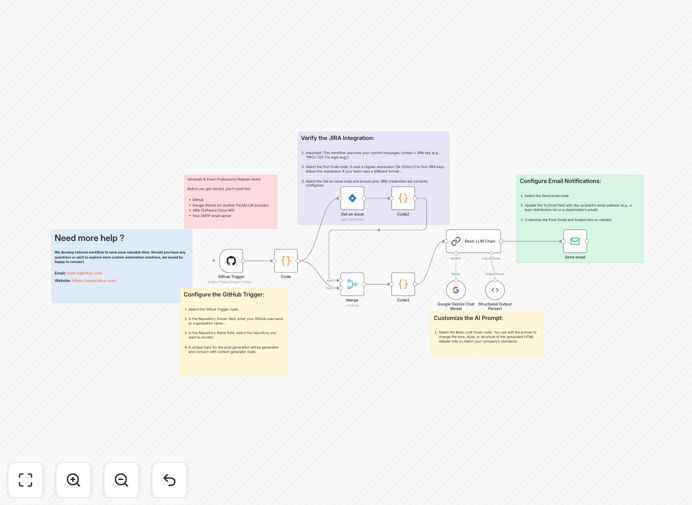
What This Workflow Does
This automation solves the tedious, error-prone process of manually writing release notes for software updates. Development teams typically spend 5-10 hours per release compiling commits, checking JIRA tickets, writing summaries, and emailing stakeholders—often under tight deadlines.
The workflow automatically triggers when code is pushed to GitHub, fetches related JIRA tickets using commit message patterns, processes the combined data through Google Gemini AI to generate human-like release notes, and emails them to your team and stakeholders. It creates a complete, end-to-end communication pipeline that ensures every release is documented professionally and distributed consistently.
How It Works
1. GitHub Trigger
The workflow activates automatically when code is pushed to your specified repository. It captures commit messages, authors, timestamps, and branch information as the starting point for release documentation.
2. JIRA Integration
Using regex patterns, the system extracts JIRA ticket keys from commit messages (like "PROJ-123"), then fetches full ticket details including summaries, descriptions, assignees, and status from your JIRA instance.
3. AI Processing
Google Gemini AI analyzes the combined GitHub and JIRA data, grouping related changes, identifying key features versus bug fixes, and writing coherent summaries in your preferred tone and format.
4. Email Distribution
The generated HTML release notes are automatically sent via your SMTP server to predefined distribution lists, ensuring stakeholders receive timely, professional updates without manual intervention.
Who This Is For
This template is ideal for development teams with frequent releases, DevOps engineers managing multiple services, product managers needing consistent stakeholder updates, and agencies delivering regular client work. If your team spends more than 2 hours per week on release documentation, this automation will deliver immediate time savings and quality improvements.
What You'll Need
- A GitHub repository with commit messages containing JIRA ticket references
- JIRA Cloud or Server instance with API access
- Google Gemini API key (or alternative LLM provider)
- SMTP email server credentials (Gmail, SendGrid, AWS SES, etc.)
- n8n instance (self-hosted or cloud)
Quick Setup Guide
1. Download the template and import it into your n8n instance.
2. Configure credentials for GitHub, JIRA, Google Gemini, and your email server in n8n's credential management.
3. Update the repository owner and name in the GitHub trigger node.
4. Adjust the regex pattern in the Code node if your team uses different JIRA key formats.
5. Customize the AI prompt in the Basic LLM Chain node to match your preferred release note style.
6. Set the recipient email addresses in the Send Email node and activate the workflow.
Key Benefits
Saves 5-10 hours per release cycle by eliminating manual compilation, writing, and distribution of release notes. Developers can focus on coding instead of documentation.
Ensures consistency and completeness across all releases. The automation never forgets to include a commit or ticket and maintains the same professional format every time.
Improves stakeholder communication with timely, well-structured updates that clearly explain what changed and why, building trust and transparency.
Reduces human error in release documentation. Manual processes often miss minor changes or contain inconsistent formatting that confuses readers.
Scalable across multiple projects and teams. Once configured, the same automation pattern can be duplicated for different repositories with minimal adjustments.