Outlook JIRA AI Triage Support Automation n8n

Automatically Create JIRA Issues from Outlook Support Emails

Free n8n template that watches a shared Outlook inbox, uses AI to triage support requests, and creates prioritized JIRA tickets automatically.

Download Template JSON · n8n compatible · Free
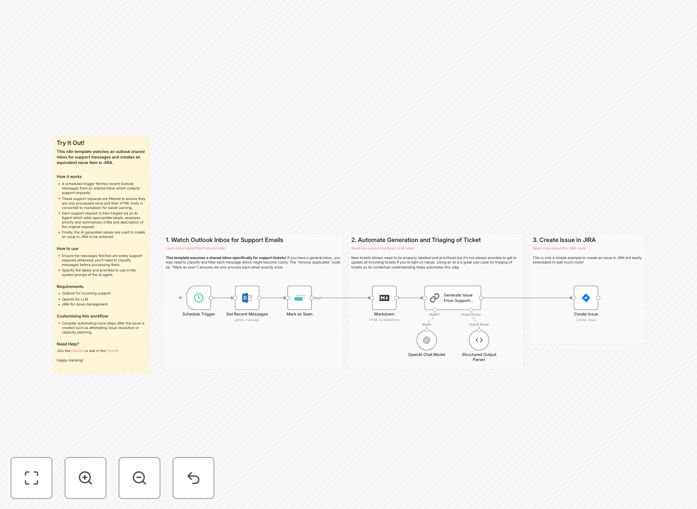
Visual diagram showing Outlook emails flowing into n8n automation which creates JIRA tickets with AI triage

What This Workflow Does

Manual support ticket creation is a time-consuming, error-prone process that delays response times and frustrates both customers and support teams. When support requests arrive via email, team members must read each message, determine priority, extract relevant details, and manually create JIRA tickets—a process that can take 10-15 minutes per request.

This n8n automation template solves this problem by connecting your Outlook shared support inbox directly to JIRA. It automatically monitors incoming emails, uses AI to analyze content and determine priority, extracts key information, and creates properly formatted JIRA issues with appropriate labels, assignees, and descriptions. The result is faster ticket creation, consistent prioritization, and elimination of manual data entry errors.

Beyond basic ticket creation, the workflow includes intelligent filtering to prevent duplicate tickets, converts HTML email content to readable markdown, and can be extended to trigger notifications, update customer records, or escalate urgent issues based on your specific business rules.

How It Works

1. Email Monitoring & Collection

A scheduled trigger checks your Outlook shared inbox at regular intervals (e.g., every 5 minutes) for new support emails. It fetches unprocessed messages while ensuring each email is only handled once through tracking mechanisms.

2. Content Processing & Deduplication

The workflow converts HTML email bodies to clean markdown format for easier parsing. It checks for potential duplicate requests by comparing sender, subject, and content patterns to prevent creating multiple tickets for the same issue.

3. AI-Powered Triage & Analysis

Each support request is sent to an AI agent (OpenAI) that analyzes the content to determine: issue category (bug, feature request, question), priority level (critical, high, medium, low), appropriate labels, and a concise summary. The AI extracts key details from the email to populate ticket fields accurately.

4. JIRA Ticket Creation

Using the AI-generated analysis, the workflow creates a structured JIRA issue with proper project assignment, issue type, summary, description, priority, labels, and any custom fields required by your team. It can also assign tickets based on round-robin or skills-based rules.

5. Confirmation & Logging

The system logs all created tickets, can send confirmation emails to customers, and provides audit trails for tracking automation performance and identifying any issues in the process.

Who This Is For

This automation is ideal for support teams, IT help desks, customer success departments, and product teams that receive support requests via email and use JIRA for issue tracking. It's particularly valuable for:

  • Tech companies with developer support channels where timely bug reporting is critical
  • SaaS businesses receiving feature requests and technical questions from customers
  • Internal IT teams handling employee support requests that need proper tracking
  • Growing startups where manual ticket creation is becoming a bottleneck
  • Enterprise support centers needing consistent, auditable ticket creation processes

If your team spends more than 5 hours per week manually creating tickets from emails, this automation will provide immediate time savings and process improvement.

What You'll Need

  1. Outlook account with access to the shared support inbox you want to monitor
  2. JIRA instance (Cloud or Server) with API access and appropriate project permissions
  3. OpenAI API key or alternative LLM service for AI-powered triage (can use other AI providers)
  4. n8n instance (self-hosted or cloud) to run the automation workflow
  5. Basic understanding of your JIRA project structure, issue types, and custom fields
  6. Defined support categories and priority levels you want the AI to use for classification

Pro tip: Start with a test JIRA project and limited email filtering rules to validate the automation works correctly before deploying to your production support workflow. Monitor the first 50-100 automated tickets to refine AI prompts and field mappings.

Quick Setup Guide

Follow these steps to implement this automation in your environment:

  1. Download the template using the button above and import it into your n8n instance
  2. Configure Outlook node with your shared inbox credentials and set appropriate polling frequency
  3. Set up JIRA connection with API credentials, project key, and desired issue type mappings
  4. Add OpenAI API key and customize the system prompt to match your support categories and priorities
  5. Test with sample emails to ensure proper field mapping and AI classification accuracy
  6. Deploy the workflow and monitor initial ticket creation for any adjustments needed
  7. Add team notifications (optional) to alert assignees when new tickets are created

Most teams can have this automation running in production within 2-3 hours of configuration time.

Key Benefits

Reduce manual ticket creation time by 80-90%. What previously took 10-15 minutes per request now happens automatically in seconds, freeing your team to focus on actual problem-solving rather than administrative work.

Ensure no support request gets lost in email. Every incoming message is automatically converted to a trackable JIRA issue with proper audit trail, eliminating the "I thought someone else was handling that" problem common in shared inboxes.

Improve response times with intelligent prioritization. AI analysis provides consistent, objective priority assignment based on actual request content rather than subjective human judgment, ensuring critical issues get attention first.

Standardize ticket quality and completeness. Automated tickets include all necessary information in consistent formats, making them easier to process and reducing back-and-forth clarification requests.

Gain valuable insights from support trends. With all requests properly categorized in JIRA, you can analyze patterns, identify common issues, and make data-driven decisions about product improvements and support resource allocation.

Frequently Asked Questions

Common questions about Outlook to JIRA automation and integration

You can automate support ticket creation by connecting your email service (like Outlook or Gmail) to a project management tool (like JIRA) using automation platforms like n8n. The system watches a shared inbox, extracts key information from incoming emails, and creates structured tickets with appropriate labels and priorities automatically.

This eliminates manual copying and pasting, reduces human error, and ensures every customer request is properly tracked from the moment it arrives. The automation can be configured to handle different types of emails, filter out non-support messages, and apply business rules for assignment and escalation.

  • Set up email filtering to distinguish support requests
  • Map email content to relevant JIRA fields automatically
  • Implement duplicate detection to prevent ticket spam

Integrating Outlook with JIRA eliminates manual data entry, reduces response times, ensures no support request gets lost in email, provides centralized tracking of all customer issues, and enables better team collaboration with standardized ticket formats and automated prioritization based on email content.

Teams report 40-60% faster initial response times because tickets are created instantly rather than waiting for manual processing. The integration also creates a single source of truth for all customer issues, making it easier to track SLAs, identify trends, and allocate resources effectively across the support team.

  • Faster ticket creation leads to quicker response times
  • Centralized tracking improves accountability and reporting
  • Automated prioritization ensures urgent issues get attention first

Yes, AI can analyze support email content to determine urgency, categorize issues, suggest appropriate labels, extract key details, and generate concise summaries. This reduces manual triage time by 70-80% and ensures consistent priority assignment based on actual request content rather than subjective judgment.

Modern AI models can understand context, detect sentiment, identify technical vs. non-technical issues, and even suggest solutions based on historical ticket data. The AI improves over time as it learns from your team's corrections and feedback, becoming more accurate at classifying your specific types of support requests.

  • AI analyzes email content for urgency indicators
  • Automatically categorizes issues into your predefined buckets
  • Extracts key details to populate ticket fields accurately

Implement filtering rules to distinguish support requests from other emails, use AI classification to identify genuine issues, set up duplicate detection to prevent multiple tickets for the same issue, and maintain a human review queue for borderline cases. Most systems achieve 95%+ accuracy with proper configuration.

Start with conservative filtering and gradually expand as confidence grows. Include fallback mechanisms like sending uncertain emails to a human review folder, setting up alerts for failed ticket creation, and regularly auditing automated tickets against manually created ones to identify and fix any gaps in the automation logic.

  • Use sender whitelists for known support email addresses
  • Implement keyword-based filtering for common support terms
  • Maintain a manual review queue for low-confidence classifications

Use a shared mailbox for all support emails, implement round-robin or skills-based assignment rules in your automation, include team member availability checks, and set up escalation workflows for urgent issues. This ensures balanced workload distribution while maintaining accountability and specialization.

For skills-based routing, tag team members with their areas of expertise and configure the automation to match ticket categories with appropriate specialists. Include overflow rules for when primary assignees are unavailable, and consider integrating with calendar systems to check actual availability before assignment.

  • Round-robin assignment prevents workload concentration
  • Skills-based routing connects issues with appropriate experts
  • Escalation workflows ensure urgent issues get prompt attention

Teams typically save 15-30 minutes per support request by eliminating manual ticket creation, data entry, and basic triage. For 20 daily requests, this translates to 5-10 hours weekly saved, plus additional time from reduced context switching and elimination of duplicate or lost requests.

The savings compound as team size grows, since the automation handles the repetitive work consistently regardless of volume. Beyond time savings, you also gain consistency in ticket quality, better tracking for reporting, and improved customer satisfaction due to faster initial responses and fewer lost requests.

  • Eliminates 10-15 minutes of manual work per ticket
  • Reduces context switching between email and JIRA
  • Prevents time wasted on duplicate ticket resolution

Yes, GrowwStacks specializes in building custom automation solutions that connect Outlook with JIRA tailored to your specific workflows, team structure, and business rules. We handle complex requirements like custom field mapping, multi-level approval workflows, integration with other tools, and specialized AI training for your industry terminology.

Our team works with you to understand your current support process, identify automation opportunities, design a solution that fits your needs, implement it with proper testing and documentation, and provide ongoing support. We've built custom email-to-ticket automations for companies ranging from 5-person startups to enterprise teams handling thousands of requests monthly.

  • Custom field mapping to your specific JIRA configuration
  • Integration with your existing tools and systems
  • Ongoing support and optimization as your needs evolve

Need a Custom Outlook to JIRA Automation?

This free template is a starting point. Our team builds fully tailored automation systems for your specific business needs.