What This Workflow Does
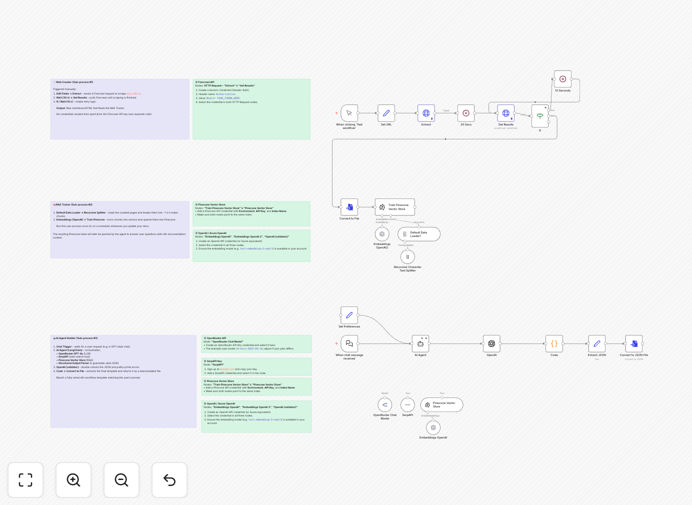
This AI Agent Builder template transforms a simple chat request into a fully-wired n8n workflow template—complete with AI agents, RAG (Retrieval-Augmented Generation), and web-search capabilities—without manual configuration. It's like having a personal workflow chef: you describe what you need in plain English, and the system designs, validates, and delivers a ready-to-import automation blueprint.
The template listens to incoming chat messages via a Chat Trigger, analyzes requests using GPT-4o, searches the web for current best practices, queries a Pinecone vector store containing n8n documentation, and generates optimized workflow templates with proper node connections and configurations. All supporting assets (embeddings, vector stores, etc.) are prepared so subsequent requests become even smarter and more accurate.
How It Works
1. Request Capture & Analysis
The Chat Trigger node captures natural language requests from users. The AI agent analyzes the request to understand the business need, desired outcomes, and required integrations.
2. Information Retrieval & Research
The system performs web searches via SerpAPI for current examples and best practices, while simultaneously querying a Pinecone vector store containing n8n documentation and community knowledge to find relevant implementation patterns.
3. Template Design & Generation
Using GPT-4o via OpenRouter, the AI designs the most efficient workflow architecture, selects appropriate nodes, configures connections, and generates a complete JSON template that passes n8n's import validation checks.
4. Validation & Delivery
An OpenAI validation node double-checks field names, connection types, and version compatibility before a Code node extracts the JSON and converts it to a downloadable template file ready for immediate use.
Who This Is For
This template is ideal for no-code builders, agencies, consultants, and internal platform teams who need to deliver customized automations quickly. Power users who don't want to wrestle with AI node wiring will appreciate the automated generation, while teams delivering bespoke automations for clients can use this as a starting point for rapid prototyping.
Internal platform teams can deploy this as a "workflow self-service portal" for non-technical colleagues, allowing them to request automations through natural language and receive working templates without requiring deep technical knowledge.
What You'll Need
- OpenAI/Azure OpenAI API key for embeddings and validation
- Pinecone API credentials for vector store operations
- OpenRouter API key for GPT-4o LLM access
- SerpAPI key for web search functionality
- Firecrawl API key (optional, for document crawling)
Pro tip: Start with a pre-populated Pinecone index containing n8n documentation to improve initial template accuracy. The system learns from each generation, making subsequent requests faster and more precise.
Quick Setup Guide
- Download the template and import it into your n8n instance
- Configure the five required API credentials in the credential manager
- Optionally crawl n8n documentation to populate your Pinecone vector store
- Activate the workflow and test with a simple request like "Build me a workflow that monitors support tickets and posts summaries to Slack"
- Download the generated template, import it as a new workflow, and customize as needed
Key Benefits
Reduce workflow design time from hours to minutes. Instead of manually researching integrations and connecting nodes, you get a complete, validated template that you can immediately import and customize for your specific use case.
Eliminate technical barriers for non-developers. Team members without automation experience can describe what they need in plain English and receive working automation blueprints, democratizing access to powerful workflow automation.
Ensure best practices and current documentation. By leveraging RAG with up-to-date n8n documentation and web searches, generated templates follow current best practices and avoid deprecated methods or outdated integration patterns.
Create a self-improving automation system. Each generated workflow and its supporting assets enhance the system's knowledge base, making future template generations more accurate and contextually aware of your specific business environment.
Scale automation delivery across teams and clients. Agencies and consultants can use this as a force multiplier, rapidly generating customized automation templates for different clients while maintaining consistent quality and architecture standards.