AI Sales Transcription OpenAI AssemblyAI

AI Call Analyzer: Transcribe & Analyze Sales Conversations

Automatically convert call recordings into actionable insights—client intent, interest scores, upsell opportunities, and more.

Download Template JSON · n8n compatible · Free
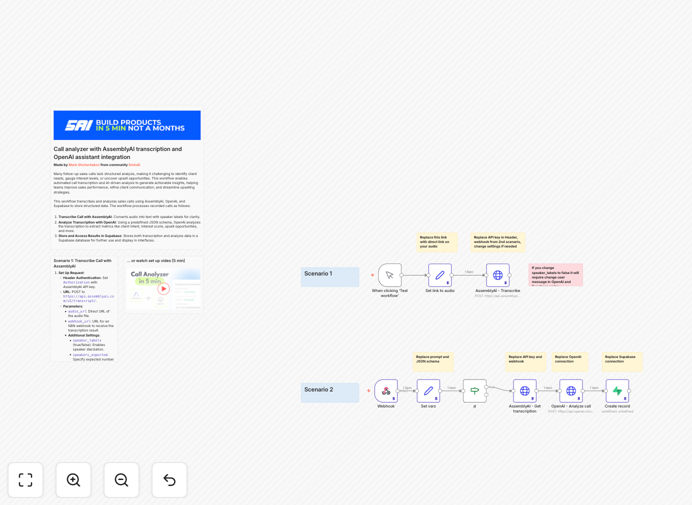
AI call analyzer workflow diagram showing transcription and analysis process

What This Workflow Does

Sales teams conduct countless follow-up calls, but manually reviewing recordings to extract insights is time-consuming and inconsistent. This AI-powered call analyzer solves that by automatically processing call recordings through a complete intelligence pipeline.

The workflow transcribes audio using AssemblyAI's advanced speech recognition, then analyzes the conversation with OpenAI's GPT models to identify key business metrics. It extracts structured data like client needs, interest levels, pain points, and upsell opportunities—transforming raw conversations into actionable sales intelligence.

Instead of relying on memory or fragmented notes, your team gets objective, data-driven insights stored in your database for trend analysis, coaching, and strategy refinement. This creates a competitive advantage through systematic conversation intelligence at scale.

How It Works

1. Audio Submission & Transcription

When a new call recording becomes available (via cloud storage, email attachment, or recording platform webhook), the workflow automatically sends it to AssemblyAI for high-accuracy transcription with speaker diarization. This separates sales rep from client dialogue.

2. AI-Powered Conversation Analysis

The clean transcript is sent to OpenAI with a carefully crafted prompt that analyzes the conversation against your specific business criteria. The AI identifies client intent, scores interest levels, flags objections, highlights buying signals, and detects upsell opportunities.

3. Structured Data Extraction & Storage

OpenAI returns analysis in a consistent JSON schema that's parsed and stored in your database (Supabase in this template). This creates a searchable repository of call intelligence that can be visualized in dashboards, connected to CRM systems, or used for automated follow-up triggers.

4. Notification & Integration

Key insights are automatically shared with relevant team members via Slack, email, or your project management tool. High-priority findings (like urgent client needs or strong buying signals) trigger immediate alerts to ensure timely follow-up.

Who This Is For

This workflow is ideal for B2B sales teams, customer success managers, sales enablement leaders, and coaching professionals. It's particularly valuable for companies with consultative sales processes, complex sales cycles, or teams that need to scale quality conversation monitoring.

Educational institutions conducting student interviews, legal firms analyzing client consultations, and healthcare providers reviewing patient interactions can also adapt this template for their specific transcription and analysis needs.

Pro tip: Start by analyzing your highest-value calls (enterprise deals, key account reviews, lost deal post-mortems) to build your insight library. The patterns you discover will help refine your analysis criteria for broader implementation.

What You'll Need

  1. n8n instance (cloud or self-hosted) with HTTP Request, Webhook, and If nodes available
  2. AssemblyAI account for speech-to-text transcription (free tier available)
  3. OpenAI API key with access to GPT-4 or GPT-4o models for advanced analysis
  4. Supabase account or alternative database (PostgreSQL, MySQL) for structured data storage
  5. Call recordings accessible via URL (cloud storage like Dropbox, Google Drive, or S3)

Quick Setup Guide

  1. Download and import the template JSON into your n8n instance
  2. Configure credentials for AssemblyAI, OpenAI, and your database in n8n
  3. Adjust the analysis prompt in the OpenAI node to match your specific sales metrics and terminology
  4. Test with a sample recording by providing the audio URL to the workflow trigger
  5. Review the output in your database and refine the JSON schema if needed
  6. Connect to your CRM by adding nodes to push insights to Salesforce, HubSpot, or your preferred system
  7. Set up monitoring and error handling to ensure reliable operation

Key Benefits

Eliminate manual call review: Save 5-10 hours per week per sales manager previously spent listening to recordings. Instead, receive summarized insights and automated coaching alerts.

Objective conversation scoring: Remove subjective bias from call evaluation. Every conversation is analyzed against consistent criteria, enabling fair performance comparisons and targeted coaching.

Discover hidden patterns: AI identifies conversation patterns across hundreds of calls that humans might miss—common objections, successful rebuttals, buying signal timing, and competitor mentions.

Scale sales enablement: New reps benefit from analyzed examples of successful calls. Coaching becomes data-driven with specific examples of what works in your market with your products.

Improve deal forecasting: Interest scores and buying signals from call analysis provide additional data points for more accurate pipeline forecasting and resource allocation.

Frequently Asked Questions

Common questions about AI call analysis and conversation intelligence

AI call analysis uses speech-to-text and natural language processing to automatically transcribe and analyze sales conversations. It benefits sales teams by identifying client needs, measuring interest levels, spotting upsell opportunities, and providing objective feedback on call performance without manual note-taking.

Instead of relying on memory or fragmented notes, your entire team gains consistent insights that improve coaching, forecasting, and strategy. Sales managers can scale quality monitoring across larger teams while focusing their time on high-impact coaching rather than listening to hours of recordings.

Modern AI transcription services like AssemblyAI achieve over 95% accuracy for clear audio with proper speaker diarization. Accuracy depends on audio quality, background noise, and accents. For sales calls in professional settings, the transcription is typically accurate enough for meaningful AI analysis and insight generation.

Most business conversations with decent recording equipment produce highly usable transcripts. The analysis layer actually improves utility by interpreting meaning beyond literal words—understanding context, intent, and emotional tone even if occasional words are transcribed imperfectly.

AI can extract client intent, pain points, buying signals, competitor mentions, pricing objections, feature interest, decision timeline, emotional tone, and specific questions asked. It can score call effectiveness, identify coaching opportunities, and track conversation patterns across your entire sales team.

Beyond basic metrics, advanced analysis reveals how top performers structure conversations, when they introduce pricing, how they handle objections, and what language resonates with your specific buyer personas. This creates a knowledge base that accelerates onboarding and improves overall team performance.

AI call analysis workflows can automatically push insights to CRM systems like Salesforce, HubSpot, or Pipedrive. Transcripts, sentiment scores, action items, and opportunity flags can be attached to contact records, enriching customer profiles and enabling data-driven follow-up strategies.

The structured output from this workflow creates standardized data fields that map directly to CRM objects. This means insights become part of the customer record rather than living in separate systems, ensuring sales reps have complete context when engaging with prospects.

Basic transcription converts speech to text only. AI-powered analysis goes further by interpreting meaning, identifying patterns, scoring conversations, extracting structured data, and providing actionable recommendations. It transforms raw audio into business intelligence that drives sales strategy and coaching.

Think of transcription as creating raw material and analysis as manufacturing finished goods. The analysis layer adds categorization, prioritization, and insight generation that turns hours of conversation into minutes of actionable intelligence with clear next steps.

Sales managers typically save 5-10 hours per week per rep by eliminating manual call review. Instead of listening to hours of recordings, they get summarized insights, trend reports, and automated coaching alerts. This allows them to scale quality management across larger teams while focusing on high-impact interventions.

The time savings compound when you consider preparation, note-taking, and follow-up documentation. Automated analysis ensures nothing important is missed and creates searchable records that make finding specific conversations or patterns instantaneous rather than a manual search process.

Yes, GrowwStacks specializes in building custom AI call analysis systems tailored to your specific sales processes, CRM, and business goals. We can integrate with your recording platforms, train models on your terminology, and design dashboards that deliver the exact insights your team needs to close more deals.

Our team will work with you to understand your unique sales methodology, key performance indicators, and integration requirements. We then build, test, and deploy a complete solution that fits seamlessly into your existing workflow while providing measurable ROI through improved sales performance.

  • Custom integration with your call recording platform
  • Industry-specific analysis criteria and scoring
  • Executive dashboards and team performance reports
  • Ongoing optimization based on results

Need a Custom Call Analysis Automation?

This free template is a starting point. Our team builds fully tailored automation systems for your specific business needs.