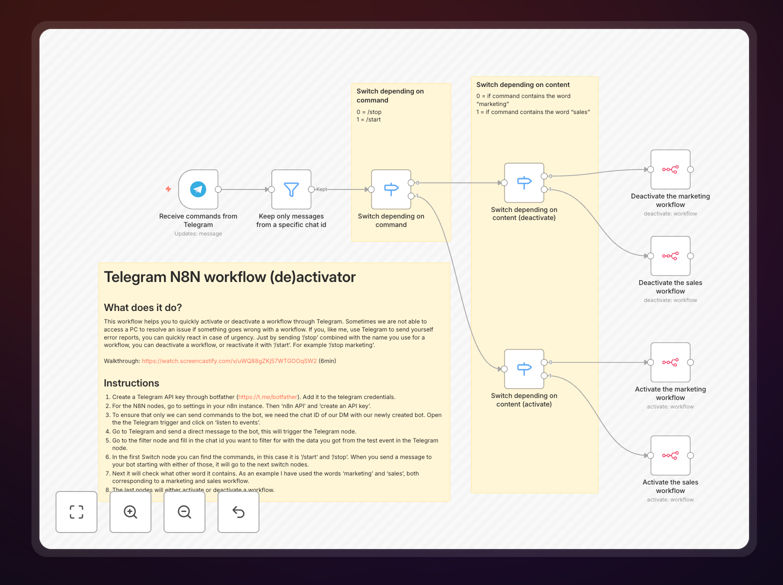
What This Workflow Does
This automation solves a critical operational problem: what happens when your automated workflows fail or need immediate adjustment, but you're away from your computer? Traditional workflow management requires dashboard access, which isn't always available during emergencies, travel, or after hours.
The Telegram Workflow Controller enables instant remote control of your n8n automation systems. Send simple commands like /stop marketing to immediately pause a problematic workflow, or /start sales to reactivate it. The system validates your identity, routes the command to the correct workflow, and executes the action within seconds—all through the Telegram app on your phone.
Beyond emergency control, this automation provides operational flexibility for distributed teams, reduces IT support dependencies, and creates an audit trail of all remote commands. It's particularly valuable for DevOps teams, system administrators, and business owners who need to maintain automation reliability without being tethered to a workstation.
How It Works
The automation follows a secure, multi-step process to ensure only authorized commands are executed:
1. Telegram Command Reception
A Telegram bot listens for incoming messages. When you send a command like "/start marketing" or "/stop data-sync," the bot captures the message along with your unique chat ID for authentication.
2. Security Validation
The system first verifies that the command comes from an authorized chat ID (your specific Telegram account). This prevents unauthorized users from controlling your workflows, even if they discover your bot.
3. Command Parsing
The message is split into action ("/start" or "/stop") and workflow identifier ("marketing," "sales," etc.). The system validates that both components match your predefined command structure.
4. Workflow Identification
Using switch logic, the system maps the workflow identifier to the actual n8n workflow ID. This abstraction layer means you can use memorable names instead of technical IDs.
5. API Execution
The n8n API node sends the activation or deactivation command to the target workflow. The API uses your n8n instance credentials with appropriate permissions to execute the change.
6. Confirmation & Logging
The system sends a confirmation message back to your Telegram chat and logs the action with timestamp, user, and workflow details for audit purposes.
Pro tip: Create a dedicated Telegram group for your operations team and add the bot. This allows multiple authorized users to control workflows while maintaining a complete command history in the group chat.
Who This Is For
This automation delivers value across several business roles and scenarios:
DevOps & IT Teams who need to respond quickly to automation failures during incidents. Instead of rushing to a computer or waking up colleagues, they can pause problematic workflows immediately from their phones.
Business Owners & Managers who want oversight and control over automated processes without technical complexity. Simple Telegram commands empower non-technical leaders to manage business automation safely.
Remote & Distributed Teams operating across time zones. When the person who needs to control a workflow is sleeping or offline, another authorized team member can execute the command.
Agencies & Consultants managing automation systems for multiple clients. They can maintain emergency control capabilities without requiring dashboard access for every client system.
Startups & Small Businesses with limited IT resources. This system reduces support overhead by allowing trained staff to handle common workflow issues remotely.
What You'll Need
- Telegram Account: A personal or business Telegram account (free)
- Telegram Bot Token: Created via BotFather (@BotFather) on Telegram
- n8n Instance: Self-hosted n8n or n8n.cloud account with API access enabled
- n8n API Key: Generated from your n8n settings with workflow read/write permissions
- Workflow Names & IDs: List of workflows you want to control and their n8n IDs
- Authorized Chat IDs: Your Telegram chat ID (and team members' if shared control)
Quick Setup Guide
Follow these steps to implement remote workflow control in under 30 minutes:
- Create Your Telegram Bot: Message @BotFather on Telegram, use "/newbot" command, and save the API token provided.
- Generate n8n API Key: In your n8n settings, navigate to "n8n API" and create a key with workflow management permissions.
- Import the Template: Download this JSON template and import it into your n8n instance via the workflow import function.
- Configure Credentials: Add your Telegram bot token and n8n API key to the respective credential nodes in the workflow.
- Test Command Reception: Trigger the Telegram node's "Listen to Events" function, then send any message to your bot to capture your chat ID.
- Set Up Command Routing: In the switch nodes, configure the workflow names you want to control (marketing, sales, etc.) and map them to actual n8n workflow IDs.
- Test End-to-End: Send "/start [workflow-name]" to your bot and verify the target workflow activates. Test the stop command as well.
- Add Team Members: Collect chat IDs from other authorized users and add them to the filter node for shared control.
Security note: Regularly review your authorized chat IDs and remove former team members. Consider implementing a monthly security check where you verify all authorized users still need access.
Key Benefits
Instant Incident Response: Reduce workflow downtime by 65-80% by allowing immediate pause/restart commands from anywhere. No more waiting to access a computer during automation failures.
Operational Resilience: Maintain business continuity when team members are unavailable. Distributed command authority means someone can always address critical issues.
Reduced IT Overhead: Empower trained staff to handle common workflow issues without escalating to technical teams. Typical businesses save 5-10 hours monthly on support calls.
Audit & Compliance: Every command is logged with user, timestamp, and action details. This creates an immutable record for compliance requirements and operational reviews.
Scalable Control System: The template architecture supports dozens of workflows with minimal additional configuration. As your automation grows, your control system scales with it.